



 Chat with AI
Exam 4: Market Failures: Public Goods and Externalities

Exam 1: Limits, Alternatives, and Choices212 Questions
Exam 2: The Market System and the Circular Flow141 Questions
Exam 3: Demand, Supply, and Market Equilibrium202 Questions
Exam 4: Market Failures: Public Goods and Externalities155 Questions
Exam 5: Governments Role and Government Failure148 Questions
Exam 6: An Introduction to Macroeconomics123 Questions
Exam 7: Measuring Domestic Output and National Income157 Questions
Exam 8: Economic Growth114 Questions
Exam 9: Business Cycles, Unemployment, and Inflation143 Questions
Exam 10: Basic Macroeconomic Relationships142 Questions
Exam 11: The Aggregate Expenditures Model143 Questions
Exam 12: Aggregate Demand and Aggregate Supply152 Questions
Exam 13: Fiscal Policy, Deficits, and Debt164 Questions
Exam 14: Money, Banking, and Financial Institutions130 Questions
Exam 15: Money Creation127 Questions
Exam 16: Interest Rates and Monetary Policy174 Questions
Exam 17: Financial Economics136 Questions
Exam 18: Extending the Analysis of Aggregate Supply135 Questions
Exam 19: Current Issues in Macro Theory and Policy134 Questions
Exam 20: International Trade151 Questions
Exam 21: The Balance of Payments, Exchange Rates, and Trade Deficits152 Questions
Exam 22: The Economics of Developing Countries135 Questions
Select questions type


The Coase Theorem suggests that the government does not have to be involved at all in resolving a market failure due to externalities.
(True/False)
5.0/5  (86)
(86) When the marginal benefit of an output exceeds the marginal cost:
(Multiple Choice)
4.7/5 (81)
(81) Answer the question on the basis of the following information is for public good. Pa and Pb represent the prices that citizens (a) and (b), the only two people in this nation, are willing to pay for additional units of a quantity (Qc) of the public good. Qs represents the quantity of the public good supplied by government at each of the collective prices. 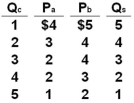 Refer to the above information. The collective willingness of this nation to pay for the fourth unit of the public good is:
 (Multiple Choice)
4.8/5 (78)
(78) There is an adverse selection problem in the market for used cars because:
(Multiple Choice)
4.9/5 (95)
(95) When the government bails out failing banks, it creates a moral hazard problem; but when the government bails out homeowners who are defaulting, there is no moral hazard problem.
(True/False)
4.8/5 (74)
(74) Assume that a government is considering a new social program and may choose to include in this program any number of four progressively larger projects. The marginal cost and the marginal benefits of each of the four projects are given in the table. 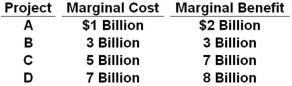 Refer to the above table and information. What project should the government select to achieve the maximum net benefit?
 (Multiple Choice)
4.9/5 (86)
(86) When the production of a good generates external costs, the firm's supply curve will be:
(Multiple Choice)
4.8/5 (87)
(87) The equilibrium point in the market is where S and D curve intersect. 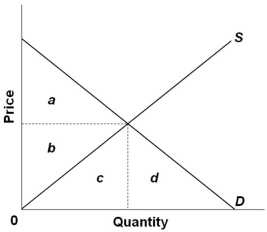 Refer to the graph above. At equilibrium, the total revenues received by sellers would be represented by the area:
 (Multiple Choice)
4.9/5 (87)
(87) It is the custom for paper mills located alongside the Layzee River to discharge waste products into the river. As a result, operators of hydroelectric power-generating plants downstream along the river find that they must clean up the river's water before it flows through their equipment. In the situation described above, we would expect an:
(Multiple Choice)
4.7/5 (76)
(76) 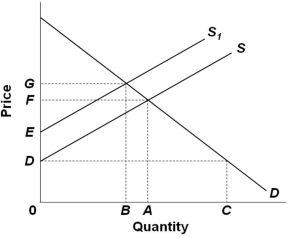 Refer to the above supply and demand graph. In the graph, line S is the current supply of this product, while line S1 is the optimal supply from the society's perspective. This figure suggests that there is (are):
 (Multiple Choice)
4.8/5 (80)
(80) Oftentimes, the socially optimal quantity for a product that imposes external costs on the society is not zero, but something greater than zero. This is because completely eliminating the externality would involve:
(Multiple Choice)
4.8/5 (82)
(82) Consumer surplus is the reason why sometimes a shopper regrets having bought a particular item.
(True/False)
4.9/5 (70)
(70) The equilibrium point in the market is where S and D curve intersect. 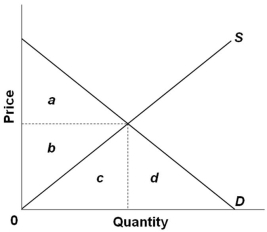 Refer to the graph above. At equilibrium, the minimum acceptable revenue that sellers would have been willing to receive is represented by the area:
 (Multiple Choice)
4.9/5 (84)
(84) Sometimes, public goods whose benefits are less than their costs still get produced because:
(Multiple Choice)
4.9/5 (89)
(89) When the government bails out large banks when the banks become unstable, it could lead to a moral hazard problem.
(True/False)
4.8/5 (89)
(89) Near an ocean beach, a high-rise building is being constructed that will block the scenic view of the ocean by the residents of a low-rise building. The Coase theorem suggests that this type of dispute between the owners of high-rise and low-rise buildings:
(Multiple Choice)
4.8/5 (75)
(75) 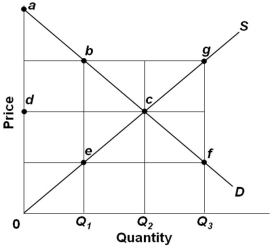 Refer to the above graph. If the output level increases from Q2 to Q3, then the:
 (Multiple Choice)
4.9/5 (90)
(90) When producers (say, of roads) are not able to make all consumers pay for enjoying their product (i.e., the roads), they tend to see a:
(Multiple Choice)
4.8/5 (84)
(84) Asymmetric information occurs when the two parties in a market transaction do not have the same amount of information regarding the product or process involved in the transaction.
(True/False)
4.9/5 (68)
(68) 
Filters
- Essay(0)
- Multiple Choice(0)
- Short Answer(0)
- True False(0)
- Matching(0)