



 Chat with AI
Exam 4: Market Failures: Public Goods and Externalities

Exam 1: Limits, Alternatives, and Choices212 Questions
Exam 2: The Market System and the Circular Flow141 Questions
Exam 3: Demand, Supply, and Market Equilibrium202 Questions
Exam 4: Market Failures: Public Goods and Externalities155 Questions
Exam 5: Governments Role and Government Failure148 Questions
Exam 6: An Introduction to Macroeconomics123 Questions
Exam 7: Measuring Domestic Output and National Income157 Questions
Exam 8: Economic Growth114 Questions
Exam 9: Business Cycles, Unemployment, and Inflation143 Questions
Exam 10: Basic Macroeconomic Relationships142 Questions
Exam 11: The Aggregate Expenditures Model143 Questions
Exam 12: Aggregate Demand and Aggregate Supply152 Questions
Exam 13: Fiscal Policy, Deficits, and Debt164 Questions
Exam 14: Money, Banking, and Financial Institutions130 Questions
Exam 15: Money Creation127 Questions
Exam 16: Interest Rates and Monetary Policy174 Questions
Exam 17: Financial Economics136 Questions
Exam 18: Extending the Analysis of Aggregate Supply135 Questions
Exam 19: Current Issues in Macro Theory and Policy134 Questions
Exam 20: International Trade151 Questions
Exam 21: The Balance of Payments, Exchange Rates, and Trade Deficits152 Questions
Exam 22: The Economics of Developing Countries135 Questions
Select questions type


Which of the following would be considered an example of adverse selection?
(Multiple Choice)
4.8/5  (75)
(75) The equilibrium point in the market is where S and D curve intersect. 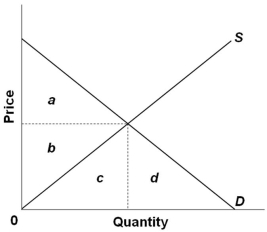 Refer to the graph above. At equilibrium, consumer surplus would be represented by the area:
 (Multiple Choice)
4.7/5 (81)
(81) At equilibrium in a market for a product, the total revenues received by sellers equal the:
(Multiple Choice)
4.9/5 (81)
(81) In dealing with market failures, the government always bases its decisions on economic analysis of marginal cost and marginal benefit.
(True/False)
4.7/5 (70)
(70) 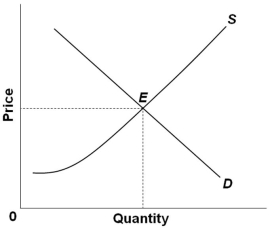 Refer to the graph above. Suppose consumers do not fully appreciate the benefits of the product whose market shown in the graph. If an external agency is able to provide full information about the benefits of the product, then:
 (Multiple Choice)
4.8/5 (77)
(77) If the production of a product or service involves external benefits, then the government can improve efficiency in the market by:
(Multiple Choice)
4.8/5 (82)
(82) When the marginal benefits exceed the marginal costs of producing a product, then allocative efficiency is not achieved in the market.
(True/False)
4.9/5 (70)
(70) When a producer cannot get all consumers of their product to pay for enjoying it, such as in the case of a fireworks display, then we'd have a demand-side market failure.
(True/False)
4.8/5 (78)
(78) A government is considering undertaking one or more construction projects. The estimated marginal costs and benefits of each project are given in the table. 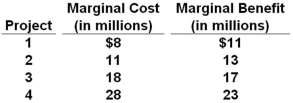 Refer to the above table and information. What is the total cost and total benefit of projects 1, 2, and 3?
 (Multiple Choice)
4.9/5 (86)
(86) Answer the question on the basis of the following information is for public good. Pa and Pb represent the prices that citizens (a) and (b), the only two people in this nation, are willing to pay for additional units of a quantity (Qc) of the public good. Qs represents the quantity of the public good supplied by government at each of the collective prices. 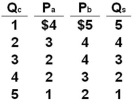 Refer to the above information. In equilibrium, the marginal benefit and cost of the public good will be:
 (Multiple Choice)
4.8/5 (78)
(78) Which of the following situations is not an example of market failure:
(Multiple Choice)
4.8/5 (82)
(82) If a person drives with less care after purchasing auto insurance, this situation would be an example of a(n):
(Multiple Choice)
4.7/5 (68)
(68) A competitive market can produce economically efficient outcomes if these conditions are met, except:
(Multiple Choice)
4.9/5 (88)
(88) When sellers are unable to distinguish "good" buyers from "bad" ones, they face the problem of:
(Multiple Choice)
4.7/5 (67)
(67) Charlie is willing to pay $10 for a T-shirt that is priced at $9. If Charlie buys the T-shirt, then his consumer surplus is
(Multiple Choice)
4.9/5 (76)
(76) The free-rider problem makes a good highly profitable for a private firm to provide.
(True/False)
4.9/5 (86)
(86) In a well-functioning cap-and-trade system for pollution rights, the right to pollute will go to those who are able to acquire the largest net benefit from using the scarce resource "clean air".
(True/False)
4.7/5 (79)
(79) 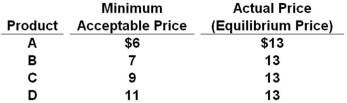 Refer to the above table. The producer surplus is $4 for producer:
 (Multiple Choice)
4.8/5 (68)
(68) Answer the question based on the following information. Normal University has found it necessary to institute a crime-control program on its campus to deal with the high costs of theft and vandalism. The university is now considering several alternative levels of crime control. This table shows the expected annual costs and benefits of these alternatives. 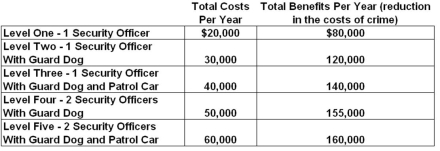 Refer to the above information. Based on cost-benefit analysis, Normal University should undertake Level:
 (Multiple Choice)
5.0/5 (80)
(80) Assume that a government is considering a new social program and may choose to include in this program any number of four progressively larger projects. The marginal cost and the marginal benefits of each of the four projects are given in the table. 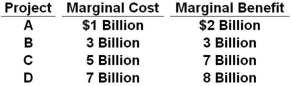 Refer to the above table and information. What is the net benefit of project D?
 (Multiple Choice)
4.8/5 (87)
(87) 
Filters
- Essay(0)
- Multiple Choice(0)
- Short Answer(0)
- True False(0)
- Matching(0)