



 Chat with AI
Exam 4: Market Failures: Public Goods and Externalities

Exam 1: Limits, Alternatives, and Choices212 Questions
Exam 2: The Market System and the Circular Flow141 Questions
Exam 3: Demand, Supply, and Market Equilibrium202 Questions
Exam 4: Market Failures: Public Goods and Externalities155 Questions
Exam 5: Governments Role and Government Failure148 Questions
Exam 6: An Introduction to Macroeconomics123 Questions
Exam 7: Measuring Domestic Output and National Income157 Questions
Exam 8: Economic Growth114 Questions
Exam 9: Business Cycles, Unemployment, and Inflation143 Questions
Exam 10: Basic Macroeconomic Relationships142 Questions
Exam 11: The Aggregate Expenditures Model143 Questions
Exam 12: Aggregate Demand and Aggregate Supply152 Questions
Exam 13: Fiscal Policy, Deficits, and Debt164 Questions
Exam 14: Money, Banking, and Financial Institutions130 Questions
Exam 15: Money Creation127 Questions
Exam 16: Interest Rates and Monetary Policy174 Questions
Exam 17: Financial Economics136 Questions
Exam 18: Extending the Analysis of Aggregate Supply135 Questions
Exam 19: Current Issues in Macro Theory and Policy134 Questions
Exam 20: International Trade151 Questions
Exam 21: The Balance of Payments, Exchange Rates, and Trade Deficits152 Questions
Exam 22: The Economics of Developing Countries135 Questions
Select questions type


Demand-side market failures refer to those situations when there is a shortage in the market because buyers want to buy more than what is available in the market.
(True/False)
4.9/5  (85)
(85) Which of the following is an example of a negative externality?
(Multiple Choice)
4.9/5 (81)
(81) One consequence of the asymmetric-information problem in the used car market, if left unresolved, is the higher probability of:
(Multiple Choice)
4.9/5 (83)
(83) 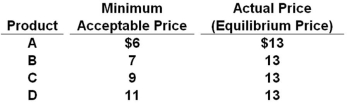 Refer to the above table. What is the producer surplus for all producers A, B, C, and D?
 (Multiple Choice)
4.7/5 (75)
(75) Assume that there are four consumers A, B, C, and D, and the prices that each of them is willing to pay for a glass of lemonade is, respectively, $1.50, $1.20, $1.00, and $0.90. If the actual price of lemonade is $1.00 per glass, then consumer surplus in this market will be $0.70.
(True/False)
4.9/5 (65)
(65) In the market for a particular pair of shoes, Jena is willing to pay $75 for a pair while Jane is willing to pay $85 for a pair. The actual price that each has to pay for a pair of shoes is $65. What is the combined amount of consumer surplus of Jena and Jane?
(Multiple Choice)
4.8/5 (79)
(79) When economic efficiency is attained, it implies all of the following, except:
(Multiple Choice)
4.9/5 (81)
(81) A moral hazard problem occurs before a transaction - when people alter their behavior before they sign a contract, imposing costs on the other party.
(True/False)
4.8/5 (76)
(76) The franchising of fast-food restaurants would be an example of how a private business:
(Multiple Choice)
4.7/5 (77)
(77) Assume there is no way to prevent someone from using an interstate highway, regardless of whether or not he or she helps pay for it. This characteristic is called:
(Multiple Choice)
4.9/5 (93)
(93) An emission fee levied against polluting firms will tend to shift the:
(Multiple Choice)
4.9/5 (83)
(83) An example of an adverse selection problem is in insurance, where the people most likely to claim insurance payouts are the people who will seek to buy the most generous policies.
(True/False)
4.8/5 (82)
(82) The equilibrium point in the market is where S and D curve intersect. 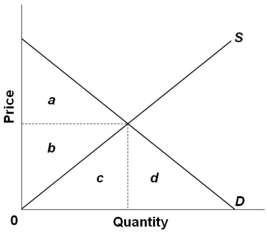 Refer to the graph above. At equilibrium, the total maximum amount that consumers would have been willing to pay for the product is represented by the area:
 (Multiple Choice)
4.9/5 (78)
(78) External benefits in consumption refer to benefits accruing to:
(Multiple Choice)
4.8/5 (81)
(81) The equilibrium point in the market is where S and D curve intersect. 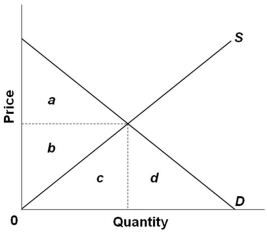 Refer to the graph above. At equilibrium, the producer surplus would be represented by the area:
 (Multiple Choice)
4.9/5 (76)
(76) Answer the question based on the following information. Normal University has found it necessary to institute a crime-control program on its campus to deal with the high costs of theft and vandalism. The university is now considering several alternative levels of crime control. This table shows the expected annual costs and benefits of these alternatives. 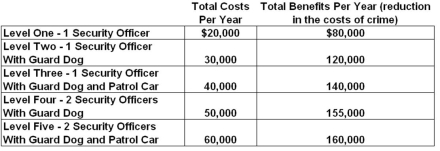 Refer to the above information. The marginal benefits of crime control for Level Two are:
 (Multiple Choice)
4.8/5 (84)
(84) Deadweight losses occur when the quantity of an output produced is:
(Multiple Choice)
4.8/5 (73)
(73) 
Filters
- Essay(0)
- Multiple Choice(0)
- Short Answer(0)
- True False(0)
- Matching(0)