



 Chat with AI
Exam 12: Aggregate Demand and Aggregate Supply

Exam 1: Limits, Alternatives, and Choices212 Questions
Exam 2: The Market System and the Circular Flow141 Questions
Exam 3: Demand, Supply, and Market Equilibrium202 Questions
Exam 4: Market Failures: Public Goods and Externalities155 Questions
Exam 5: Governments Role and Government Failure148 Questions
Exam 6: An Introduction to Macroeconomics123 Questions
Exam 7: Measuring Domestic Output and National Income157 Questions
Exam 8: Economic Growth114 Questions
Exam 9: Business Cycles, Unemployment, and Inflation143 Questions
Exam 10: Basic Macroeconomic Relationships142 Questions
Exam 11: The Aggregate Expenditures Model143 Questions
Exam 12: Aggregate Demand and Aggregate Supply152 Questions
Exam 13: Fiscal Policy, Deficits, and Debt164 Questions
Exam 14: Money, Banking, and Financial Institutions130 Questions
Exam 15: Money Creation127 Questions
Exam 16: Interest Rates and Monetary Policy174 Questions
Exam 17: Financial Economics136 Questions
Exam 18: Extending the Analysis of Aggregate Supply135 Questions
Exam 19: Current Issues in Macro Theory and Policy134 Questions
Exam 20: International Trade151 Questions
Exam 21: The Balance of Payments, Exchange Rates, and Trade Deficits152 Questions
Exam 22: The Economics of Developing Countries135 Questions
Select questions type


It shows the aggregate demand and aggregate supply schedule for a hypothetical economy. 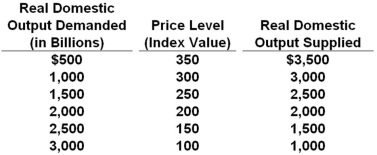 Refer to the table above. If the quantity of real domestic output demanded decreased by $500 and the quantity of real domestic output supplied increased by $500 at each price level, the new equilibrium price level and quantity of real domestic output would be:
 (Multiple Choice)
4.9/5  (81)
(81) The foreign purchases effect on aggregate demand suggests that a:
(Multiple Choice)
5.0/5 (79)
(79) 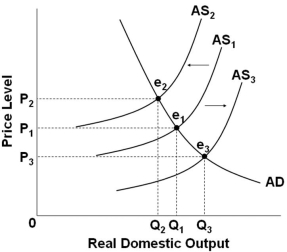 Refer to the graph above. If aggregate supply shifts from AS1 to AS2, then the price level will:
 (Multiple Choice)
4.8/5 (73)
(73) 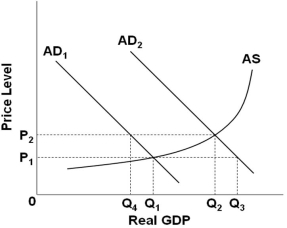 Refer to the figure above. The massive increase in government spending during World War II moved the economy in the span of a few short years from mass unemployment and price stability to "overfull" employment. This situation can be best illustrated in the figure above as a:
 (Multiple Choice)
4.8/5 (78)
(78) If the price of crude oil decreases, then this would most likely:
(Multiple Choice)
4.8/5 (75)
(75) An increase in investment and government spending can be expected to shift the:
(Multiple Choice)
4.9/5 (86)
(86) The economy experiences a decrease in the price level and an increase in real domestic output. Which is a likely explanation?
(Multiple Choice)
4.9/5 (72)
(72) If at a particular price level, real output from producers is greater than real output desired by purchasers, then there will be a general:
(Multiple Choice)
4.8/5 (79)
(79) The labels for the axes of an aggregate supply curve should be:
(Multiple Choice)
4.8/5 (72)
(72) A decrease in aggregate demand in the short run will reduce:
(Multiple Choice)
4.8/5 (85)
(85) Changes in the national incomes of our trading partners would directly impact our:
(Multiple Choice)
4.7/5 (75)
(75) The slope of the immediate-short-run aggregate supply curve is based on the assumption that:
(Multiple Choice)
4.8/5 (90)
(90) The aggregate expenditures model and the immediate-short-run aggregate supply have similar assumptions regarding the economy's price level.
(True/False)
4.8/5 (84)
(84)  Refer to the graph above. Which line might represent an aggregate demand curve?
 (Multiple Choice)
4.9/5 (87)
(87)  Refer to the graph above. Which of the following factors will shift AS1 to AS3?
 (Multiple Choice)
4.8/5 (64)
(64) 
Filters
- Essay(0)
- Multiple Choice(0)
- Short Answer(0)
- True False(0)
- Matching(0)