



 Chat with AI
Exam 12: Aggregate Demand and Aggregate Supply

Exam 1: Limits, Alternatives, and Choices212 Questions
Exam 2: The Market System and the Circular Flow141 Questions
Exam 3: Demand, Supply, and Market Equilibrium202 Questions
Exam 4: Market Failures: Public Goods and Externalities155 Questions
Exam 5: Governments Role and Government Failure148 Questions
Exam 6: An Introduction to Macroeconomics123 Questions
Exam 7: Measuring Domestic Output and National Income157 Questions
Exam 8: Economic Growth114 Questions
Exam 9: Business Cycles, Unemployment, and Inflation143 Questions
Exam 10: Basic Macroeconomic Relationships142 Questions
Exam 11: The Aggregate Expenditures Model143 Questions
Exam 12: Aggregate Demand and Aggregate Supply152 Questions
Exam 13: Fiscal Policy, Deficits, and Debt164 Questions
Exam 14: Money, Banking, and Financial Institutions130 Questions
Exam 15: Money Creation127 Questions
Exam 16: Interest Rates and Monetary Policy174 Questions
Exam 17: Financial Economics136 Questions
Exam 18: Extending the Analysis of Aggregate Supply135 Questions
Exam 19: Current Issues in Macro Theory and Policy134 Questions
Exam 20: International Trade151 Questions
Exam 21: The Balance of Payments, Exchange Rates, and Trade Deficits152 Questions
Exam 22: The Economics of Developing Countries135 Questions
Select questions type


If productivity increases, then the per-unit production cost decreases.
(True/False)
4.9/5  (90)
(90) Cost-push inflation can be described as a rightward shift of the aggregate supply curve.
(True/False)
4.9/5 (80)
(80) The short-run version of aggregate supply assumes that product prices are:
(Multiple Choice)
4.9/5 (79)
(79) Suppose that an economy produces 2400 units of output, employing the 60 units of input, and the price of the input is $30 per unit. Refer to the information above. The level of productivity in this economy is:
(Multiple Choice)
4.9/5 (73)
(73) The oil crises of the 1970s and 1980s can best be illustrated as a shift of the aggregate demand curve to the left.
(True/False)
4.9/5 (71)
(71) If the dollar appreciates relative to foreign currencies, then:
(Multiple Choice)
4.8/5 (80)
(80) The aggregate expenditures schedule relates total spending with the price level, while the aggregate demand schedule relates total demand for output with income.
(True/False)
4.7/5 (77)
(77) 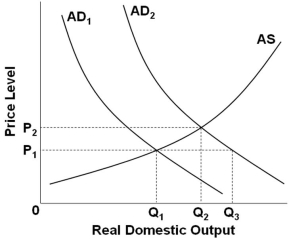 Refer to the figure above. A shift from AD2 shifts to AD1 would be consistent with what economic event in U.S. history?
 (Multiple Choice)
5.0/5 (78)
(78) 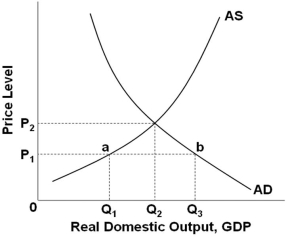 Refer to the graph above. If the price level is initially at P1, then the economy will adjust by:
 (Multiple Choice)
4.9/5 (74)
(74) Suppose that an economy produces 2400 units of output, employing the 60 units of input, and the price of the input is $30 per unit. Refer to the information above. The per-unit cost of production is:
(Multiple Choice)
4.8/5 (85)
(85) When the excess capacity of business expands unintentionally, aggregate:
(Multiple Choice)
4.9/5 (74)
(74) An increase in the price level, other things equal, will shift the:
(Multiple Choice)
4.8/5 (79)
(79) The real-balance effect explains a shift in aggregate demand, while the wealth effect explains a movement along the AD curve.
(True/False)
4.8/5 (84)
(84)  Refer to the graph above. Which of the following factors will shift AD1 to AD3?
 (Multiple Choice)
4.9/5 (90)
(90) A decrease in consumer spending can be expected to shift the:
(Multiple Choice)
4.7/5 (85)
(85) The stimulus package that the government implemented during the Great Recession of 2007-09 did not have as strong an impact on GDP and unemployment as expected, for the following reasons, except:
(Multiple Choice)
4.9/5 (85)
(85) The economy experiences an increase in the price level and an increase in real domestic output. Which is a likely explanation?
(Multiple Choice)
4.8/5 (85)
(85) Answer the question based on the following list of items that are related to aggregate demand and/or aggregate supply.  Refer to the list above. Changes in which of the above two factors would most likely cause a change in aggregate demand?
 (Multiple Choice)
4.7/5 (81)
(81) 
Filters
- Essay(0)
- Multiple Choice(0)
- Short Answer(0)
- True False(0)
- Matching(0)