



 Chat with AI
Exam 12: Aggregate Demand and Aggregate Supply

Exam 1: Limits, Alternatives, and Choices212 Questions
Exam 2: The Market System and the Circular Flow141 Questions
Exam 3: Demand, Supply, and Market Equilibrium202 Questions
Exam 4: Market Failures: Public Goods and Externalities155 Questions
Exam 5: Governments Role and Government Failure148 Questions
Exam 6: An Introduction to Macroeconomics123 Questions
Exam 7: Measuring Domestic Output and National Income157 Questions
Exam 8: Economic Growth114 Questions
Exam 9: Business Cycles, Unemployment, and Inflation143 Questions
Exam 10: Basic Macroeconomic Relationships142 Questions
Exam 11: The Aggregate Expenditures Model143 Questions
Exam 12: Aggregate Demand and Aggregate Supply152 Questions
Exam 13: Fiscal Policy, Deficits, and Debt164 Questions
Exam 14: Money, Banking, and Financial Institutions130 Questions
Exam 15: Money Creation127 Questions
Exam 16: Interest Rates and Monetary Policy174 Questions
Exam 17: Financial Economics136 Questions
Exam 18: Extending the Analysis of Aggregate Supply135 Questions
Exam 19: Current Issues in Macro Theory and Policy134 Questions
Exam 20: International Trade151 Questions
Exam 21: The Balance of Payments, Exchange Rates, and Trade Deficits152 Questions
Exam 22: The Economics of Developing Countries135 Questions
Select questions type


A change in business taxes and regulation can affect production costs and aggregate supply.
(True/False)
4.9/5  (88)
(88) If the price level increases, then the aggregate expenditures schedule will shift down and the aggregate demand curve will shift to the left.
(True/False)
4.9/5 (88)
(88) An aggregate supply curve represents the relationship between the:
(Multiple Choice)
4.8/5 (65)
(65) A decrease in personal and business taxes will cause government spending and aggregate demand to decrease.
(True/False)
4.9/5 (79)
(79) 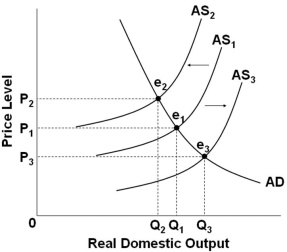 Refer to the graph above. When output increases from Q1 and the price level decreases from P1, this change will:
 (Multiple Choice)
4.8/5 (83)
(83) If the U.S. dollar appreciates in value relative to foreign currencies, then this will:
(Multiple Choice)
4.8/5 (75)
(75) Answer the question based on the following list of factors that are related to the aggregate demand curve.  Refer to the list above. Investment spending would most likely be influenced by changes in:
 (Multiple Choice)
4.9/5 (89)
(89) Macroeconomic equilibrium in the short run always occurs at full-employment GDP.
(True/False)
4.7/5 (82)
(82) Answer the question based on the following list of items that are related to aggregate demand and/or aggregate supply. 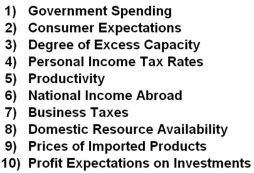 Refer to the list above. A change in which factor is most likely to change both aggregate demand and aggregate supply?
 (Multiple Choice)
4.7/5 (83)
(83) The intersection of the aggregate demand and aggregate supply curves determines the:
(Multiple Choice)
4.9/5 (96)
(96) The aggregate demand curve shows that when the price level rises, the quantity of real output demanded decreases.
(True/False)
4.7/5 (80)
(80) Which of the following would not shift the aggregate demand curve? Changes in:
(Multiple Choice)
4.8/5 (91)
(91) The table below shows the aggregate demand and aggregate supply schedules for a hypothetical economy. 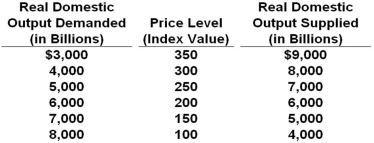 Refer to the table above. The equilibrium price and output levels will be:
 (Multiple Choice)
4.8/5 (80)
(80) When there is an increase in aggregate demand in the short run, there will be an increase in the price level but not in the level of output or employment.
(True/False)
4.9/5 (84)
(84) Which would most likely shift the aggregate supply curve? A change in the prices of:
(Multiple Choice)
4.8/5 (76)
(76) Demand-pull inflation is illustrated in the short run aggregate supply-aggregate demand model as a shift of the aggregate:
(Multiple Choice)
4.7/5 (83)
(83) Answer the question based on the following list of factors that are related to the aggregate demand curve.  Changes in which two of the factors in the list above would most likely cause a shift in aggregate demand due to a change in consumer spending?
 (Multiple Choice)
4.8/5 (88)
(88) 
Filters
- Essay(0)
- Multiple Choice(0)
- Short Answer(0)
- True False(0)
- Matching(0)