



 Chat with AI
Exam 12: Aggregate Demand and Aggregate Supply

Exam 1: Limits, Alternatives, and Choices212 Questions
Exam 2: The Market System and the Circular Flow141 Questions
Exam 3: Demand, Supply, and Market Equilibrium202 Questions
Exam 4: Market Failures: Public Goods and Externalities155 Questions
Exam 5: Governments Role and Government Failure148 Questions
Exam 6: An Introduction to Macroeconomics123 Questions
Exam 7: Measuring Domestic Output and National Income157 Questions
Exam 8: Economic Growth114 Questions
Exam 9: Business Cycles, Unemployment, and Inflation143 Questions
Exam 10: Basic Macroeconomic Relationships142 Questions
Exam 11: The Aggregate Expenditures Model143 Questions
Exam 12: Aggregate Demand and Aggregate Supply152 Questions
Exam 13: Fiscal Policy, Deficits, and Debt164 Questions
Exam 14: Money, Banking, and Financial Institutions130 Questions
Exam 15: Money Creation127 Questions
Exam 16: Interest Rates and Monetary Policy174 Questions
Exam 17: Financial Economics136 Questions
Exam 18: Extending the Analysis of Aggregate Supply135 Questions
Exam 19: Current Issues in Macro Theory and Policy134 Questions
Exam 20: International Trade151 Questions
Exam 21: The Balance of Payments, Exchange Rates, and Trade Deficits152 Questions
Exam 22: The Economics of Developing Countries135 Questions
Select questions type


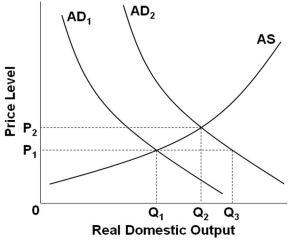 Refer to the figure above. If AD1 shifts to AD2, then the equilibrium output:
 (Multiple Choice)
4.9/5  (80)
(80) Which of the following effects best explains the downward slope of the aggregate demand curve?
(Multiple Choice)
4.8/5 (92)
(92) The upward slope of the short-run aggregate supply curve is based on the assumption that:
(Multiple Choice)
4.7/5 (96)
(96)  Refer to the graph above, which shows an aggregate demand curve. If the price level decreases from 200 to 100, the real output demanded will:
 (Multiple Choice)
4.8/5 (91)
(91) In an economy it costs $1,500 to produce 2,000 units of output. If the costs increase to $2,500, then the per unit cost of production will have increased from:
(Multiple Choice)
4.8/5 (85)
(85) Which of the following events would most likely reduce aggregate demand?
(Multiple Choice)
4.9/5 (82)
(82) If the price level decreases, then the aggregate expenditures schedule will shift and this translates into a:
(Multiple Choice)
4.8/5 (85)
(85) An expected increase in the prices of consumer goods in the near future will:
(Multiple Choice)
4.8/5 (87)
(87) The so-called ratchet effect refers to the characteristic in the economy where product prices, wages, and per-unit production cost are flexible when:
(Multiple Choice)
4.9/5 (82)
(82) In the Great Recession of 2007-2009, the stock market values shrank, causing a reverse:
(Multiple Choice)
4.7/5 (90)
(90) The economy experiences an increase in the price level and a decrease in real domestic output. Which of the following is a likely explanation?
(Multiple Choice)
4.8/5 (104)
(104) The real-balances effect on aggregate demand suggests that a:
(Multiple Choice)
4.9/5 (69)
(69) The relationship between the aggregate demand curve and the aggregate expenditures model is derived from the fact that:
(Multiple Choice)
4.8/5 (92)
(92) An increase in aggregate demand is most likely to be caused by:
(Multiple Choice)
4.8/5 (75)
(75)  Refer to the graph above. Which of the following factors will shift AS1 to AS2?
 (Multiple Choice)
4.9/5 (84)
(84)  Refer to the graph above. Which of the following changes will shift AD1 to AD2?
 (Multiple Choice)
4.9/5 (67)
(67) The expenditure multiplier concept of the aggregate-expenditures model:
(Multiple Choice)
5.0/5 (81)
(81) 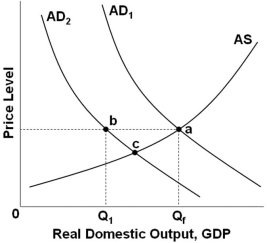 Refer to the graph above. The ratchet effect would suggest that:
 (Multiple Choice)
4.8/5 (86)
(86) 
Filters
- Essay(0)
- Multiple Choice(0)
- Short Answer(0)
- True False(0)
- Matching(0)