



 Chat with AI
Exam 15: Reactions of Aromatic Compounds

Exam 1: Carbon Compounds and Chemical Bonds134 Questions
Exam 2: Representative Carbon Compounds: Functional Groups, Intermolecular Forces, and Infrared Ir Spectroscopy114 Questions
Exam 3: An Introduction to Organic Reactions: Acids and Bases47 Questions
Exam 4: Alkanes: Nomenclature, Conformational Analysis, and an Introduction to Synthesis125 Questions
Exam 5: Stereochemistry: Chiral Molecules150 Questions
Exam 6: Ionic Reactions - Nucleophilic Substitution and Elimination Reactions of Alkyl Halides146 Questions
Exam 7: Alkenes and Alkynes I: Properties and Synthesis, Elimination Reactions of Alkyl Halides99 Questions
Exam 8: Alkenes and Alkynes Ii: Addition Reactions140 Questions
Exam 9: Nuclear Magnetic Resonance and Mass Spectrometry: Tools for Structure Determination94 Questions
Exam 10: Radical Reactions114 Questions
Exam 11: Alcohols and Ethers172 Questions
Exam 12: Alcohols From Carbonyl Compounds Oxidation-Reduction and Organometallic Compounds147 Questions
Exam 13: Conjugated Unsaturated Systems166 Questions
Exam 14: Aromatic Compounds151 Questions
Exam 15: Reactions of Aromatic Compounds173 Questions
Exam 16: Aldehydes and Ketones I Nucleophilic Addition to the Carbonyl Group165 Questions
Exam 17: Aldehydes and Ketones Ii Aldol Reactions131 Questions
Exam 18: Carboxylic Acids and Their Derivatives Nucleophilic Addition - Elimination at the Acyl Carbon124 Questions
Exam 19: Synthesis and Reactions of Beta-Dicarbonyl Compounds: More Chemistry of Enolate Ions131 Questions
Exam 20: Amines148 Questions
Exam 21: Phenols and Aryl Halides: Nucleophilic Aromatic Substitution87 Questions
Exam 22: Carbohydrates104 Questions
Exam 23: Lipids99 Questions
Exam 24: Amino Acids and Proteins94 Questions
Exam 25: Nucleic Acids and Protein Synthesis89 Questions
Select questions type


Which is the best sequence of reactions for the following transformation? 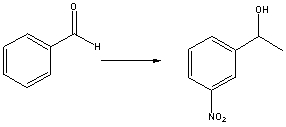
(Multiple Choice)
4.9/5  (89)
(89) Based on your knowledge of electrophilic aromatic substitution,and assuming the thiophene ring of benzo[b]thiophene (shown)is activated toward electrophilic aromatic substituted more so than the benzenoid ring,predict the preferential position of attack of an electrophile,i.e. ,does the electrophile E+ attack carbon 2,or 3? Explain your answer. 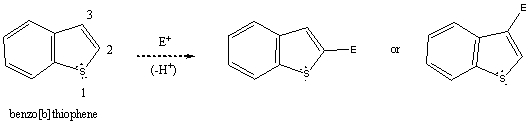 Which substitution product forms preferentially and why?
 (Essay)
5.0/5 (64)
(64) Which reagent(s)would you use to carry out the following transformation? toluene -- benzyl bromide
(Multiple Choice)
4.9/5 (78)
(78) What would be the major product(s)of the following reaction? 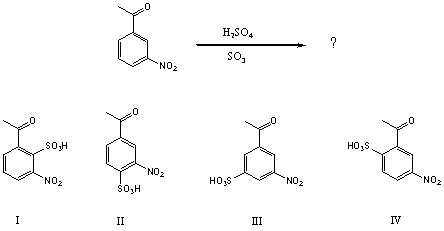
(Multiple Choice)
4.7/5 (77)
(77) Electron-withdrawing groups decrease the electron density on the aromatic ring,causing it to be less reactive than benzene itself towards EAS.These types of groups are called _____________ groups.
(Short Answer)
4.8/5 (73)
(73) Suggest a reasonable synthetic strategy for the synthesis of 6-methyl-3-phenyl-3-heptanol from 4-methylpentanoyl chloride, (CH3)2CHCH2CH2COCl
(Essay)
4.8/5 (87)
(87) What would you expect to be the major product obtained from the following reaction? 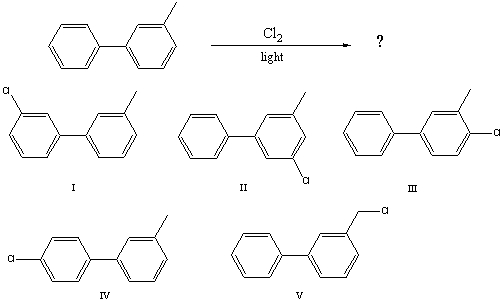
(Multiple Choice)
4.9/5 (79)
(79) Starting with benzene,the best method for preparing m-nitrobenzoic acid is:
(Multiple Choice)
4.9/5 (83)
(83) Which reagent(s)would you use to carry out the following transformation? toluene -- benzoic acid
(Multiple Choice)
5.0/5 (70)
(70) Which would be the major product(s)of the following reaction? 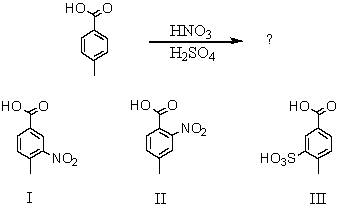
(Multiple Choice)
4.9/5 (74)
(74) Which of the following compounds would be least reactive toward electrophilic substitution? 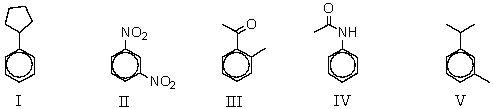
(Multiple Choice)
4.9/5 (75)
(75) What would you expect to be the major product obtained from the following reaction? 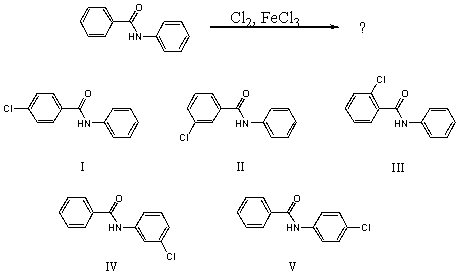
(Multiple Choice)
4.8/5 (81)
(81) Which would be the major product(s)of the following reaction? 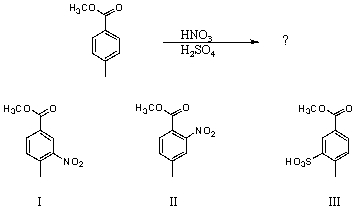
(Multiple Choice)
4.9/5 (85)
(85) 
Filters
- Essay(0)
- Multiple Choice(0)
- Short Answer(0)
- True False(0)
- Matching(0)