



 Chat with AI
Exam 15: Reactions of Aromatic Compounds

Exam 1: Carbon Compounds and Chemical Bonds134 Questions
Exam 2: Representative Carbon Compounds: Functional Groups, Intermolecular Forces, and Infrared Ir Spectroscopy114 Questions
Exam 3: An Introduction to Organic Reactions: Acids and Bases47 Questions
Exam 4: Alkanes: Nomenclature, Conformational Analysis, and an Introduction to Synthesis125 Questions
Exam 5: Stereochemistry: Chiral Molecules150 Questions
Exam 6: Ionic Reactions - Nucleophilic Substitution and Elimination Reactions of Alkyl Halides146 Questions
Exam 7: Alkenes and Alkynes I: Properties and Synthesis, Elimination Reactions of Alkyl Halides99 Questions
Exam 8: Alkenes and Alkynes Ii: Addition Reactions140 Questions
Exam 9: Nuclear Magnetic Resonance and Mass Spectrometry: Tools for Structure Determination94 Questions
Exam 10: Radical Reactions114 Questions
Exam 11: Alcohols and Ethers172 Questions
Exam 12: Alcohols From Carbonyl Compounds Oxidation-Reduction and Organometallic Compounds147 Questions
Exam 13: Conjugated Unsaturated Systems166 Questions
Exam 14: Aromatic Compounds151 Questions
Exam 15: Reactions of Aromatic Compounds173 Questions
Exam 16: Aldehydes and Ketones I Nucleophilic Addition to the Carbonyl Group165 Questions
Exam 17: Aldehydes and Ketones Ii Aldol Reactions131 Questions
Exam 18: Carboxylic Acids and Their Derivatives Nucleophilic Addition - Elimination at the Acyl Carbon124 Questions
Exam 19: Synthesis and Reactions of Beta-Dicarbonyl Compounds: More Chemistry of Enolate Ions131 Questions
Exam 20: Amines148 Questions
Exam 21: Phenols and Aryl Halides: Nucleophilic Aromatic Substitution87 Questions
Exam 22: Carbohydrates104 Questions
Exam 23: Lipids99 Questions
Exam 24: Amino Acids and Proteins94 Questions
Exam 25: Nucleic Acids and Protein Synthesis89 Questions
Select questions type


Starting with benzene,the best method for preparing p-nitrobenzoic acid is:
(Multiple Choice)
4.8/5  (69)
(69) A mixture of chlorobenzene (1 mol)and acetanilide (1mol)is allowed to react with Br2 (0.5 mol)in the presence of trace amounts of FeBr3.What is the principal product of the competing reactions?
(Multiple Choice)
4.9/5 (78)
(78) The ortho/para product ratio is expected to be the smallest for the bromination of which of these?
(Multiple Choice)
4.8/5 (90)
(90) Which of the following contributors to the resonance stabilized hybrid formed when aniline undergoes para-chlorination would be exceptionally stable? 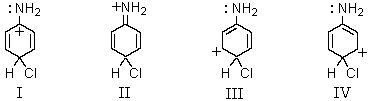
(Multiple Choice)
4.9/5 (82)
(82) Which would be the product,X,of the following reaction sequence? 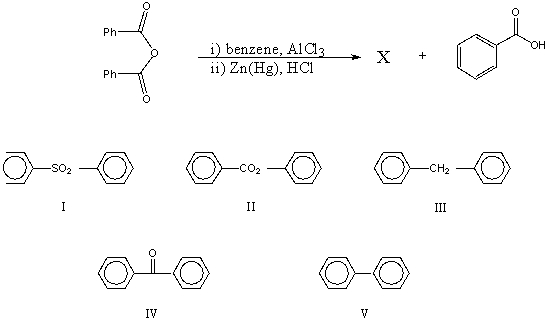
(Multiple Choice)
4.8/5 (88)
(88) Aryl and vinyl halides cannot be used in the Friedel-Crafts alkylation because they do not __________.
(Short Answer)
4.7/5 (68)
(68) Which of these liquids would be unsuitable as an inert solvent for a Friedel-Crafts reaction?
(Multiple Choice)
4.9/5 (74)
(74) What would you expect to be the major product obtained from the monobromination of m-dichlorobenzene? 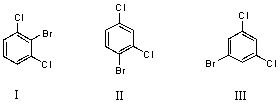
(Multiple Choice)
4.8/5 (80)
(80) Which of the following would be the best synthesis of 1,4-dimethyl-2-nitrobenzene?
(Multiple Choice)
4.7/5 (77)
(77) The reaction of benzene with  in the presence of anhydrous aluminum chloride produces principally which of these?
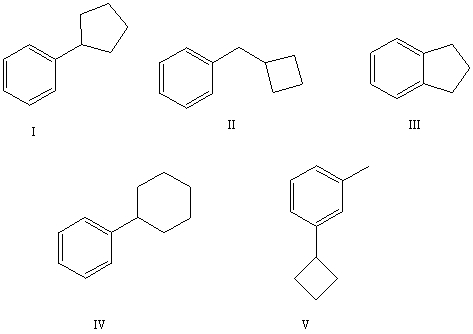
in the presence of anhydrous aluminum chloride produces principally which of these? (Multiple Choice)
4.9/5 (80)
(80) 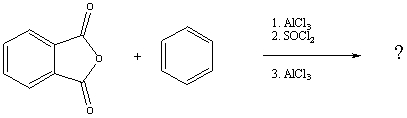
The compound 4-bromo-1-propylbenzene is best made from benzene by the application of these reagents in the order shown:
(Multiple Choice)
4.8/5 (80)
(80) Using a potential energy diagram,explain/illustrate the preferential formation of the 3 substituted product instead of the 2 product in the electrophilic aromatic substitution of benzo[b] thiophene (shown). 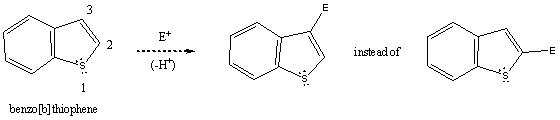
(Essay)
4.7/5 (79)
(79) Which of the following is not an ortho-para director in electrophilic aromatic substitution?
(Multiple Choice)
4.9/5 (78)
(78) Suggest a reasonable synthetic strategy for the synthesis of 4-methyl-1-phenyl-1-pentanol from 4-methylpentanoyl chloride, (CH3)2CHCH2CH2COCl
(Essay)
4.7/5 (86)
(86) Electron-donating groups increase the electron density on the aromatic ring,causing it to be more reactive than benzene itself towards EAS.These types of groups are called _____________ groups.
(Short Answer)
4.8/5 (90)
(90) Which of the compounds listed below would you expect to give the greatest amount of meta-product when subjected to ring bromination? 
(Multiple Choice)
4.7/5 (86)
(86) What is a feature found in all ortho-para directing groups?
(Multiple Choice)
4.7/5 (70)
(70) Consider the following reaction: what is the expected product? 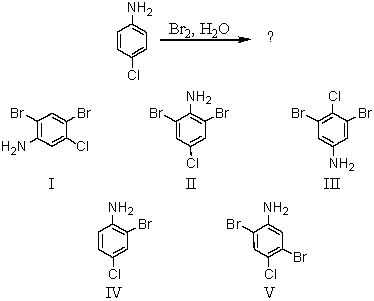
(Multiple Choice)
4.9/5 (85)
(85) 
Filters
- Essay(0)
- Multiple Choice(0)
- Short Answer(0)
- True False(0)
- Matching(0)