



 Chat with AI
Exam 20: Amines

Exam 1: Carbon Compounds and Chemical Bonds134 Questions
Exam 2: Representative Carbon Compounds: Functional Groups, Intermolecular Forces, and Infrared Ir Spectroscopy114 Questions
Exam 3: An Introduction to Organic Reactions: Acids and Bases47 Questions
Exam 4: Alkanes: Nomenclature, Conformational Analysis, and an Introduction to Synthesis125 Questions
Exam 5: Stereochemistry: Chiral Molecules150 Questions
Exam 6: Ionic Reactions - Nucleophilic Substitution and Elimination Reactions of Alkyl Halides146 Questions
Exam 7: Alkenes and Alkynes I: Properties and Synthesis, Elimination Reactions of Alkyl Halides99 Questions
Exam 8: Alkenes and Alkynes Ii: Addition Reactions140 Questions
Exam 9: Nuclear Magnetic Resonance and Mass Spectrometry: Tools for Structure Determination94 Questions
Exam 10: Radical Reactions114 Questions
Exam 11: Alcohols and Ethers172 Questions
Exam 12: Alcohols From Carbonyl Compounds Oxidation-Reduction and Organometallic Compounds147 Questions
Exam 13: Conjugated Unsaturated Systems166 Questions
Exam 14: Aromatic Compounds151 Questions
Exam 15: Reactions of Aromatic Compounds173 Questions
Exam 16: Aldehydes and Ketones I Nucleophilic Addition to the Carbonyl Group165 Questions
Exam 17: Aldehydes and Ketones Ii Aldol Reactions131 Questions
Exam 18: Carboxylic Acids and Their Derivatives Nucleophilic Addition - Elimination at the Acyl Carbon124 Questions
Exam 19: Synthesis and Reactions of Beta-Dicarbonyl Compounds: More Chemistry of Enolate Ions131 Questions
Exam 20: Amines148 Questions
Exam 21: Phenols and Aryl Halides: Nucleophilic Aromatic Substitution87 Questions
Exam 22: Carbohydrates104 Questions
Exam 23: Lipids99 Questions
Exam 24: Amino Acids and Proteins94 Questions
Exam 25: Nucleic Acids and Protein Synthesis89 Questions
Select questions type


Draw the structure corresponding to the following name:
(4Z,3S)-2,4,7-trimethyl-3-amino-4-octene

Free
(Essay)
4.9/5  (71)
(71) Correct Answer: Verified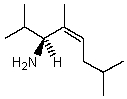
Which product could not be formed during the following reaction? 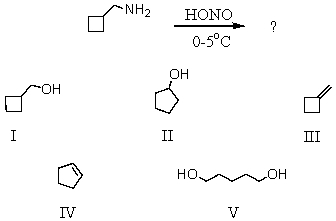
Free
(Multiple Choice)
4.8/5 (73)
(73) Correct Answer:Verified
VerifiedE
You have just completed an experiment involving the reduction of m-nitrobenzoic acid with Fe/HCl.In order to determine if your reaction has worked as planned,you have obtained the 1H NMR of your crude product.What will you scrutinize the spectrum for,in order to help you make this assessment?
Free
(Essay)
4.8/5 (73)
(73) Correct Answer:Verified
VerifiedThe appearance of 2 new N-H signals,in the range of about 2-6 ppm will be indicative of successful reduction of the -NO2 group to the -NH2 group.These signals are characteristically somewhat broad,and should disappear (or decrease markedly)if the spectrum is rerun with an added drop of D2O to the original sample prepared for obtaining the 1H NMR.The rest of the signals are likely to remain more or less similar,with some changes in chemical shift likely (probably upfield shifts),since the -NO2 group is electron-withdrawing,while the -NH2 group is electron-donating.
What would be the product of the following reaction sequence? 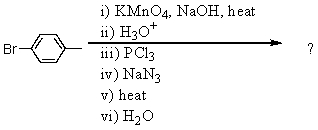
(Multiple Choice)
4.9/5 (76)
(76) What compound is likely to be obtained via the following reaction sequence? 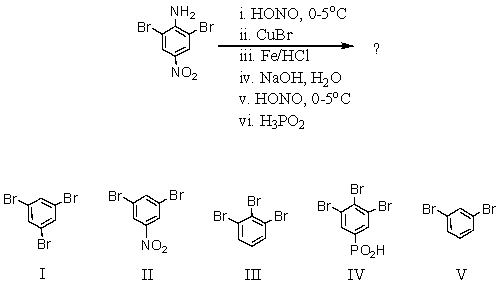
(Multiple Choice)
4.9/5 (91)
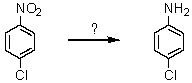
(91) The overall conversion RBr -- RCH2NH2 can be accomplished by successive application of which of these sets of reagents?
(Multiple Choice)
4.9/5 (84)
(84) 
Which of these is properly termed a "quaternary ammonium salt"?
(Multiple Choice)
4.8/5 (76)
(76) Amines are known to rapidly undergo pyramidal inversion at ordinary temperatures,preventing the resolution of enantiomeric forms when the amine is a chirality center.The proposed transition state of the inversion process is shown below.Using an orbital diagram,illustrate the hybridization at nitrogen for this proposed transition state. 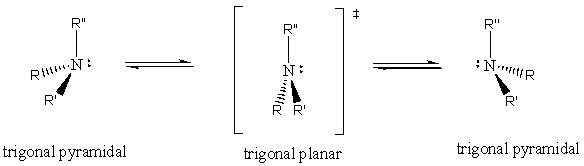
(Essay)
4.9/5 (74)
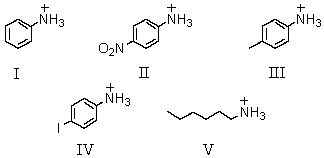
(74) Arrange the following amines in order of increasing basicity (least to most)in aqueous solution: 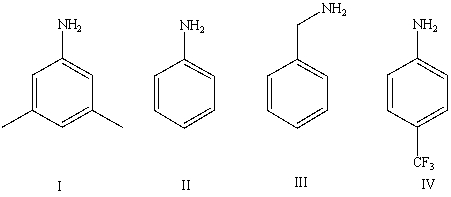
(Multiple Choice)
4.8/5 (86)
(86) What would be the product of the following reaction sequence? 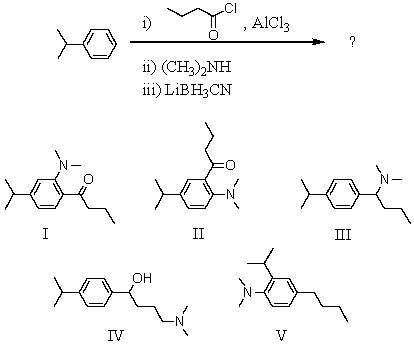
(Multiple Choice)
4.8/5 (78)
(78) 
What final product is expected when toluene is subjected to the following reaction sequence? i)KMnO4,NaOH;ii)H3O+ ( product = C7H6O2);iii)SOCl2;
Iv)NH3 (product = C7H7NO);v)Br2,NaOH
(Multiple Choice)
4.7/5 (89)
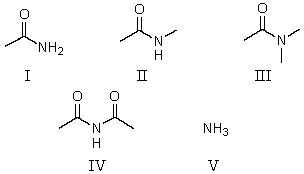
(89) Which of the following bases has a conjugate acid with the largest pKa? 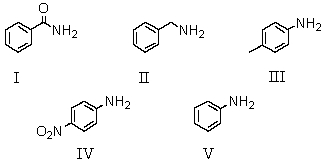
(Multiple Choice)
4.7/5 (70)
(70) If the three alkyl groups of a tertiary amine are all different,the amine will be chiral.In practice,however,it is virtually impossible to separate the two enantiomers,because they interconvert rapidly through a process called _________________.
(Short Answer)
5.0/5 (77)
(77) 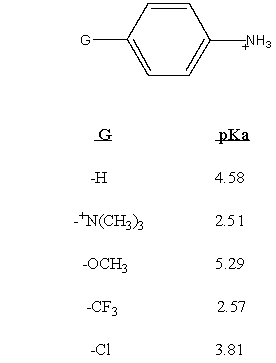 -In aqueous solution,which of the following bases as the conjugate acid possesses the largest value for pKa?
 (Multiple Choice)
4.8/5 (89)
(89) 
Filters
- Essay(0)
- Multiple Choice(0)
- Short Answer(0)
- True False(0)
- Matching(0)