



 Chat with AI
Exam 12: Alcohols From Carbonyl Compounds Oxidation-Reduction and Organometallic Compounds

Exam 1: Carbon Compounds and Chemical Bonds134 Questions
Exam 2: Representative Carbon Compounds: Functional Groups, Intermolecular Forces, and Infrared Ir Spectroscopy114 Questions
Exam 3: An Introduction to Organic Reactions: Acids and Bases47 Questions
Exam 4: Alkanes: Nomenclature, Conformational Analysis, and an Introduction to Synthesis125 Questions
Exam 5: Stereochemistry: Chiral Molecules150 Questions
Exam 6: Ionic Reactions - Nucleophilic Substitution and Elimination Reactions of Alkyl Halides146 Questions
Exam 7: Alkenes and Alkynes I: Properties and Synthesis, Elimination Reactions of Alkyl Halides99 Questions
Exam 8: Alkenes and Alkynes Ii: Addition Reactions140 Questions
Exam 9: Nuclear Magnetic Resonance and Mass Spectrometry: Tools for Structure Determination94 Questions
Exam 10: Radical Reactions114 Questions
Exam 11: Alcohols and Ethers172 Questions
Exam 12: Alcohols From Carbonyl Compounds Oxidation-Reduction and Organometallic Compounds147 Questions
Exam 13: Conjugated Unsaturated Systems166 Questions
Exam 14: Aromatic Compounds151 Questions
Exam 15: Reactions of Aromatic Compounds173 Questions
Exam 16: Aldehydes and Ketones I Nucleophilic Addition to the Carbonyl Group165 Questions
Exam 17: Aldehydes and Ketones Ii Aldol Reactions131 Questions
Exam 18: Carboxylic Acids and Their Derivatives Nucleophilic Addition - Elimination at the Acyl Carbon124 Questions
Exam 19: Synthesis and Reactions of Beta-Dicarbonyl Compounds: More Chemistry of Enolate Ions131 Questions
Exam 20: Amines148 Questions
Exam 21: Phenols and Aryl Halides: Nucleophilic Aromatic Substitution87 Questions
Exam 22: Carbohydrates104 Questions
Exam 23: Lipids99 Questions
Exam 24: Amino Acids and Proteins94 Questions
Exam 25: Nucleic Acids and Protein Synthesis89 Questions
Select questions type


Diethyl ether,the most commonly used solvent for Grignard reactions,also acts as an 'internal cooling agent',preventing the overheating of the reaction mixture: what specific property of diethyl ether is exploited here and why is it important to prevent the overheating of the reaction mixture?

Free
(Essay)
4.8/5  (80)
(80) Correct Answer: Verified
Diethyl ether is very volatile (35-36oC): its low boiling point ensures that reactions carried out in diethyl ether solvent cannot become overheated (the maximum temperature cannot exceed the b.p.of the solvent): this is important in Grignard reactions,because Grignard reagents decompose at higher temperatures.Thus,the decomposition of the newly formed Grignard reagent is minimized by use of this 'internal cooling agent'.
Primary and secondary alcohols can be distinguished from most other compounds (with the exception of aldehydes)because they will react rapidly with a solution of CrO3 in aqueous sulfuric acid,causing a color change from ______________ to _____________.
Free
(Short Answer)
4.8/5 (67)
(67) Correct Answer:Verified
Verifiedorange;green
What is/are the principal product(s)formed when excess methylmagnesium iodide reacts with p-hydroxyacetophenone ? 


Free
(Multiple Choice)
4.8/5 (87)
(87) Correct Answer:Verified
VerifiedB
Which of these is the least reactive type of organometallic compound?
(Multiple Choice)
4.8/5 (74)
(74) Which of the following synthetic procedures would be employed most effectively to transform ethanol into ethyl propyl ether?
(Multiple Choice)
4.9/5 (95)
(95) Suggest a reasonable synthetic strategy for the synthesis of 1,4-pentanediol from 4-hydroxybutanal HOCH2CH2CH2CHO.
(Essay)
4.8/5 (73)
(73) 
Upon reaction with a primary or secondary alcohol,the change in oxidation state of chromium ion in Jones reagent is from ________to __________.
(Short Answer)
4.9/5 (84)
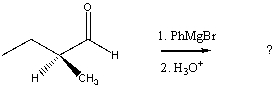
(84) 

If the role of the solvent is to assist in the preparation and stabilization of the Grignard reagent by coordination with the magnesium,which of these solvents should be least effective? 
(Multiple Choice)
4.8/5 (72)
(72) 
PCC and CrO3 are both Cr(VI)reagents.However,PCC/CH2Cl2 is useful in oxidizing primary alcohols to aldehydes,while the analogous reaction with CrO3/H2SO4 will typically produce carboxylic acids.Why?
(Essay)
4.9/5 (77)
(77) What is the product,A,that would be obtained from the following reaction sequence? 

(Multiple Choice)
4.8/5 (74)
(74) 
Which of the reagents listed below would serve as the basis for a simple chemical test to distinguish between (CH3)3COH and (CH3)2CHCH2OH ?
(Multiple Choice)
4.9/5 (79)
(79) List the following compounds in order of increasing level of oxidation: 
(Multiple Choice)
4.8/5 (73)
(73) In which of the following series are the compounds arranged in order of decreasing basicity?
(Multiple Choice)
4.7/5 (78)
(78) 
Filters
- Essay(0)
- Multiple Choice(0)
- Short Answer(0)
- True False(0)
- Matching(0)