



 Chat with AI
Exam 12: Alcohols From Carbonyl Compounds Oxidation-Reduction and Organometallic Compounds

Exam 1: Carbon Compounds and Chemical Bonds134 Questions
Exam 2: Representative Carbon Compounds: Functional Groups, Intermolecular Forces, and Infrared Ir Spectroscopy114 Questions
Exam 3: An Introduction to Organic Reactions: Acids and Bases47 Questions
Exam 4: Alkanes: Nomenclature, Conformational Analysis, and an Introduction to Synthesis125 Questions
Exam 5: Stereochemistry: Chiral Molecules150 Questions
Exam 6: Ionic Reactions - Nucleophilic Substitution and Elimination Reactions of Alkyl Halides146 Questions
Exam 7: Alkenes and Alkynes I: Properties and Synthesis, Elimination Reactions of Alkyl Halides99 Questions
Exam 8: Alkenes and Alkynes Ii: Addition Reactions140 Questions
Exam 9: Nuclear Magnetic Resonance and Mass Spectrometry: Tools for Structure Determination94 Questions
Exam 10: Radical Reactions114 Questions
Exam 11: Alcohols and Ethers172 Questions
Exam 12: Alcohols From Carbonyl Compounds Oxidation-Reduction and Organometallic Compounds147 Questions
Exam 13: Conjugated Unsaturated Systems166 Questions
Exam 14: Aromatic Compounds151 Questions
Exam 15: Reactions of Aromatic Compounds173 Questions
Exam 16: Aldehydes and Ketones I Nucleophilic Addition to the Carbonyl Group165 Questions
Exam 17: Aldehydes and Ketones Ii Aldol Reactions131 Questions
Exam 18: Carboxylic Acids and Their Derivatives Nucleophilic Addition - Elimination at the Acyl Carbon124 Questions
Exam 19: Synthesis and Reactions of Beta-Dicarbonyl Compounds: More Chemistry of Enolate Ions131 Questions
Exam 20: Amines148 Questions
Exam 21: Phenols and Aryl Halides: Nucleophilic Aromatic Substitution87 Questions
Exam 22: Carbohydrates104 Questions
Exam 23: Lipids99 Questions
Exam 24: Amino Acids and Proteins94 Questions
Exam 25: Nucleic Acids and Protein Synthesis89 Questions
Select questions type


A reaction which increases the oxygen content or decreases the hydrogen content of an organic molecule is called a(n)_____________.
(Short Answer)
4.9/5  (85)
(85) 
Because the carbonyl carbon bears a partial positive charge,it is susceptible to ________________ attack.
(Short Answer)
4.9/5 (76)
(76) 
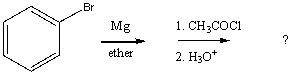
Grignard reagents react with oxirane (ethylene oxide)to form 1 alcohols but can be prepared in tetrahydrofuran solvent.Why is this difference in behavior observed?
(Multiple Choice)
4.8/5 (82)
(82) Suggest a reasonable synthetic strategy for the synthesis of 4-methyl-1,4-pentanediol from 4-hydroxybutanone HOCH2CH2CH2COCH3.
(Essay)
4.8/5 (69)
(69) 
For the ketone shown,indicate on the appropriate arrow which face is the re face,and which face is si? 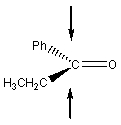
(Essay)
5.0/5 (82)
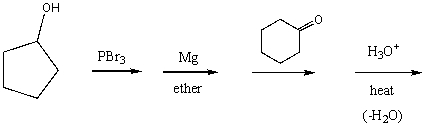
(82) 
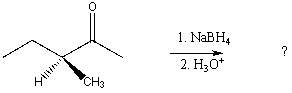
Your task is to synthesize  through a Grignard synthesis.Which pairs of compounds listed below would you choose as starting materials?
 (Multiple Choice)
4.8/5 (74)
(74) Which synthesis of a Grignard reagent would fail to occur as written?
(Multiple Choice)
5.0/5 (71)
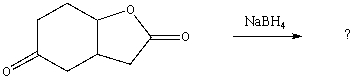
(71) 
A reaction which increases the hydrogen content or decreases the oxygen content of an organic molecule is called a(n)_____________.
(Short Answer)
4.8/5 (75)
(75) Because the carbonyl oxygen bears a partial negative charge,it is susceptible to ________________ attack.
(Short Answer)
4.9/5 (72)
(72) What is/are the principal product(s)formed when excess methylmagnesium iodide reacts with p-hydroxyacetophenone ? 
(Multiple Choice)
4.7/5 (75)
(75) 
A Grignard reagent will produce a secondary alcohol when reacted with ____________.
(Short Answer)
4.9/5 (86)
(86) When nucleophilic addition to a carbonyl group occurs,the carbon attacked undergoes this hybridization change:
(Essay)
4.9/5 (80)
(80) 
Filters
- Essay(0)
- Multiple Choice(0)
- Short Answer(0)
- True False(0)
- Matching(0)