



 Chat with AI
Exam 10: Radical Reactions

Exam 1: Carbon Compounds and Chemical Bonds134 Questions
Exam 2: Representative Carbon Compounds: Functional Groups, Intermolecular Forces, and Infrared Ir Spectroscopy114 Questions
Exam 3: An Introduction to Organic Reactions: Acids and Bases47 Questions
Exam 4: Alkanes: Nomenclature, Conformational Analysis, and an Introduction to Synthesis125 Questions
Exam 5: Stereochemistry: Chiral Molecules150 Questions
Exam 6: Ionic Reactions - Nucleophilic Substitution and Elimination Reactions of Alkyl Halides146 Questions
Exam 7: Alkenes and Alkynes I: Properties and Synthesis, Elimination Reactions of Alkyl Halides99 Questions
Exam 8: Alkenes and Alkynes Ii: Addition Reactions140 Questions
Exam 9: Nuclear Magnetic Resonance and Mass Spectrometry: Tools for Structure Determination94 Questions
Exam 10: Radical Reactions114 Questions
Exam 11: Alcohols and Ethers172 Questions
Exam 12: Alcohols From Carbonyl Compounds Oxidation-Reduction and Organometallic Compounds147 Questions
Exam 13: Conjugated Unsaturated Systems166 Questions
Exam 14: Aromatic Compounds151 Questions
Exam 15: Reactions of Aromatic Compounds173 Questions
Exam 16: Aldehydes and Ketones I Nucleophilic Addition to the Carbonyl Group165 Questions
Exam 17: Aldehydes and Ketones Ii Aldol Reactions131 Questions
Exam 18: Carboxylic Acids and Their Derivatives Nucleophilic Addition - Elimination at the Acyl Carbon124 Questions
Exam 19: Synthesis and Reactions of Beta-Dicarbonyl Compounds: More Chemistry of Enolate Ions131 Questions
Exam 20: Amines148 Questions
Exam 21: Phenols and Aryl Halides: Nucleophilic Aromatic Substitution87 Questions
Exam 22: Carbohydrates104 Questions
Exam 23: Lipids99 Questions
Exam 24: Amino Acids and Proteins94 Questions
Exam 25: Nucleic Acids and Protein Synthesis89 Questions
Select questions type


What is the major product obtained from the following reaction sequence? 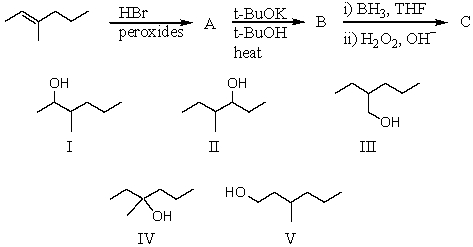

Free
(Multiple Choice)
4.9/5  (85)
(85) Correct Answer: Verified
E
An alternate mechanism for the chlorination of methane is: Cl2 2Cl·
Cl-Cl, H° = 243 kJ mol-1
Cl· + CH4 CH3Cl + H·
CH3-H, H° = 440 kJ mol-1
H· + Cl2 HCl + Cl·
CH3-Cl, H° = 352 kJ mol-1
H-Cl, H° = 432 kJ mol -1
This mechanism is unlikely because:
Free
(Multiple Choice)
4.8/5 (77)
(77) Correct Answer:Verified
VerifiedD
What is the product for the following three-step reaction sequence? 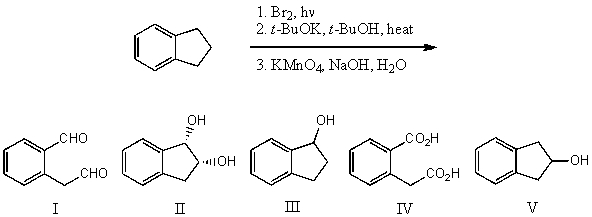
Free
(Multiple Choice)
4.9/5 (94)
(94) Correct Answer:Verified
VerifiedB
Free radical chlorination will produce but one monochloro derivative in the case of:
(Multiple Choice)
4.8/5 (77)
(77) Which of the following reactions would have an activation energy equal to zero?
(Multiple Choice)
4.7/5 (87)
(87) Draw bond-line formulas of all monochloro derivatives that might be formed when 1,1-dimethylcyclobutane is allowed to react with Cl2 under UV irradiation.For each structure,indicate,with an asterisk,any stereocenters that might be present.
(Essay)
4.8/5 (77)
(77) How many different monochlorobutanes (including stereoisomers)are formed in the free radical chlorination of butane?
(Multiple Choice)
4.9/5 (76)
(76) If propene polymerization is initiated by the use of diacyl peroxide,this is an intermediate species formed early in the process.
(Multiple Choice)
4.9/5 (85)
(85) What is the product for the following three-step reaction sequence? 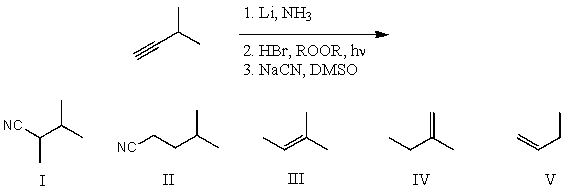
(Multiple Choice)
4.7/5 (88)
(88) The reaction of 1-butene with HBr in the presence of peroxides yields 1-bromobutane.The mechanism for the reaction involves:
(Multiple Choice)
4.7/5 (70)
(70) What is the product for the following three-step reaction sequence? 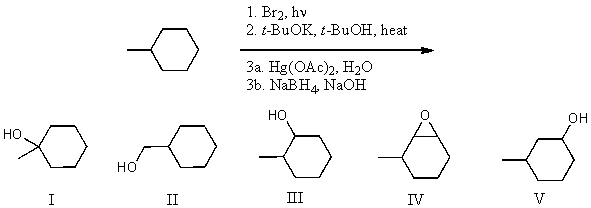
(Multiple Choice)
4.9/5 (93)
(93) More than one monochloro compound can be obtained from the free radical chlorination of:
(Multiple Choice)
4.8/5 (86)
(86) Consider the light-initiated chlorination of (S)-2-chlorobutane followed by careful fractional distillation (or separation by GLC)of all of the products with the formula C4H8Cl2.How many fractions (in total)would be obtained and how many of these fractions would be optically active?
(Multiple Choice)
4.9/5 (75)
(75) For which of the following reactions would the transition state most resemble the products? The following bond dissociation energies may be useful. (CH3)2CH-H CH3CH2CH2-H H-F
(413 kJ mol-1) (423 kJ mol-1) (570 kJ mol-1)
H-Cl H-Br
(432 kJ mol-1) (366 kJ mol-1)
(Multiple Choice)
4.9/5 (85)
(85) What is the major product obtained from the following reaction sequence? 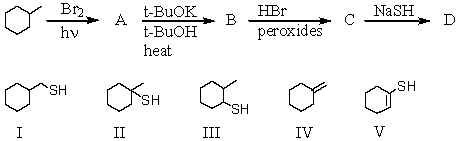
(Multiple Choice)
4.9/5 (66)
(66) The bond dissociation energies for the relevant bonds are given below each of the species involved in the following reaction.Calculate the overall H° for the reaction. 
(Multiple Choice)
4.9/5 (78)
(78) The free radical chlorination of (R)-2-chloropentane forms a mixture of dichloropentanes which includes:
(Multiple Choice)
4.9/5 (67)
(67) Draw bond-line formulas of all dichloro derivatives that might be formed when 1-chloro-2,2,3,3,-tetramethylpentane is allowed to react with Cl2 under UV irradiation.For each structure,indicate,with an asterisk,any stereocenters that might be present.
(Essay)
4.9/5 (71)
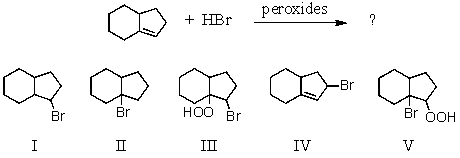
(71) 

Filters
- Essay(0)
- Multiple Choice(0)
- Short Answer(0)
- True False(0)
- Matching(0)