



 Chat with AI
Exam 10: Radical Reactions

Exam 1: Carbon Compounds and Chemical Bonds134 Questions
Exam 2: Representative Carbon Compounds: Functional Groups, Intermolecular Forces, and Infrared Ir Spectroscopy114 Questions
Exam 3: An Introduction to Organic Reactions: Acids and Bases47 Questions
Exam 4: Alkanes: Nomenclature, Conformational Analysis, and an Introduction to Synthesis125 Questions
Exam 5: Stereochemistry: Chiral Molecules150 Questions
Exam 6: Ionic Reactions - Nucleophilic Substitution and Elimination Reactions of Alkyl Halides146 Questions
Exam 7: Alkenes and Alkynes I: Properties and Synthesis, Elimination Reactions of Alkyl Halides99 Questions
Exam 8: Alkenes and Alkynes Ii: Addition Reactions140 Questions
Exam 9: Nuclear Magnetic Resonance and Mass Spectrometry: Tools for Structure Determination94 Questions
Exam 10: Radical Reactions114 Questions
Exam 11: Alcohols and Ethers172 Questions
Exam 12: Alcohols From Carbonyl Compounds Oxidation-Reduction and Organometallic Compounds147 Questions
Exam 13: Conjugated Unsaturated Systems166 Questions
Exam 14: Aromatic Compounds151 Questions
Exam 15: Reactions of Aromatic Compounds173 Questions
Exam 16: Aldehydes and Ketones I Nucleophilic Addition to the Carbonyl Group165 Questions
Exam 17: Aldehydes and Ketones Ii Aldol Reactions131 Questions
Exam 18: Carboxylic Acids and Their Derivatives Nucleophilic Addition - Elimination at the Acyl Carbon124 Questions
Exam 19: Synthesis and Reactions of Beta-Dicarbonyl Compounds: More Chemistry of Enolate Ions131 Questions
Exam 20: Amines148 Questions
Exam 21: Phenols and Aryl Halides: Nucleophilic Aromatic Substitution87 Questions
Exam 22: Carbohydrates104 Questions
Exam 23: Lipids99 Questions
Exam 24: Amino Acids and Proteins94 Questions
Exam 25: Nucleic Acids and Protein Synthesis89 Questions
Select questions type


Draw bond-line formulas of all monochloro derivatives that might be formed when 2,2,4-trimethylpentane is allowed to react with Cl2 under UV irradiation.For each structure,indicate,with an asterisk,any stereocenters that might be present.
(Essay)
4.9/5  (83)
(83) Which of the following reactions would have the smallest energy of activation?
(Multiple Choice)
5.0/5 (85)
(85) The reaction of 2-methylbutane with chlorine would yield how many monochloro derivatives? (include stereoisomers)
(Multiple Choice)
4.7/5 (85)
(85) 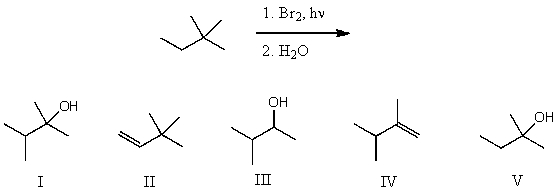
At some temperatures,the relative reactivities of 3°,2° and 1° alkane hydrogens in free radical chlorination are in the ratio of 5:3:1.Thus,monochlorination of isopentane should produce these percentages of 2-chloro-2-methylbutane (A),combined 1-chloro-2-methylbutane and 1-chloro-3-methylbutane (B),and 2-chloro-3-methylbutane (C):
(Multiple Choice)
4.8/5 (91)
(91) What feature would you expect to see in the 1H NMR spectrum of B after subjecting A to the following reaction? 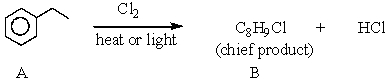
(Multiple Choice)
4.8/5 (94)
(94) If chlorocyclopentane were chlorinated to form all possible dichloro compounds and the product mixture subjected to precise fractional distillation,how many fractions would be obtained (ideally)?
(Multiple Choice)
5.0/5 (68)
(68) What is the product for the following three-step reaction sequence? 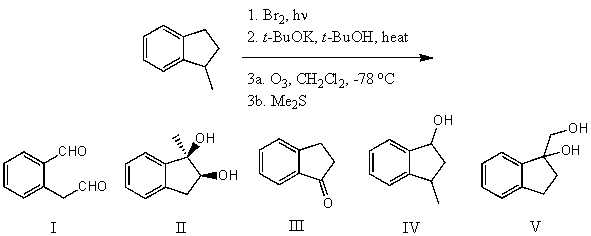
(Multiple Choice)
4.8/5 (74)
(74) The p-orbital of a methyl radical carbon,CH3·,contains how many electrons?
(Multiple Choice)
4.8/5 (79)
(79) The mechanism for a free-radical reaction consists of three types of steps.These are: _______________
(Essay)
4.9/5 (78)
(78) Which of the following reactions would have the smallest energy of activation?
(Multiple Choice)
4.8/5 (78)
(78) Which of the reactions listed below would have a value of H° equal to zero?
(Multiple Choice)
4.9/5 (78)
(78) Draw bond-line formulas of all monochloro derivatives that might be formed when 2,3-dimethylbutane is allowed to react with Cl2 under UV irradiation.For each structure,indicate,with an asterisk,any stereocenters that might be present.
(Essay)
4.7/5 (84)
(84) The free radical chlorination of pentane produces this number of monochloro compounds,including stereoisomers.
(Multiple Choice)
4.9/5 (82)
(82) What is the product for the following three-step reaction sequence? 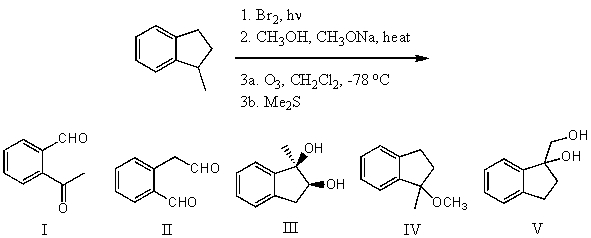
(Multiple Choice)
4.9/5 (80)
(80) What is the product for the following three-step reaction sequence? 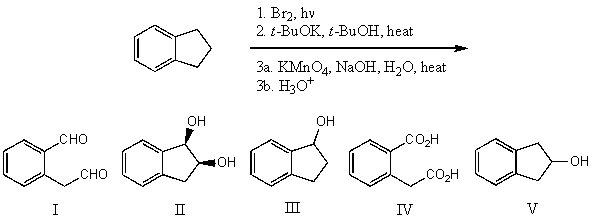
(Multiple Choice)
4.9/5 (81)
(81) The free radical chlorination of 3-chloropentane forms a mixture of dichloropentanes which,on precise fractional distillation,affords these fractions:
(Multiple Choice)
4.8/5 (82)
(82) Draw bond-line formulas of all monochloro derivatives that might be formed when 3-ethylhexane is allowed to react with Cl2 under UV irradiation.For each structure,indicate,with an asterisk,any stereocenters that might be present.
(Essay)
4.9/5 (77)
(77) 
Filters
- Essay(0)
- Multiple Choice(0)
- Short Answer(0)
- True False(0)
- Matching(0)