



 Chat with AI
Exam 22: Carbohydrates

Exam 1: Carbon Compounds and Chemical Bonds134 Questions
Exam 2: Representative Carbon Compounds: Functional Groups, Intermolecular Forces, and Infrared Ir Spectroscopy114 Questions
Exam 3: An Introduction to Organic Reactions: Acids and Bases47 Questions
Exam 4: Alkanes: Nomenclature, Conformational Analysis, and an Introduction to Synthesis125 Questions
Exam 5: Stereochemistry: Chiral Molecules150 Questions
Exam 6: Ionic Reactions - Nucleophilic Substitution and Elimination Reactions of Alkyl Halides146 Questions
Exam 7: Alkenes and Alkynes I: Properties and Synthesis, Elimination Reactions of Alkyl Halides99 Questions
Exam 8: Alkenes and Alkynes Ii: Addition Reactions140 Questions
Exam 9: Nuclear Magnetic Resonance and Mass Spectrometry: Tools for Structure Determination94 Questions
Exam 10: Radical Reactions114 Questions
Exam 11: Alcohols and Ethers172 Questions
Exam 12: Alcohols From Carbonyl Compounds Oxidation-Reduction and Organometallic Compounds147 Questions
Exam 13: Conjugated Unsaturated Systems166 Questions
Exam 14: Aromatic Compounds151 Questions
Exam 15: Reactions of Aromatic Compounds173 Questions
Exam 16: Aldehydes and Ketones I Nucleophilic Addition to the Carbonyl Group165 Questions
Exam 17: Aldehydes and Ketones Ii Aldol Reactions131 Questions
Exam 18: Carboxylic Acids and Their Derivatives Nucleophilic Addition - Elimination at the Acyl Carbon124 Questions
Exam 19: Synthesis and Reactions of Beta-Dicarbonyl Compounds: More Chemistry of Enolate Ions131 Questions
Exam 20: Amines148 Questions
Exam 21: Phenols and Aryl Halides: Nucleophilic Aromatic Substitution87 Questions
Exam 22: Carbohydrates104 Questions
Exam 23: Lipids99 Questions
Exam 24: Amino Acids and Proteins94 Questions
Exam 25: Nucleic Acids and Protein Synthesis89 Questions
Select questions type


Which compound will not reduce Ag(NH3)2+ ? 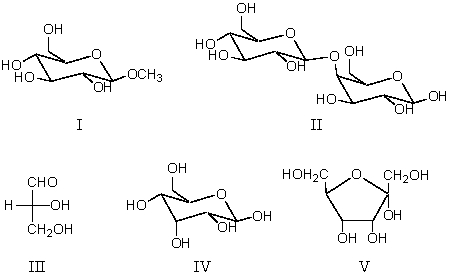

Free
(Multiple Choice)
4.7/5  (71)
(71) Correct Answer: Verified
A
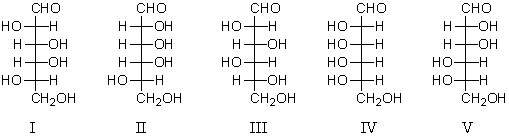
Refer to the structures below.Which sugars would react with phenylhydrazine to yield the same phenylosazone? 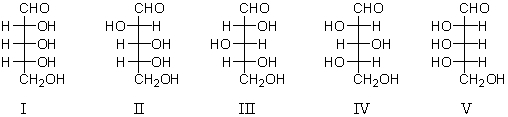
Free
(Multiple Choice)
4.7/5 (63)
(63) Correct Answer:Verified
VerifiedA
Which aldohexose would yield an optically active aldaric acid when treated with nitric acid? 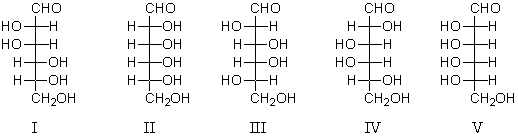
Free
(Multiple Choice)
4.8/5 (77)
(77) Correct Answer:Verified
VerifiedA
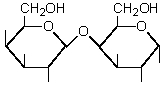
A D-aldohexose X,is subjected to a Ruff degradation.The degradation product is treated with nitric acid to yield an optically inactive aldaric acid.A possible structure for X is: 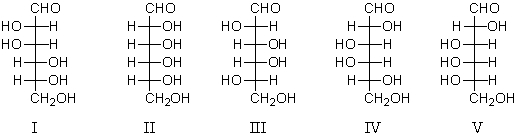
(Multiple Choice)
4.9/5 (76)
(76) 
A polysaccharide found in the shells of lobsters,crabs,and in the exoskeletons of insects and spiders is called _________.
(Short Answer)
4.7/5 (83)
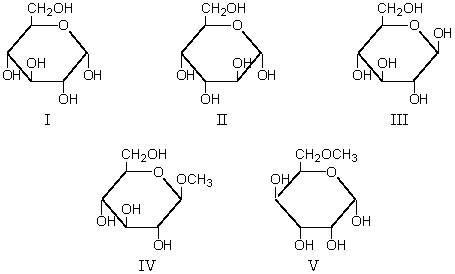
(83) Which compound or compounds would be formed when D-glucose is dissolved in methanol and then treated with anhydrous acid? 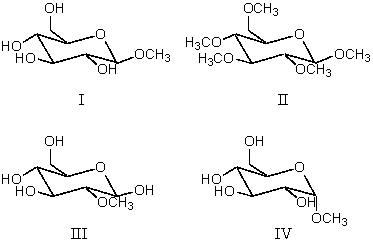
(Multiple Choice)
4.8/5 (84)
(84) A glycoside is a compound which contains the structural features of these classes of organic compounds:
(Multiple Choice)
4.8/5 (82)
(82) Which reagent would be used for the following transformation? 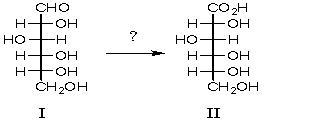
(Multiple Choice)
4.8/5 (82)
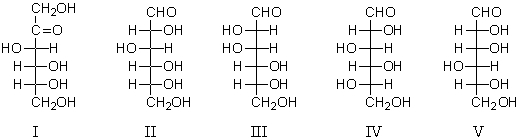
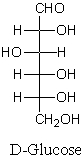
(82) Consider the structures of D-allose below: 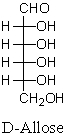 Which of the following structures represents L-allose?
Which of the following structures represents L-allose? (Multiple Choice)
4.8/5 (75)
(75) 
Carbohydrates that hydrolyze to give a large number of molecules of monosaccharides are called _____________.
(Short Answer)
4.9/5 (79)
(79) Sugars that give positive tests with Benedict's or Tollens' solution are called _______________.
(Essay)
4.8/5 (80)
(80) An optically active hexose,A,C6H12O6,was degraded to an optically active pentose (B),C5H10O5,by the following series of reactions:  Compound (B)was degraded to an optically active tetrose (C)C4H8O4,through the same series of reactions as shown above,then (B)and (C)oxidized with HNO3 to yield the optically active tartaric acid.
Give possible structure for (A)and (B).
Compound (B)was degraded to an optically active tetrose (C)C4H8O4,through the same series of reactions as shown above,then (B)and (C)oxidized with HNO3 to yield the optically active tartaric acid.
Give possible structure for (A)and (B). (Essay)
4.8/5 (71)
(71) 
Which would undergo mutarotation in neutral aqueous solution? 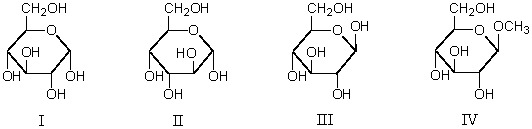
(Multiple Choice)
4.8/5 (76)
(76) 
Filters
- Essay(0)
- Multiple Choice(0)
- Short Answer(0)
- True False(0)
- Matching(0)