



 Chat with AI
Exam 22: Carbohydrates

Exam 1: Carbon Compounds and Chemical Bonds134 Questions
Exam 2: Representative Carbon Compounds: Functional Groups, Intermolecular Forces, and Infrared Ir Spectroscopy114 Questions
Exam 3: An Introduction to Organic Reactions: Acids and Bases47 Questions
Exam 4: Alkanes: Nomenclature, Conformational Analysis, and an Introduction to Synthesis125 Questions
Exam 5: Stereochemistry: Chiral Molecules150 Questions
Exam 6: Ionic Reactions - Nucleophilic Substitution and Elimination Reactions of Alkyl Halides146 Questions
Exam 7: Alkenes and Alkynes I: Properties and Synthesis, Elimination Reactions of Alkyl Halides99 Questions
Exam 8: Alkenes and Alkynes Ii: Addition Reactions140 Questions
Exam 9: Nuclear Magnetic Resonance and Mass Spectrometry: Tools for Structure Determination94 Questions
Exam 10: Radical Reactions114 Questions
Exam 11: Alcohols and Ethers172 Questions
Exam 12: Alcohols From Carbonyl Compounds Oxidation-Reduction and Organometallic Compounds147 Questions
Exam 13: Conjugated Unsaturated Systems166 Questions
Exam 14: Aromatic Compounds151 Questions
Exam 15: Reactions of Aromatic Compounds173 Questions
Exam 16: Aldehydes and Ketones I Nucleophilic Addition to the Carbonyl Group165 Questions
Exam 17: Aldehydes and Ketones Ii Aldol Reactions131 Questions
Exam 18: Carboxylic Acids and Their Derivatives Nucleophilic Addition - Elimination at the Acyl Carbon124 Questions
Exam 19: Synthesis and Reactions of Beta-Dicarbonyl Compounds: More Chemistry of Enolate Ions131 Questions
Exam 20: Amines148 Questions
Exam 21: Phenols and Aryl Halides: Nucleophilic Aromatic Substitution87 Questions
Exam 22: Carbohydrates104 Questions
Exam 23: Lipids99 Questions
Exam 24: Amino Acids and Proteins94 Questions
Exam 25: Nucleic Acids and Protein Synthesis89 Questions
Select questions type


What products are expected to be formed upon subjecting D-galactose (shown below)to the following reaction sequence? (Draw Fischer projection formulas)
i)Br2,H2O;ii)H2O2,Fe2(SO4)3 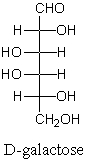
(Essay)
4.8/5  (78)
(78) Sugars that undergo mutarotation in neutral aqueous solution are: 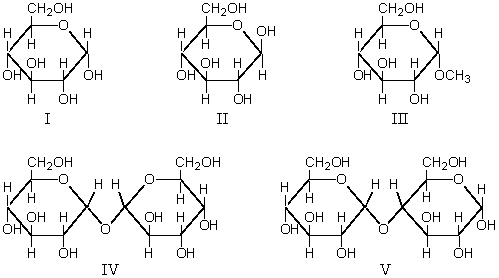
(Multiple Choice)
4.9/5 (83)
(83) 
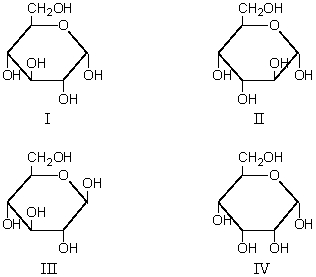
Reaction of the following substance with sodium borohydride (NaBH4)would yield: 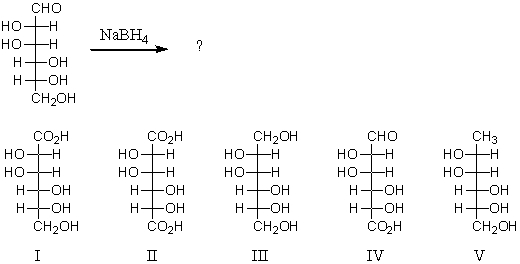
(Multiple Choice)
4.8/5 (75)
(75) Which is not an intermediate monosaccharide in the Kiliani-Fischer synthesis of D-mannose from D-glyceraldehyde?
(Multiple Choice)
4.8/5 (78)
(78) A pentose of the D-family gave an optically active glycaric acid (a dicarboxylic acid)on oxidation with nitric acid.The pentose was converted by the Kiliani-Fischer Synthesis into a pair of diastereoisomeric hexoses,one of which gave an optically active glycaric acid when oxidized with nitric acid and the other of which gave an optically inactive glycaric acid.What are the names and structures of the pentose and the two hexoses?
(Essay)
4.9/5 (84)
(84) What is the mechanism of the hydrolysis of maltose to glucose under acidic conditions?
(Essay)
4.9/5 (83)
(83) 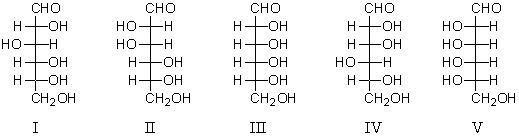
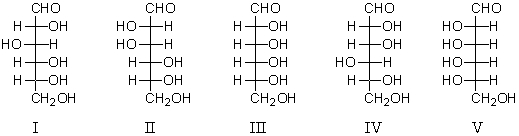
Consider the structures above.Which monosaccharides would yield the same phenylosazone when treated with excess phenylhydrazine? 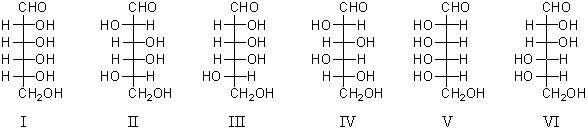
(Multiple Choice)
4.9/5 (85)
(85) Which of the following substances will afford a meso- product upon reaction with Br2/H2O ? 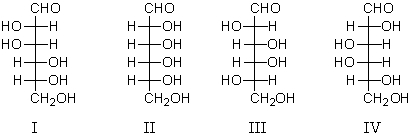
(Multiple Choice)
4.8/5 (72)
(72) 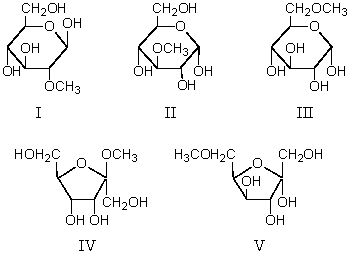
Consider the structures below.Which monosaccharides would yield an optically active aldonic acid when oxidized with bromine water? 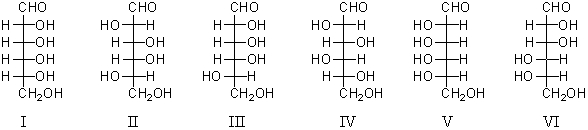
(Multiple Choice)
4.8/5 (76)
(76) Reaction of the following substance with nitric acid would yield: 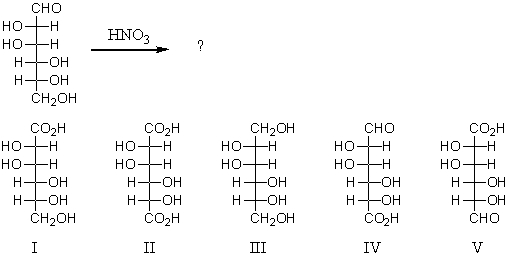
(Multiple Choice)
4.9/5 (86)
(86) 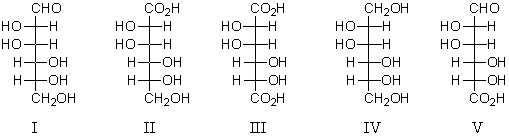
Refer to the following structures.Which D-aldohexose would react with NaBH4 to yield an optically inactive alditol? 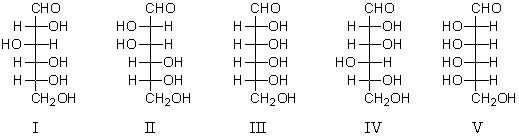
(Multiple Choice)
4.7/5 (68)
(68) 

Filters
- Essay(0)
- Multiple Choice(0)
- Short Answer(0)
- True False(0)
- Matching(0)