



 Chat with AI
Exam 22: Carbohydrates

Exam 1: Carbon Compounds and Chemical Bonds134 Questions
Exam 2: Representative Carbon Compounds: Functional Groups, Intermolecular Forces, and Infrared Ir Spectroscopy114 Questions
Exam 3: An Introduction to Organic Reactions: Acids and Bases47 Questions
Exam 4: Alkanes: Nomenclature, Conformational Analysis, and an Introduction to Synthesis125 Questions
Exam 5: Stereochemistry: Chiral Molecules150 Questions
Exam 6: Ionic Reactions - Nucleophilic Substitution and Elimination Reactions of Alkyl Halides146 Questions
Exam 7: Alkenes and Alkynes I: Properties and Synthesis, Elimination Reactions of Alkyl Halides99 Questions
Exam 8: Alkenes and Alkynes Ii: Addition Reactions140 Questions
Exam 9: Nuclear Magnetic Resonance and Mass Spectrometry: Tools for Structure Determination94 Questions
Exam 10: Radical Reactions114 Questions
Exam 11: Alcohols and Ethers172 Questions
Exam 12: Alcohols From Carbonyl Compounds Oxidation-Reduction and Organometallic Compounds147 Questions
Exam 13: Conjugated Unsaturated Systems166 Questions
Exam 14: Aromatic Compounds151 Questions
Exam 15: Reactions of Aromatic Compounds173 Questions
Exam 16: Aldehydes and Ketones I Nucleophilic Addition to the Carbonyl Group165 Questions
Exam 17: Aldehydes and Ketones Ii Aldol Reactions131 Questions
Exam 18: Carboxylic Acids and Their Derivatives Nucleophilic Addition - Elimination at the Acyl Carbon124 Questions
Exam 19: Synthesis and Reactions of Beta-Dicarbonyl Compounds: More Chemistry of Enolate Ions131 Questions
Exam 20: Amines148 Questions
Exam 21: Phenols and Aryl Halides: Nucleophilic Aromatic Substitution87 Questions
Exam 22: Carbohydrates104 Questions
Exam 23: Lipids99 Questions
Exam 24: Amino Acids and Proteins94 Questions
Exam 25: Nucleic Acids and Protein Synthesis89 Questions
Select questions type


Which reagent would cause the following conversion to take place? 
(Multiple Choice)
4.7/5  (70)
(70) Which reagent would be used for the following transformation? 
(Multiple Choice)
4.8/5 (67)
(67) Consider the structure of D-erythrose,shown below.Draw the structure of the product obtained upon treatment of D-erythrose with nitric acid.Give its IUPAC name and comment on its stereochemistry. 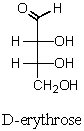
(Essay)
4.9/5 (75)
(75) What is the ratio of products formed by the reaction of periodic acid with the following compound? 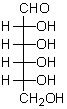 H2C=O HCO2H
CO2
I
5
1
0
II
3
3
0
III
1
5
0
IV
1
4
1
V
0
4
2
H2C=O HCO2H
CO2
I
5
1
0
II
3
3
0
III
1
5
0
IV
1
4
1
V
0
4
2 (Multiple Choice)
4.8/5 (74)
(74) Suggest a simple chemical test that you might use to distinguish between 2,3-pentanediol and 2,4-pentanediol?
(Essay)
4.8/5 (68)
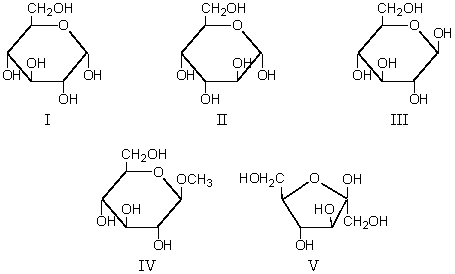
(68) Consider the structures shown below.Which structure represents -D-glucopyranose? 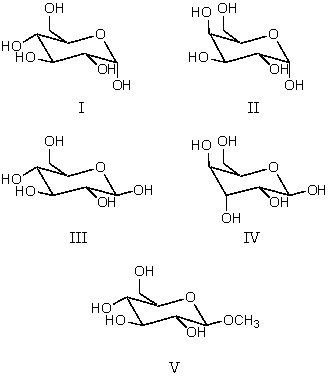
(Multiple Choice)
4.7/5 (79)
(79) Bromine water is a reagent that converts an aldose to an ___________.
(Essay)
4.8/5 (81)
(81) Consider the structures shown below.Which compound is not a reducing sugar? 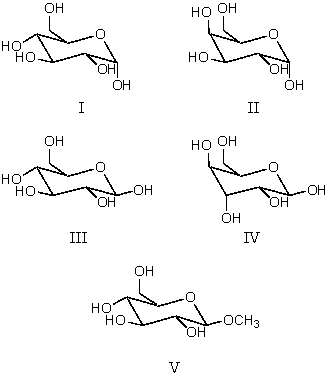
(Multiple Choice)
4.9/5 (90)
(90) Consider the structures below: what term(s)describe(s)the relationship between them? 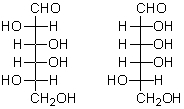
(Multiple Choice)
4.9/5 (82)
(82) 
Which of these is a component of the mixture formed when D-galactose is placed in aqueous base (de Bruyn - van Ekenstein transformation)? 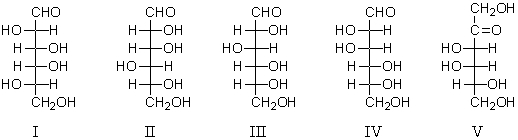
(Multiple Choice)
4.9/5 (65)
(65) 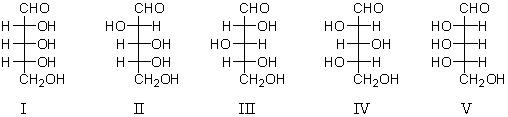
Which of the following would give a positive test with Benedict's solution? 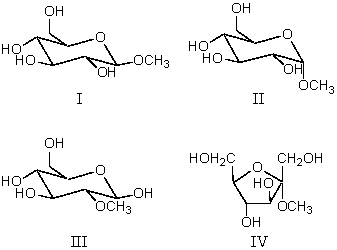
(Multiple Choice)
4.9/5 (83)
(83) 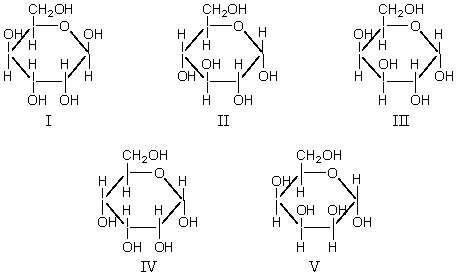
Many carbohydrates exist in equilibrium with cyclic hemiacetals.Those carbohydrates that form a five-membered cyclic hemiacetal are called _____________.
(Short Answer)
4.8/5 (81)
(81) Lactose exists in two forms α and β.Anomer α has [α]D = +92.6o,and anomer β has [α]D = +34o.What are the percentages of each anomer at equilibrium when the specific rotation of the water solution is + 52o?
(Essay)
4.9/5 (83)
(83) 
Filters
- Essay(0)
- Multiple Choice(0)
- Short Answer(0)
- True False(0)
- Matching(0)