



 Chat with AI
Exam 12: Alcohols From Carbonyl Compounds Oxidation-Reduction and Organometallic Compounds

Exam 1: Carbon Compounds and Chemical Bonds134 Questions
Exam 2: Representative Carbon Compounds: Functional Groups, Intermolecular Forces, and Infrared Ir Spectroscopy114 Questions
Exam 3: An Introduction to Organic Reactions: Acids and Bases47 Questions
Exam 4: Alkanes: Nomenclature, Conformational Analysis, and an Introduction to Synthesis125 Questions
Exam 5: Stereochemistry: Chiral Molecules150 Questions
Exam 6: Ionic Reactions - Nucleophilic Substitution and Elimination Reactions of Alkyl Halides146 Questions
Exam 7: Alkenes and Alkynes I: Properties and Synthesis, Elimination Reactions of Alkyl Halides99 Questions
Exam 8: Alkenes and Alkynes Ii: Addition Reactions140 Questions
Exam 9: Nuclear Magnetic Resonance and Mass Spectrometry: Tools for Structure Determination94 Questions
Exam 10: Radical Reactions114 Questions
Exam 11: Alcohols and Ethers172 Questions
Exam 12: Alcohols From Carbonyl Compounds Oxidation-Reduction and Organometallic Compounds147 Questions
Exam 13: Conjugated Unsaturated Systems166 Questions
Exam 14: Aromatic Compounds151 Questions
Exam 15: Reactions of Aromatic Compounds173 Questions
Exam 16: Aldehydes and Ketones I Nucleophilic Addition to the Carbonyl Group165 Questions
Exam 17: Aldehydes and Ketones Ii Aldol Reactions131 Questions
Exam 18: Carboxylic Acids and Their Derivatives Nucleophilic Addition - Elimination at the Acyl Carbon124 Questions
Exam 19: Synthesis and Reactions of Beta-Dicarbonyl Compounds: More Chemistry of Enolate Ions131 Questions
Exam 20: Amines148 Questions
Exam 21: Phenols and Aryl Halides: Nucleophilic Aromatic Substitution87 Questions
Exam 22: Carbohydrates104 Questions
Exam 23: Lipids99 Questions
Exam 24: Amino Acids and Proteins94 Questions
Exam 25: Nucleic Acids and Protein Synthesis89 Questions
Select questions type


Compounds that contain carbon-metal bonds are known as _________________.
(Short Answer)
4.8/5  (81)
(81) 
Suggest a reasonable synthetic strategy for the synthesis of 3-methyl-3-hexanol from 3-hexanol.
(Essay)
4.8/5 (86)
(86) 
Which of the following would serve as a synthesis of racemic 2-methyl-1-phenyl-2-butanol? 
(Multiple Choice)
4.9/5 (83)
(83) What compound(s)result(s)from the reaction of CH3CH2CH2MgBr with CH3CH2CH2CH2CO2H (1:1 mole ratio)?
(Multiple Choice)
4.9/5 (77)
(77) What is the product,A,that would be obtained from the following reaction sequence? 
(Multiple Choice)
4.8/5 (83)
(83) CrO3 in H2SO4/H2O will fail to give a positive test with which of these compounds?
(Multiple Choice)
4.9/5 (85)
(85) What is/are the principal product(s)formed when excess methylmagnesium iodide reacts with p-hydroxyacetophenone ? 
(Multiple Choice)
4.9/5 (80)
(80) Suggest a reasonable synthetic strategy for the synthesis of 3-ethyl-3-heptanol from pentanoic acid,CH3CH2CH2CH2CO2H.
(Essay)
4.7/5 (72)
(72) Complete the following reaction sequence,giving structural details of all key intermediates.
4-methyl-1-hexene------------------
i)BH3,THF
ii)H2O2,NaOH
iii)SOCl2
iv)Mg,Et2O
iv)ethylene oxide
v)NH4Cl
(Essay)
4.7/5 (77)
(77) What is the principal product of the following reaction:  + CH3CH2CH2CH2MgBr/ether;then H2O ?
 (Multiple Choice)
4.9/5 (79)
(79) A solution of CrO3 in aqueous acetone is called the _______________.
(Short Answer)
4.9/5 (80)
(80) 
Which of the following reagents might serve as the basis for a simple chemical test that would distinguish between CH3CH=CHCH3 and CH3CHOHCH2CH3?
(Multiple Choice)
4.9/5 (72)
(72) In a Grignard reagent,the carbon bonded to magnesium has a partial_______charge and therefore behaves as a(n)___________
(Short Answer)
4.7/5 (69)
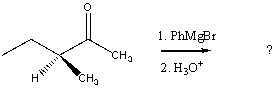
(69) 
Your task is to synthesize  through a Grignard synthesis.Which pairs of compounds listed below would you choose as starting materials?
 (Multiple Choice)
4.8/5 (60)
(60) Fundamentally,2-methyl-2-pentanol does not undergo oxidation by H2CrO4 because:
(Multiple Choice)
4.8/5 (98)
(98) 
Filters
- Essay(0)
- Multiple Choice(0)
- Short Answer(0)
- True False(0)
- Matching(0)