



 Chat with AI
Exam 15: Reactions of Aromatic Compounds

Exam 1: Carbon Compounds and Chemical Bonds134 Questions
Exam 2: Representative Carbon Compounds: Functional Groups, Intermolecular Forces, and Infrared Ir Spectroscopy114 Questions
Exam 3: An Introduction to Organic Reactions: Acids and Bases47 Questions
Exam 4: Alkanes: Nomenclature, Conformational Analysis, and an Introduction to Synthesis125 Questions
Exam 5: Stereochemistry: Chiral Molecules150 Questions
Exam 6: Ionic Reactions - Nucleophilic Substitution and Elimination Reactions of Alkyl Halides146 Questions
Exam 7: Alkenes and Alkynes I: Properties and Synthesis, Elimination Reactions of Alkyl Halides99 Questions
Exam 8: Alkenes and Alkynes Ii: Addition Reactions140 Questions
Exam 9: Nuclear Magnetic Resonance and Mass Spectrometry: Tools for Structure Determination94 Questions
Exam 10: Radical Reactions114 Questions
Exam 11: Alcohols and Ethers172 Questions
Exam 12: Alcohols From Carbonyl Compounds Oxidation-Reduction and Organometallic Compounds147 Questions
Exam 13: Conjugated Unsaturated Systems166 Questions
Exam 14: Aromatic Compounds151 Questions
Exam 15: Reactions of Aromatic Compounds173 Questions
Exam 16: Aldehydes and Ketones I Nucleophilic Addition to the Carbonyl Group165 Questions
Exam 17: Aldehydes and Ketones Ii Aldol Reactions131 Questions
Exam 18: Carboxylic Acids and Their Derivatives Nucleophilic Addition - Elimination at the Acyl Carbon124 Questions
Exam 19: Synthesis and Reactions of Beta-Dicarbonyl Compounds: More Chemistry of Enolate Ions131 Questions
Exam 20: Amines148 Questions
Exam 21: Phenols and Aryl Halides: Nucleophilic Aromatic Substitution87 Questions
Exam 22: Carbohydrates104 Questions
Exam 23: Lipids99 Questions
Exam 24: Amino Acids and Proteins94 Questions
Exam 25: Nucleic Acids and Protein Synthesis89 Questions
Select questions type


When two different groups are present on a benzene ring,the ____________ generally determines the outcome of an EAS reaction.
(Essay)
4.8/5  (84)
(84) Using a potential energy diagram,explain/illustrate the preferential formation of the 3 substituted product instead of the 2 or 4 product in the electrophilic aromatic substitution of pyridine. 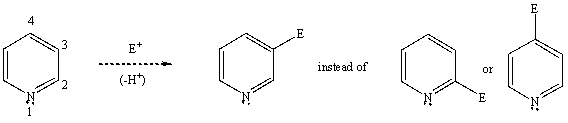
(Essay)
4.7/5 (77)
(77) When toluene reacts with Cl2,the identity of the major product(s)obtained depends on whether the reaction is carried out in the presence of catalytic amounts of FeCl3,or without catalyst,at high temp.Explain clearly.
(Essay)
4.8/5 (84)
(84) The major product(s),D,of the following reaction, 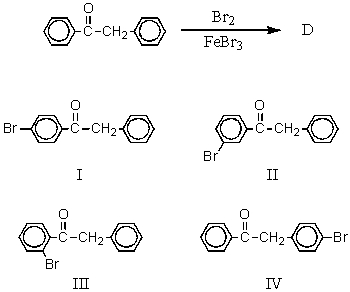 would be:
 (Multiple Choice)
4.8/5 (83)
(83) Which reagent(s)would you use to carry out the following transformation? ethylbenzene -- 1-chloro-1-phenylethane
(Multiple Choice)
4.8/5 (67)
(67) Which of the following compounds would be most reactive toward electrophilic substitution? 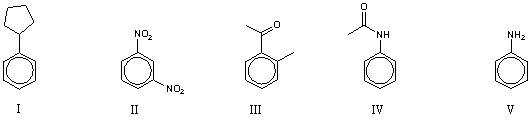
(Multiple Choice)
4.8/5 (85)
(85) What would you expect to be the major product obtained from the following reaction? 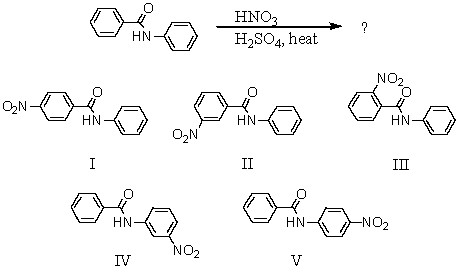
(Multiple Choice)
4.9/5 (86)
(86) What would you expect to be the major product obtained from the following reaction? 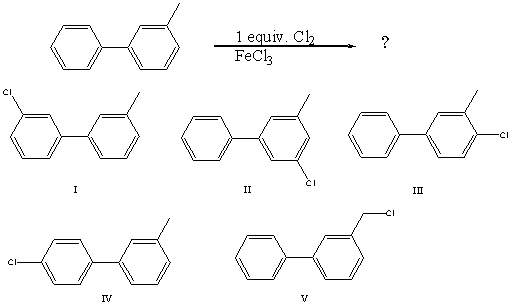
(Multiple Choice)
4.8/5 (83)
(83) The reaction of benzene with 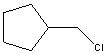 in the presence of anhydrous aluminum chloride produces principally which of these?
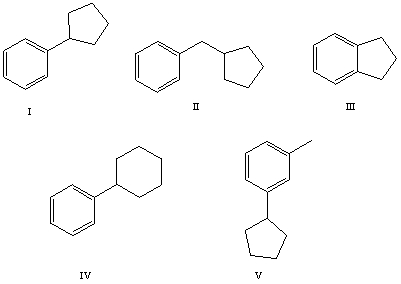
in the presence of anhydrous aluminum chloride produces principally which of these? (Multiple Choice)
4.9/5 (77)
(77) The rate of solvolysis in ethanol is least for which of these compounds?
(Multiple Choice)
4.9/5 (80)
(80) Which is the best sequence of reactions for the following transformation? 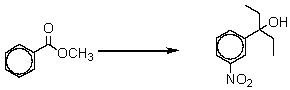
(Multiple Choice)
4.9/5 (89)
(89) Using a potential energy diagram,explain/illustrate the preferential formation of the 3 substituted product instead of the 2 product in the electrophilic aromatic substitution of indole (shown). 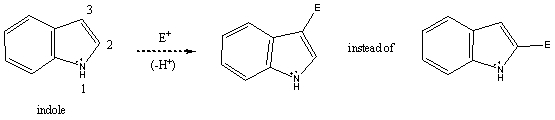
(Essay)
4.9/5 (77)
(77) With the exception of halogens,activating groups are ____________ directors and deactivating groups are _________ directors.
(Short Answer)
4.9/5 (91)
(91) Which reagent or test could you use to distinguish between phenylacetylene and vinylbenzene?
(Multiple Choice)
4.8/5 (86)
(86) Which of the following compounds would be most reactive toward electrophilic substitution? 
(Multiple Choice)
4.9/5 (72)
(72) Based on your knowledge of electrophilic aromatic substitution,predict the preferential
position of attack of an electrophile on pyrrole,i.e. ,does the electrophile E+ attack carbon 2,or 3? Explain your answer. 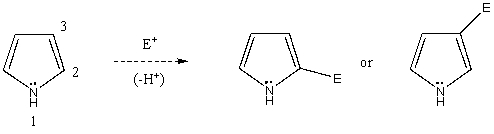 Which substitution product forms preferentially and why?
 (Essay)
4.9/5 (61)
(61) What would you expect to be the major product obtained from the following reaction? 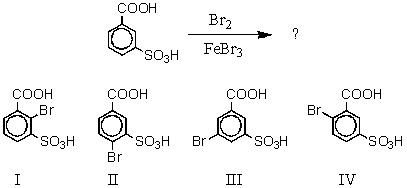
(Multiple Choice)
4.8/5 (70)
(70) Using a potential energy diagram,explain/illustrate the preferential formation of the 2 substituted product instead of the 3 product in the electrophilic aromatic substitution of furan. 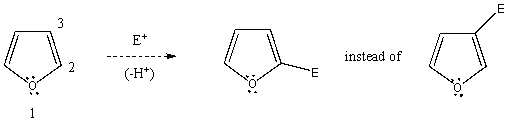
(Essay)
4.7/5 (81)
(81) Toluene is subjected to the action of the following reagents in the order given: (1)KMnO4,OH-,heat;then H3O+ (2)HNO3,H2SO4 (3)Br2,FeBr3 What is the final product of this sequence? 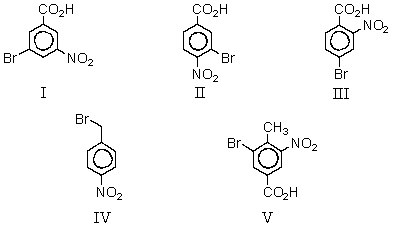
(Multiple Choice)
4.9/5 (75)
(75) Toluene is subjected to the action of the following reagents in the order given: (1)KMnO4,OH-,heat;then H3O+ (2)HNO3,H2SO4 (3)Cl2,FeCl3 What is the final product of this sequence? 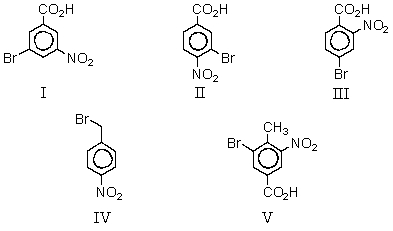
(Multiple Choice)
4.9/5 (74)
(74) 
Filters
- Essay(0)
- Multiple Choice(0)
- Short Answer(0)
- True False(0)
- Matching(0)