



 Chat with AI
Exam 15: Reactions of Aromatic Compounds

Exam 1: Carbon Compounds and Chemical Bonds134 Questions
Exam 2: Representative Carbon Compounds: Functional Groups, Intermolecular Forces, and Infrared Ir Spectroscopy114 Questions
Exam 3: An Introduction to Organic Reactions: Acids and Bases47 Questions
Exam 4: Alkanes: Nomenclature, Conformational Analysis, and an Introduction to Synthesis125 Questions
Exam 5: Stereochemistry: Chiral Molecules150 Questions
Exam 6: Ionic Reactions - Nucleophilic Substitution and Elimination Reactions of Alkyl Halides146 Questions
Exam 7: Alkenes and Alkynes I: Properties and Synthesis, Elimination Reactions of Alkyl Halides99 Questions
Exam 8: Alkenes and Alkynes Ii: Addition Reactions140 Questions
Exam 9: Nuclear Magnetic Resonance and Mass Spectrometry: Tools for Structure Determination94 Questions
Exam 10: Radical Reactions114 Questions
Exam 11: Alcohols and Ethers172 Questions
Exam 12: Alcohols From Carbonyl Compounds Oxidation-Reduction and Organometallic Compounds147 Questions
Exam 13: Conjugated Unsaturated Systems166 Questions
Exam 14: Aromatic Compounds151 Questions
Exam 15: Reactions of Aromatic Compounds173 Questions
Exam 16: Aldehydes and Ketones I Nucleophilic Addition to the Carbonyl Group165 Questions
Exam 17: Aldehydes and Ketones Ii Aldol Reactions131 Questions
Exam 18: Carboxylic Acids and Their Derivatives Nucleophilic Addition - Elimination at the Acyl Carbon124 Questions
Exam 19: Synthesis and Reactions of Beta-Dicarbonyl Compounds: More Chemistry of Enolate Ions131 Questions
Exam 20: Amines148 Questions
Exam 21: Phenols and Aryl Halides: Nucleophilic Aromatic Substitution87 Questions
Exam 22: Carbohydrates104 Questions
Exam 23: Lipids99 Questions
Exam 24: Amino Acids and Proteins94 Questions
Exam 25: Nucleic Acids and Protein Synthesis89 Questions
Select questions type


Which of the following reactions would yield isopropylbenzene as the major product?
(Multiple Choice)
4.8/5  (77)
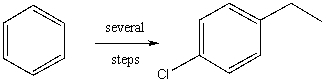
(77) Which is the best sequence of reactions for the following transformation? 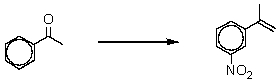
(Multiple Choice)
4.7/5 (81)
(81) Which of these is a satisfactory synthesis of 1-bromo-2-phenylethane?
(Multiple Choice)
4.9/5 (87)
(87) Which reagent(s)would you use to carry out the following transformation? ethylbenzene-- benzoic acid
(Multiple Choice)
4.7/5 (72)
(72) Using a potential energy diagram,explain/illustrate the preferential formation of the 2 substituted product instead of the 3 product in the electrophilic aromatic substitution of pyrrole. 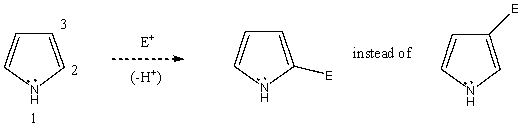
(Essay)
5.0/5 (73)
(73) When the following substance is treated with Br2/FeBr3,the major product is obtained in good yield,and only very small amounts of minor products are found.What is this major product and why are the minor products not formed to any significant degree? Explain clearly. 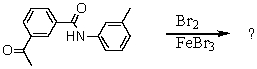
(Essay)
4.8/5 (76)
(76) Which of the following compounds would be least reactive toward electrophilic substitution? 
(Multiple Choice)
4.9/5 (82)
(82) Undesired polysubstitution of an aromatic nucleus is most likely to be encountered in the case of:
(Multiple Choice)
5.0/5 (68)
(68) What would you expect to be the major product obtained from the following reaction? 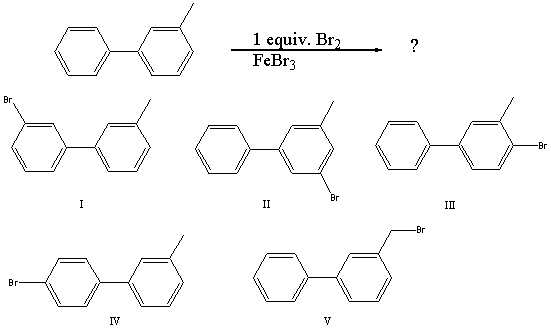
(Multiple Choice)
4.7/5 (74)
(74) 
Based on your knowledge of electrophilic aromatic substitution,predict the preferential position of attack of an electrophile on thiophene,i.e. ,does the electrophile E+ attack carbon 2,or 3? Explain your answer. 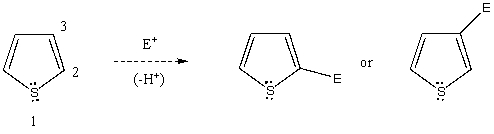 Which substitution product forms preferentially and why?
 (Essay)
4.8/5 (86)
(86) 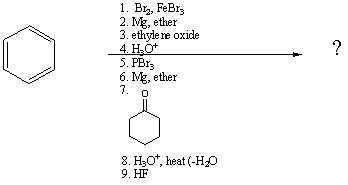
Which of the following reactions could be used to synthesize tert-butylbenzene?
(Multiple Choice)
4.8/5 (89)
(89) Which of the following structures would not be a contributor to the resonance hybrid of the benzyl cation? 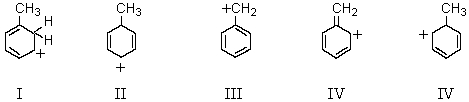
(Multiple Choice)
4.8/5 (81)
(81) Which of the compounds listed below would you expect to give the greatest amount of meta-product when subjected to ring nitration? 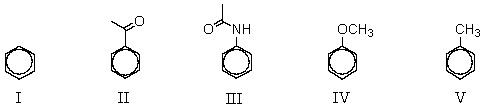
(Multiple Choice)
5.0/5 (83)
(83) Based on your knowledge of electrophilic aromatic substitution,and assuming the furan ring of benzo[b]furan (shown)is activated toward electrophilic aromatic substituted more so than the benzenoid ring,predict the preferential position of attack of an electrophile,i.e. ,does the electrophile E+ attack carbon 2,or 3? Explain your answer. 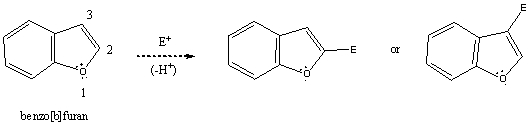 Which substitution product forms preferentially and why?
 (Essay)
4.8/5 (75)
(75) This substituent deactivates the benzene ring towards electrophilic substitution but directs the incoming group chiefly to the ortho and para positions.
(Multiple Choice)
5.0/5 (69)
(69) Consider the structures given below.Which of them would be a relatively stable contributor to the hybrid formed when toluene undergoes para bromination? 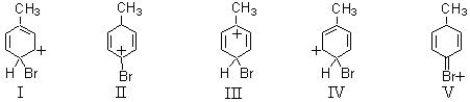
(Multiple Choice)
4.9/5 (75)
(75) Which alkyl halide can undergo both SN1 and SN2 reactions in nonacidic solvents?
(Multiple Choice)
4.8/5 (93)
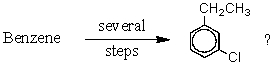
(93) 

Filters
- Essay(0)
- Multiple Choice(0)
- Short Answer(0)
- True False(0)
- Matching(0)