



 Chat with AI
Exam 8: Price Ceilings and Floors

Exam 1: The Big Ideas253 Questions
Exam 2: The Power of Trade and Comparative239 Questions
Exam 3: Supply and Demand249 Questions
Exam 4: Equilibrium256 Questions
Exam 5: Elasticity and Its Applications271 Questions
Exam 6: Taxes and Subsidies225 Questions
Exam 7: The Price System275 Questions
Exam 8: Price Ceilings and Floors327 Questions
Exam 9: International Trade195 Questions
Exam 10: Externalities- When the Price Is Not Right273 Questions
Exam 11: Costs and Profit Maximization Under Competition217 Questions
Exam 12: Competition and the Invisible Hand144 Questions
Exam 13: Monopoly233 Questions
Exam 14: Price Discrimination262 Questions
Exam 15: Oligopoly and Game Theory218 Questions
Exam 16: Competing for Monopoly160 Questions
Exam 17: Monopolistic Competition and Advertising113 Questions
Exam 18: Labor Markets262 Questions
Exam 19: Public Goods and the Tragedy of the Commons244 Questions
Exam 20: Political Economy and Public Choice306 Questions
Exam 21: Economics, Ethics, and Public Policy241 Questions
Exam 22: Managing Incentives263 Questions
Exam 23: Stock Markets and Personal Finance271 Questions
Exam 24: Price Discrimination151 Questions
Exam 25: Consumer Choice145 Questions
Select questions type


Use the following to answer questions:
Figure: Government Price Controls  -(Figure: Government Price Controls) Refer to the figure. The government enacts a price control causing a shortage of 15 units of the good. Therefore, the ________ is set at ________.
 (Multiple Choice)
4.7/5  (68)
(68) The U.S. government establishes a price floor of $1,000 on personal computers. The market price for netbooks (personal computers that specialize in Internet and other basic computer functions) is about $500. How would this price control affect the netbook market?
(Multiple Choice)
4.7/5 (80)
(80) Likely the most significant example of federal price controls in the United States, in terms of value of regulated market, came in the market for:
(Multiple Choice)
4.8/5 (71)
(71) Use the following to answer question 96:
Figure: Supply and Demand 3 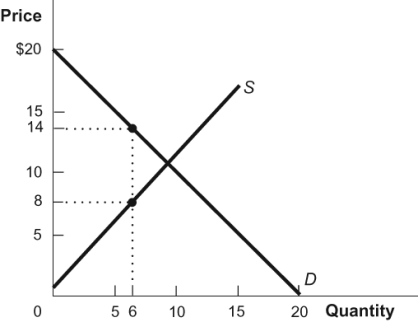 -(Figure: Supply and Demand 3) Refer to the figure. If the government sets a price ceiling at $8 in this figure, it will create a deadweight loss of:
 (Multiple Choice)
4.8/5 (75)
(75) Price controls such as those instituted by President Richard Nixon in 1971 led to severe shortages in many markets across the United States.
(True/False)
4.9/5 (69)
(69) Use the following to answer questions:
Figure: Effects of Price Ceilings  -(Figure: Effects of Price Ceilings) Refer to the figure. Suppose that the data represent the retail gasoline market. At a price ceiling of $2, the total value of wasted time from waiting in line is:
 (Multiple Choice)
4.9/5 (71)
(71) Illustrate on a supply and demand diagram how price ceilings may distort the market outcome and specify what secondary effects price ceilings can create.
(Essay)
4.8/5 (78)
(78) Use the following to answer questions:
Figure: Price Floor 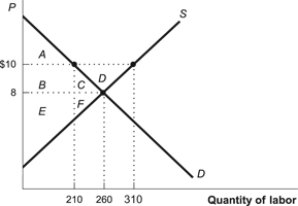 -(Figure: Price Floor) Refer to the figure. How much unemployment results from the imposition of a price floor set at $10?
 (Multiple Choice)
4.8/5 (68)
(68) In the presence of a price floor, some suppliers are willing to take a lower price for their goods, but these trades never take place because they are illegal. This illustrates the problem of misallocation of resources.
(True/False)
4.8/5 (73)
(73) Use the following to answer questions:
Figure: Labor Market 1  -(Figure: Labor Market 1) Refer to the figure. If there is a price ceiling set at $6, how much shortage or surplus, if any, is there?
 (Multiple Choice)
4.7/5 (89)
(89) Although a minimum wage increases unemployment, it doesn't create a deadweight loss.
(True/False)
4.7/5 (68)
(68) Figure: Labor Market 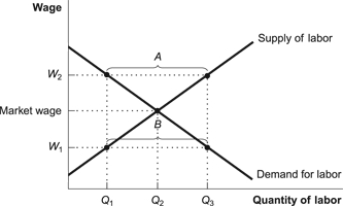 Refer to the figure. Which statement is correct?
 (Multiple Choice)
4.8/5 (89)
(89) The blat economy described in the text results when price controls are:
(Multiple Choice)
4.8/5 (85)
(85) Regulation of entry in the airline industry increased costs and reduced innovation.
(True/False)
4.9/5 (78)
(78) When the maximum legal price is below the market price we say that there is a price:
(Multiple Choice)
5.0/5 (77)
(77) Mobile homes are housing units installed on a permanent foundation owned by a landlord. Although a resident owns the home, she rents the foundation from the landlord. In theory, owners of mobile homes can transfer their home to a different foundation if the rent becomes too steep, but uninstalling, transporting, and reinstalling the mobile home is usually prohibitively expensive. This "lock-in" effect encourages state legislatures to create rent controls for mobile home foundations. Which statement is a plausible, unintended consequence of these laws?
(Multiple Choice)
4.9/5 (84)
(84) Why do you think full-service gas stations have largely disappeared across the United States?
(Multiple Choice)
4.9/5 (76)
(76) 
Filters
- Essay(0)
- Multiple Choice(0)
- Short Answer(0)
- True False(0)
- Matching(0)