



 Chat with AI
Exam 8: Price Ceilings and Floors

Exam 1: The Big Ideas253 Questions
Exam 2: The Power of Trade and Comparative239 Questions
Exam 3: Supply and Demand249 Questions
Exam 4: Equilibrium256 Questions
Exam 5: Elasticity and Its Applications271 Questions
Exam 6: Taxes and Subsidies225 Questions
Exam 7: The Price System275 Questions
Exam 8: Price Ceilings and Floors327 Questions
Exam 9: International Trade195 Questions
Exam 10: Externalities- When the Price Is Not Right273 Questions
Exam 11: Costs and Profit Maximization Under Competition217 Questions
Exam 12: Competition and the Invisible Hand144 Questions
Exam 13: Monopoly233 Questions
Exam 14: Price Discrimination262 Questions
Exam 15: Oligopoly and Game Theory218 Questions
Exam 16: Competing for Monopoly160 Questions
Exam 17: Monopolistic Competition and Advertising113 Questions
Exam 18: Labor Markets262 Questions
Exam 19: Public Goods and the Tragedy of the Commons244 Questions
Exam 20: Political Economy and Public Choice306 Questions
Exam 21: Economics, Ethics, and Public Policy241 Questions
Exam 22: Managing Incentives263 Questions
Exam 23: Stock Markets and Personal Finance271 Questions
Exam 24: Price Discrimination151 Questions
Exam 25: Consumer Choice145 Questions
Select questions type


Use the following to answer questions:
Figure: Price Ceilings and Random Allocation 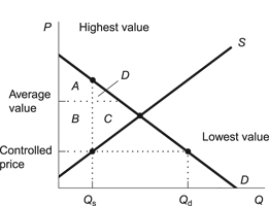 -(Figure: Price Ceilings and Random Allocation) Refer to the figure. When a controlled price is imposed and the quantity of goods is allocated randomly between the highest-valued uses and lowest-valued uses, loss due to random allocation instead of allocation to the highest-valued use is represented by area:
 (Multiple Choice)
4.8/5  (71)
(71) The minimum wage causes unemployment mainly among poor, unskilled workers.
(True/False)
4.9/5 (77)
(77) Even though shortages typically result from the imposition of price ceilings, the overall gains in economic efficiency outweigh the costs.
(True/False)
4.9/5 (69)
(69) In 1972-1973, the swimming pools in California were heated but homes in New Jersey were cold, is an example of a(n):
(Multiple Choice)
4.9/5 (73)
(73) The Civil Aeronautics Board regulated airline fares above the free-market rates, which led airlines to compete by offering fancy meals, wide seats, and frequent flights.
(True/False)
4.7/5 (72)
(72) Businesses may respond to price ceilings by closing down, reducing product quality, and by accepting bribes to sell their product.
(True/False)
4.9/5 (84)
(84) Many times after natural disasters such as hurricanes, prices are controlled so that it is illegal to charge any price greater than "pre-hurricane" levels. For consumers who value these goods very highly, is this a good policy? If prices were allowed to increase, what do you think would happen to supply of these highly valued goods? Explain.
(Essay)
5.0/5 (76)
(76) Which would MOST LIKELY result after setting a price ceiling on automobiles?
(Multiple Choice)
4.8/5 (72)
(72) The statement that "price controls do not eliminate competition":
(Multiple Choice)
4.8/5 (77)
(77) Which would be the least likely result of a price ceiling imposed in the market for gasoline?
(Multiple Choice)
4.9/5 (85)
(85) Price floors make it illegal to compete for more customers by lowering prices, so firms compete by offering customers:
(Multiple Choice)
4.8/5 (79)
(79) Economists call the maximum legal price a price ceiling because the price:
(Multiple Choice)
5.0/5 (94)
(94) In the case of a nonbinding price floor, the price paid in the market will be:
(Multiple Choice)
4.8/5 (77)
(77) Figure: Supply and Demand 1  Refer to figure. If, in this figure, the government enacts a price ______ by setting the good's price at $6, it will create a ______.
 (Multiple Choice)
4.8/5 (79)
(79) 
Filters
- Essay(0)
- Multiple Choice(0)
- Short Answer(0)
- True False(0)
- Matching(0)