



 Chat with AI
Exam 8: Price Ceilings and Floors

Exam 1: The Big Ideas253 Questions
Exam 2: The Power of Trade and Comparative239 Questions
Exam 3: Supply and Demand249 Questions
Exam 4: Equilibrium256 Questions
Exam 5: Elasticity and Its Applications271 Questions
Exam 6: Taxes and Subsidies225 Questions
Exam 7: The Price System275 Questions
Exam 8: Price Ceilings and Floors327 Questions
Exam 9: International Trade195 Questions
Exam 10: Externalities- When the Price Is Not Right273 Questions
Exam 11: Costs and Profit Maximization Under Competition217 Questions
Exam 12: Competition and the Invisible Hand144 Questions
Exam 13: Monopoly233 Questions
Exam 14: Price Discrimination262 Questions
Exam 15: Oligopoly and Game Theory218 Questions
Exam 16: Competing for Monopoly160 Questions
Exam 17: Monopolistic Competition and Advertising113 Questions
Exam 18: Labor Markets262 Questions
Exam 19: Public Goods and the Tragedy of the Commons244 Questions
Exam 20: Political Economy and Public Choice306 Questions
Exam 21: Economics, Ethics, and Public Policy241 Questions
Exam 22: Managing Incentives263 Questions
Exam 23: Stock Markets and Personal Finance271 Questions
Exam 24: Price Discrimination151 Questions
Exam 25: Consumer Choice145 Questions
Select questions type


An alternative to rent control that has been used in some cities since the 1990s is:
(Multiple Choice)
4.9/5  (80)
(80) If the minimum wage is lowered and closer to the market level, the:
(Multiple Choice)
4.8/5 (84)
(84) Use the following to answer questions:
Figure: Price Ceiling  -(Figure: Price Ceiling) Refer to the figure. A price ceiling of $10 results in a:
 (Multiple Choice)
4.8/5 (95)
(95) Which is the MOST correct statement about the impact of rent controls?
(Multiple Choice)
4.9/5 (84)
(84) Rent controls create large shortages in the long run rather than the short run because the long-run supply curve for apartments is inelastic.
(True/False)
4.7/5 (83)
(83) Use the following to answer questions:
Figure: Effects of Price Ceilings  -(Figure: Effects of Price Ceilings) Refer to the figure. At a price ceiling of $2:
 (Multiple Choice)
4.8/5 (73)
(73) Figure: Allocating Goods under Price Ceilings 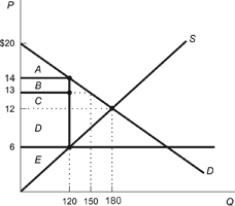 Refer to the figure. Using the information provided in the graph, answer the following questions:
a. If the goods were allocated only to those users who had the highest-value uses, find the total dollar amount of consumer surplus.
b. If the goods are allocated randomly between the high-value uses and the low-value uses, then what is the average value of the good?
c. If goods are allocated randomly, what is the total dollar amount of consumer surplus?
Refer to the figure. Using the information provided in the graph, answer the following questions:
a. If the goods were allocated only to those users who had the highest-value uses, find the total dollar amount of consumer surplus.
b. If the goods are allocated randomly between the high-value uses and the low-value uses, then what is the average value of the good?
c. If goods are allocated randomly, what is the total dollar amount of consumer surplus? (Essay)
4.9/5 (86)
(86) Vietnam's foreign minister said, "The Americans couldn't destroy Hanoi, but we have destroyed our city by very low rents." He was referring to the fact that:
(Multiple Choice)
4.8/5 (82)
(82) If a price floor is above the equilibrium price it will have no effect in the market.
(True/False)
4.7/5 (72)
(72) Use the following to answer questions:
Figure: Losses from Price Ceilings  -(Figure: Losses from Price Ceilings) Refer to the figure. At a price ceiling of $1, the area representing the total value of wasted time is ________, and the area of the deadweight loss is ________.
 (Multiple Choice)
5.0/5 (80)
(80) Figure: Labor Market 2 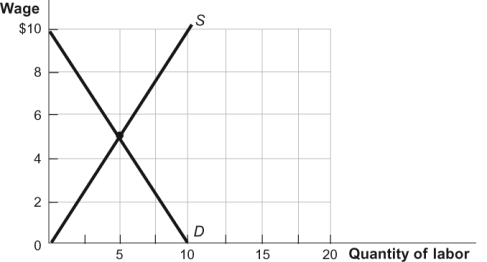 Refer to the figure. In the figure, there will be 6 unemployed workers at a minimum wage of:
 (Multiple Choice)
4.9/5 (75)
(75) Price controls cause resources to be ________ not just geographically, but also across different ________ of those resources.
(Multiple Choice)
4.8/5 (74)
(74) Illustrate on a demand and supply diagram how the existence of a price floor would distort the market outcome, and specify what effect (i.e., shortage or surplus) the price floor may create.
(Essay)
5.0/5 (77)
(77) In Puerto Rico in 1938, the market wage was 3¢ to 4¢ per hour when Congress passed a law raising it to 25¢ per hour. Workers in Puerto Rico were:
(Multiple Choice)
4.9/5 (75)
(75) The lower the price ceiling is relative to the market equilibrium price, the:
(Multiple Choice)
4.8/5 (96)
(96) Prices ceilings misallocate resources because with them resources are not necessarily allocated to their highest-valued use.
(True/False)
4.8/5 (79)
(79) 
Filters
- Essay(0)
- Multiple Choice(0)
- Short Answer(0)
- True False(0)
- Matching(0)