



 Chat with AI
Exam 8: Price Ceilings and Floors

Exam 1: The Big Ideas253 Questions
Exam 2: The Power of Trade and Comparative239 Questions
Exam 3: Supply and Demand249 Questions
Exam 4: Equilibrium256 Questions
Exam 5: Elasticity and Its Applications271 Questions
Exam 6: Taxes and Subsidies225 Questions
Exam 7: The Price System275 Questions
Exam 8: Price Ceilings and Floors327 Questions
Exam 9: International Trade195 Questions
Exam 10: Externalities- When the Price Is Not Right273 Questions
Exam 11: Costs and Profit Maximization Under Competition217 Questions
Exam 12: Competition and the Invisible Hand144 Questions
Exam 13: Monopoly233 Questions
Exam 14: Price Discrimination262 Questions
Exam 15: Oligopoly and Game Theory218 Questions
Exam 16: Competing for Monopoly160 Questions
Exam 17: Monopolistic Competition and Advertising113 Questions
Exam 18: Labor Markets262 Questions
Exam 19: Public Goods and the Tragedy of the Commons244 Questions
Exam 20: Political Economy and Public Choice306 Questions
Exam 21: Economics, Ethics, and Public Policy241 Questions
Exam 22: Managing Incentives263 Questions
Exam 23: Stock Markets and Personal Finance271 Questions
Exam 24: Price Discrimination151 Questions
Exam 25: Consumer Choice145 Questions
Select questions type


Airline regulation from 1938 to 1978 was successful in keeping prices high because:
(Multiple Choice)
4.8/5  (70)
(70) President Richard Nixon froze all prices and wages in 1971, which led to shortages of goods throughout the economy.
(True/False)
4.9/5 (68)
(68) Use the following to answer questions:
Figure: Losses from Price Ceilings  -(Figure: Losses from Price Ceilings) Refer to the figure. A price ceiling of $1 causes lost consumer surplus equal to area ________, and lost producer surplus equal to area ________.
 (Multiple Choice)
4.9/5 (85)
(85) During the 1970s, the 11-tier oil production definitions came into play because of firms' attempts to bypass regulations and produce decontrolled oil.
(True/False)
4.7/5 (73)
(73) If price controls are so harmful, why would a country ever impose them?
(Multiple Choice)
4.9/5 (81)
(81) Housing shortages caused by rent controls are larger in the long run because the supply of housing is more elastic in the long run.
(True/False)
4.8/5 (77)
(77) When the price of gasoline rose to $4 per gallon in the summer of 2008, many people were outraged at how gas companies were "price gouging" individuals, and called for price controls on gasoline. If the government had agreed to legally cap the price of gasoline, would this have lowered the cost to consumers? Explain.
(Essay)
4.7/5 (89)
(89) If a seller facing excess demand is unable to raise the price of the good due to a price ceiling, the seller might:
(Multiple Choice)
4.9/5 (95)
(95) Which of these statements explains why price ceilings result in lost gains from trade?
(Multiple Choice)
4.9/5 (75)
(75) A market with price ceilings fails to maximize all of the following EXCEPT:
(Multiple Choice)
4.9/5 (91)
(91) Figure: Minimum Wage for Country A 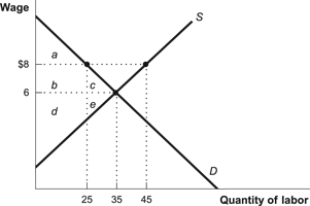 Refer to the figure. The deadweight loss from the $8 minimum wage is area:
 (Multiple Choice)
4.8/5 (78)
(78) If prices are not allowed to rise because of a price ceiling, then:
(Multiple Choice)
4.8/5 (79)
(79) (Figure: Labor Market 3 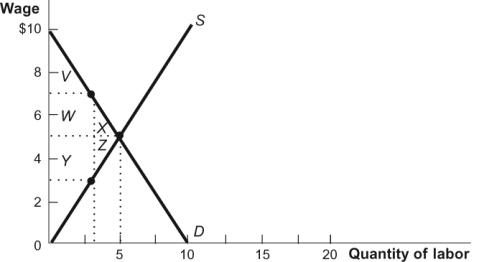 Refer to the figure. In the diagram, a minimum wage of $7 causes a deadweight loss of:
 (Multiple Choice)
4.8/5 (72)
(72) Which statement(s) is TRUE?
I. Regulations that limit the rate of increase in rents are equally as inefficient as rent controls.
II. Rent regulations reduce the incentive for landlords to cut back on maintenance.
III. Regulations that limit the rate of increase in rents allow the price of rental housing to respond to market forces.
(Multiple Choice)
4.8/5 (75)
(75) When an effective price ceiling causes a shortage, some of the buyers who value the good the most may not be able to get the good. Why does this occur?
(Multiple Choice)
4.8/5 (74)
(74) In Ancient Egypt, the "Bronze Law" set maximum prices for wages, preventing them from rising above what rulers perceived as the minimum needed to survive. If this was 10¢ a day for a porter (someone who carries things short distances) and the market wage was 8¢ a day, which of the following would be a plausible consequence of this law?
(Multiple Choice)
4.8/5 (72)
(72) When he was president, Richard Nixon froze all prices and wages in the United States.
(True/False)
4.8/5 (86)
(86) 
Filters
- Essay(0)
- Multiple Choice(0)
- Short Answer(0)
- True False(0)
- Matching(0)