



 Chat with AI
Exam 8: Price Ceilings and Floors

Exam 1: The Big Ideas253 Questions
Exam 2: The Power of Trade and Comparative239 Questions
Exam 3: Supply and Demand249 Questions
Exam 4: Equilibrium256 Questions
Exam 5: Elasticity and Its Applications271 Questions
Exam 6: Taxes and Subsidies225 Questions
Exam 7: The Price System275 Questions
Exam 8: Price Ceilings and Floors327 Questions
Exam 9: International Trade195 Questions
Exam 10: Externalities- When the Price Is Not Right273 Questions
Exam 11: Costs and Profit Maximization Under Competition217 Questions
Exam 12: Competition and the Invisible Hand144 Questions
Exam 13: Monopoly233 Questions
Exam 14: Price Discrimination262 Questions
Exam 15: Oligopoly and Game Theory218 Questions
Exam 16: Competing for Monopoly160 Questions
Exam 17: Monopolistic Competition and Advertising113 Questions
Exam 18: Labor Markets262 Questions
Exam 19: Public Goods and the Tragedy of the Commons244 Questions
Exam 20: Political Economy and Public Choice306 Questions
Exam 21: Economics, Ethics, and Public Policy241 Questions
Exam 22: Managing Incentives263 Questions
Exam 23: Stock Markets and Personal Finance271 Questions
Exam 24: Price Discrimination151 Questions
Exam 25: Consumer Choice145 Questions
Select questions type


The poor state of the economy was the dominant factor that caused the fall in the number of new apartments built in Ontario, Canada, during the first half of the 1970s.
(True/False)
4.8/5  (82)
(82) Use the following to answer questions:
Figure: Minimum Wage 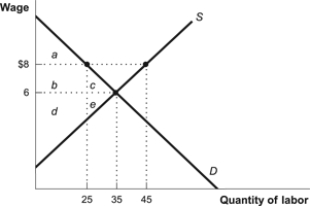 -(Figure: Minimum Wage) Refer to the figure. How many workers are unemployed at a minimum wage of $8?
 (Multiple Choice)
4.9/5 (71)
(71) During the energy crisis of the 1970s, President Nixon ordered gas stations to close between 9:00 PM Saturday and 12:01 AM Monday, in an attempt to prevent wasteful and unnecessary Sunday driving. This policy:
(Multiple Choice)
5.0/5 (86)
(86) Ben is willing to work for $4/hour and an employer is willing to hire Ben for $7/hour. Which statements is TRUE?
(Multiple Choice)
4.8/5 (73)
(73) Use the following to answer questions:
Figure: Effects of Price Ceilings  -(Figure: Effects of Price Ceilings) Refer to the figure. At a price ceiling of $2 per unit, consumers are willing to pay a maximum of:
 (Multiple Choice)
4.9/5 (83)
(83) Use the following to answer questions:
Figure: Price Controls  -(Figure: Price Controls) Refer to the figure. If the government imposes a price ceiling in this market at a price of $6, the result would be a:
 (Multiple Choice)
4.9/5 (74)
(74) If there are 100 tickets to a concert and 200 fans who would like to go to the concert, each placing a slightly different value on the tickets, is it more efficient to hold an auction for the tickets or to hold a random drawing for the tickets?
(Multiple Choice)
4.9/5 (84)
(84) A price ceiling creates a ________ when it is set ________.
(Multiple Choice)
4.9/5 (83)
(83) Because of government price controls, a business must now sell soft-serve ice cream at half its original price. This business might respond by:
(Multiple Choice)
4.8/5 (84)
(84) Dramatic price increases, such as those seen in the markets for gas and oil in the 1970s, are typically the result of:
(Multiple Choice)
4.8/5 (78)
(78) When the maximum legal price is set below the market price then:
I. a price floor is in effect.
II. a shortage will develop.
III. there will be lost gains from trade.
IV. there will be no impact on the quantity demanded or supplied.
(Multiple Choice)
4.9/5 (86)
(86) If affordable housing is a concern, then a better policy than rent controls may be for the government to provide:
(Multiple Choice)
4.7/5 (84)
(84) 
Filters
- Essay(0)
- Multiple Choice(0)
- Short Answer(0)
- True False(0)
- Matching(0)