



 Chat with AI
Exam 11: Oxidative Phosphorylation

Exam 1: Principles of Biochemistry98 Questions
Exam 2: Physical Biochemistry: Energy Conversion,water,and Membranes99 Questions
Exam 3: Nucleic Acid Structure and Function100 Questions
Exam 4: Protein Structure100 Questions
Exam 5: Methods in Protein Biochemistry98 Questions
Exam 6: Protein Function113 Questions
Exam 7: Enzyme Mechanisms105 Questions
Exam 8: Cell Signaling Systems102 Questions
Exam 9: Glycolysis: a Paradigm of Metabolic Regulation100 Questions
Exam 10: The Citrate Cycle100 Questions
Exam 11: Oxidative Phosphorylation98 Questions
Exam 12: Photosynthesis100 Questions
Exam 13: Carbohydrate Structure and Function100 Questions
Exam 14: Carbohydrate Metabolism100 Questions
Exam 15: Lipid Structure and Function98 Questions
Exam 16: Lipid Metabolism100 Questions
Exam 17: Amino Acid Metabolism100 Questions
Exam 18: Nucleotide Metabolism98 Questions
Exam 19: Metabolic Integration101 Questions
Exam 20: Dna Replication, repair, and Recombination99 Questions
Exam 21: Rna Synthesis, processing, and Gene Silencing100 Questions
Exam 22: Protein Synthesis, posttranslational Modification, and Transport100 Questions
Exam 23: Gene Regulation99 Questions
Select questions type


Which statement is true of the mitochondrial electron transport system?
(Multiple Choice)
4.8/5  (78)
(78) As electrons from NADH pass through the electron transport system,
(Multiple Choice)
4.8/5 (79)
(79) The last enzyme in the electron transport system,where O2 is reduced to water,is called
(Multiple Choice)
4.9/5 (79)
(79) Studies of the inner mitochondrial membrane reveal its composition to be approximately 20% lipid bilayer and 80% protein.What is true of these proteins?
(Multiple Choice)
4.9/5 (78)
(78) What is the driving force for ATP synthesis by the ATP synthase enzyme?
(Multiple Choice)
4.7/5 (92)
(92) Submitochondrial particles are inside-out pieces of the inner mitochondrial membrane formed through the sonication of mitochondria.Draw a diagram of these inside-out particles clearly showing (A)where electron transport from NADH occurs,(B)the direction of proton pumping,(C)the location of ATP synthesis,and (D)where O2 reacts.
(Essay)
4.9/5 (81)
(81) The free energy released from the electron transport system reaction NADH + 1/2 O2 + H+  H2O + NAD+ is
 '= -220 kJ/mol.How many moles of ATP could theoretically be made assuming 100% efficiency in energy coupling through the chemiosmotic theory,and that ADP+Pi
 ATP
 '= 30.5 kJ/mol?
H2O + NAD+ is '= -220 kJ/mol.How many moles of ATP could theoretically be made assuming 100% efficiency in energy coupling through the chemiosmotic theory,and that ADP+Pi ATP '= 30.5 kJ/mol? (Essay)
4.7/5 (74)
(74) The __________ causes the catalytic headpiece of ATP synthase to change conformation.
(Multiple Choice)
4.7/5 (82)
(82) What is the fate of NADH after it donates its electrons to the electron transport system?
(Multiple Choice)
5.0/5 (81)
(81) Use the table below to answer the question. 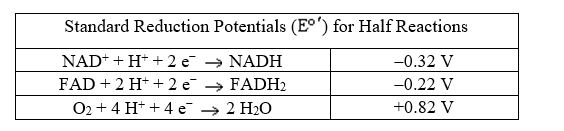 In the direction indicated,which of the following reactions are thermodynamically favored?
I.NAD+ + H2O
 O2 + NADH
II.FADH2 + H2O
 O2 + FAD
III.NADH + O2
 H2O + NAD+
In the direction indicated,which of the following reactions are thermodynamically favored?
I.NAD+ + H2O O2 + NADH
II.FADH2 + H2O O2 + FAD
III.NADH + O2 H2O + NAD+ (Multiple Choice)
4.9/5 (84)
(84) The first enzyme in the electron transport system is referred to as complex I,otherwise known as
(Multiple Choice)
4.9/5 (76)
(76) For each molecule below,list the number of ATP obtained assuming that the electron transport chain and oxidative phosphorylation are active.
NADH (from the TCA cycle)
FADH2 (from the TCA cycle)
NADH (from the cytoplasm,malate aspartate shuttle)
NAD+ (from the mitochondria)
(Essay)
4.8/5 (90)
(90) For one electron entering the electron transport chain at complex I,how many times is it handed off between redox active cofactors on its way through the enzyme complexes to end up on O2?
(Multiple Choice)
4.9/5 (88)
(88) How many ATPs are obtained from one acetyl-CoA run once through the TCA cycle,assuming that all resulting NADH and FADH2 is used by the electron transport chain and oxidative phosphorylation to make ATP?
(Multiple Choice)
4.8/5 (83)
(83) If the mitochondrial ATP synthase were inhibited,but the electron transport chain was allowed to run continuously,the pH of the cytoplasm would
(Multiple Choice)
4.9/5 (82)
(82) The ATP synthase enzyme contains a central stalk embedded in the mitochondrial membrane.What part of this stalk rotates?
(Multiple Choice)
4.8/5 (98)
(98) Approximately how many more ATPs are made from one glucose molecule under aerobic conditions with oxidative phosphorylation than under anaerobic conditions?
(Multiple Choice)
4.9/5 (72)
(72) 
Filters
- Essay(0)
- Multiple Choice(0)
- Short Answer(0)
- True False(0)
- Matching(0)