



 Chat with AI
Exam 17: Amino Acid Metabolism

Exam 1: Principles of Biochemistry98 Questions
Exam 2: Physical Biochemistry: Energy Conversion,water,and Membranes99 Questions
Exam 3: Nucleic Acid Structure and Function100 Questions
Exam 4: Protein Structure100 Questions
Exam 5: Methods in Protein Biochemistry98 Questions
Exam 6: Protein Function113 Questions
Exam 7: Enzyme Mechanisms105 Questions
Exam 8: Cell Signaling Systems102 Questions
Exam 9: Glycolysis: a Paradigm of Metabolic Regulation100 Questions
Exam 10: The Citrate Cycle100 Questions
Exam 11: Oxidative Phosphorylation98 Questions
Exam 12: Photosynthesis100 Questions
Exam 13: Carbohydrate Structure and Function100 Questions
Exam 14: Carbohydrate Metabolism100 Questions
Exam 15: Lipid Structure and Function98 Questions
Exam 16: Lipid Metabolism100 Questions
Exam 17: Amino Acid Metabolism100 Questions
Exam 18: Nucleotide Metabolism98 Questions
Exam 19: Metabolic Integration101 Questions
Exam 20: Dna Replication, repair, and Recombination99 Questions
Exam 21: Rna Synthesis, processing, and Gene Silencing100 Questions
Exam 22: Protein Synthesis, posttranslational Modification, and Transport100 Questions
Exam 23: Gene Regulation99 Questions
Select questions type


During vigorous anaerobic exercise,glycogen degradation leads to the buildup of pyruvate.How does the alanine-glucose cycle prevent a toxic buildup?

Free
(Essay)
4.8/5  (77)
(77) Correct Answer: Verified
The alanine-glucose cycle removes excess nitrogen from muscle cells,using alanine as the carrier.The alanine aminotransferase reaction in liver cells removes the nitrogen from alanine to generate pyruvate and glutamate.The pyruvate is then used to produce glucose via gluconeogenesis,and the glucose is exported back to muscle cells,where it can be used as a source of energy for muscle contraction or converted to glycogen
Alkaptonuria is a disease coming from a deficiency in which pathway?
Free
(Multiple Choice)
4.7/5 (72)
(72) Correct Answer:Verified
VerifiedC
What would the products be for the reaction below? 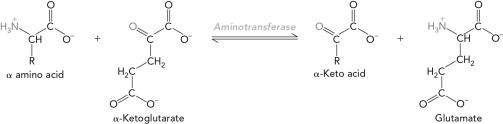
Free
(Multiple Choice)
4.9/5 (88)
(88) Correct Answer:Verified
VerifiedA
How is carbamoyl phosphate synthetase I allosterically regulated in the urea cycle?
(Essay)
5.0/5 (82)
(82) If no NAD+ was available,the group 2 amino acid degradation pathway would experience a 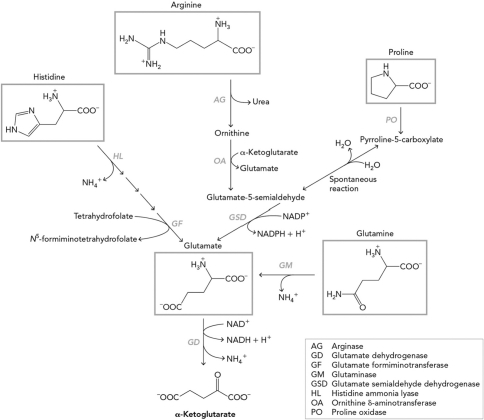
(Multiple Choice)
4.9/5 (84)
(84) In the absence of ATP for glutamine synthetase to use,what would happen to the concentration of glutamine in the cell?
(Multiple Choice)
4.7/5 (75)
(75) Bacteria in the genus Nitrosomonas are able to oxidize ammonia to what final product?
(Multiple Choice)
4.7/5 (86)
(86) It is important that proteolytic enzymes in the lysosome are optimized to work at low pH because low pH
(Multiple Choice)
4.7/5 (77)
(77) How does atmospheric fixation occur given the high energy barrier to convert nitrogen to nitrogen oxides?
(Multiple Choice)
4.8/5 (91)
(91) Distinguish between the first and second stages of the aminotransferase reaction.
(Essay)
4.8/5 (84)
(84) Using the figure below,determine which of the following is NOT a final product from group 1 amino acid degradation. 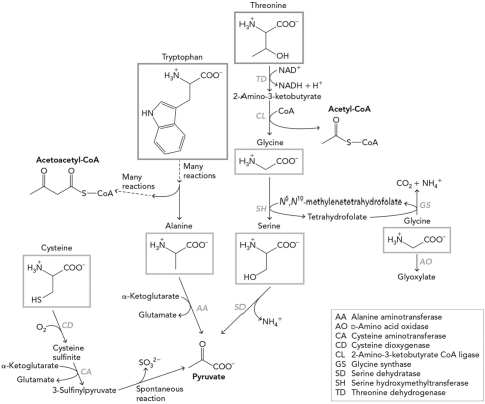
(Multiple Choice)
4.8/5 (81)
(81) The 10 amino acids that animals need to take in through their diet are called the __________ amino acids.
(Multiple Choice)
4.7/5 (90)
(90) What specific characteristic must a target protein have to be recognized by an ubiquitinating protein?
(Multiple Choice)
5.0/5 (80)
(80) Aspartate is a(n)__________ amino acid,so if a person had a diet that contained no aspartate,__________.
(Multiple Choice)
4.8/5 (73)
(73) 
Filters
- Essay(0)
- Multiple Choice(0)
- Short Answer(0)
- True False(0)
- Matching(0)