



 Chat with AI
Exam 11: Oxidative Phosphorylation

Exam 1: Principles of Biochemistry98 Questions
Exam 2: Physical Biochemistry: Energy Conversion,water,and Membranes99 Questions
Exam 3: Nucleic Acid Structure and Function100 Questions
Exam 4: Protein Structure100 Questions
Exam 5: Methods in Protein Biochemistry98 Questions
Exam 6: Protein Function113 Questions
Exam 7: Enzyme Mechanisms105 Questions
Exam 8: Cell Signaling Systems102 Questions
Exam 9: Glycolysis: a Paradigm of Metabolic Regulation100 Questions
Exam 10: The Citrate Cycle100 Questions
Exam 11: Oxidative Phosphorylation98 Questions
Exam 12: Photosynthesis100 Questions
Exam 13: Carbohydrate Structure and Function100 Questions
Exam 14: Carbohydrate Metabolism100 Questions
Exam 15: Lipid Structure and Function98 Questions
Exam 16: Lipid Metabolism100 Questions
Exam 17: Amino Acid Metabolism100 Questions
Exam 18: Nucleotide Metabolism98 Questions
Exam 19: Metabolic Integration101 Questions
Exam 20: Dna Replication, repair, and Recombination99 Questions
Exam 21: Rna Synthesis, processing, and Gene Silencing100 Questions
Exam 22: Protein Synthesis, posttranslational Modification, and Transport100 Questions
Exam 23: Gene Regulation99 Questions
Select questions type


What is the reaction catalyzed by complex III in the electron transport system?
(Multiple Choice)
4.8/5  (79)
(79) The structure of the electron transport system protein called cytochrome c is highly conserved in nature because the
(Multiple Choice)
4.8/5 (73)
(73) On the left hand side of the figure,label the regions above and below the lipid membrane assuming the process occurs in mitochondria.On the right hand side,label the regions assuming the process occurs in chloroplasts. 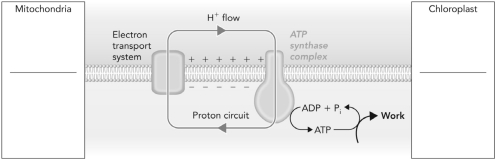
(Essay)
4.8/5 (61)
(61) Use the structure of the oxidized coenzyme Q (ubiquinone)shown below and draw the two-electron reduced form. 
(Essay)
4.8/5 (79)
(79) What is the primary fuel metabolized by the mitochondria in brown adipose tissue of hibernating animals?
(Multiple Choice)
4.8/5 (85)
(85) How many ATPs are produced from the complete metabolism of one glucose molecule,assuming that all resulting NADH and FADH2 is used by the electron transport chain and oxidative phosphorylation to make ATP?
(Multiple Choice)
4.8/5 (76)
(76) On the figure below label the clearly identify the positions of the three functional units of ATP synthase: the rotor,the catalytic headpiece,and the stator. 
(Essay)
4.9/5 (76)
(76) Which of the following is an electron carrier in the mitochondrial electron transport system?
(Multiple Choice)
4.9/5 (85)
(85) Which directions across the mitochondria must H+,ATP,ADP,and Pi travel during active mitochondrial ATP synthesis?
(Essay)
4.8/5 (79)
(79) Describe the process by which proton flow through the c subunits forces the rotation of the ATP synthase spindle in the mitochondrial membrane.Please include the roles of aspartic acid residues and the half-channels in your description.
(Essay)
5.0/5 (79)
(79) What enzyme uses the proton motive force for its driving force?
(Multiple Choice)
4.8/5 (80)
(80) Which process or pathway describes the coupling of the oxidation reaction of NADH with the formation of ATP?
(Multiple Choice)
4.8/5 (88)
(88) Complex IV in the mitochondrial electron transport chain belongs to which enzyme class?
(Multiple Choice)
4.7/5 (72)
(72) Label the locations of  ,
 ,
 ,and c,and the F0 and F1 subunits on the following ATP synthase enzyme.

,
, ,and c,and the F0 and F1 subunits on the following ATP synthase enzyme. (Essay)
5.0/5 (80)
(80) Inhibitors of the electron transport system,such as cyanide (CN-)and carbon monoxide (CO),inhibit complex IV by binding to the heme iron cofactor.What is the resulting effect on oxidative phosphorylation?
(Multiple Choice)
5.0/5 (83)
(83) A decrease in __________ would be LEAST likely to affect the processes of the electron transport system.
(Multiple Choice)
4.9/5 (83)
(83) 
Filters
- Essay(0)
- Multiple Choice(0)
- Short Answer(0)
- True False(0)
- Matching(0)