



 Chat with AI
Exam 11: Oxidative Phosphorylation

Exam 1: Principles of Biochemistry98 Questions
Exam 2: Physical Biochemistry: Energy Conversion,water,and Membranes99 Questions
Exam 3: Nucleic Acid Structure and Function100 Questions
Exam 4: Protein Structure100 Questions
Exam 5: Methods in Protein Biochemistry98 Questions
Exam 6: Protein Function113 Questions
Exam 7: Enzyme Mechanisms105 Questions
Exam 8: Cell Signaling Systems102 Questions
Exam 9: Glycolysis: a Paradigm of Metabolic Regulation100 Questions
Exam 10: The Citrate Cycle100 Questions
Exam 11: Oxidative Phosphorylation98 Questions
Exam 12: Photosynthesis100 Questions
Exam 13: Carbohydrate Structure and Function100 Questions
Exam 14: Carbohydrate Metabolism100 Questions
Exam 15: Lipid Structure and Function98 Questions
Exam 16: Lipid Metabolism100 Questions
Exam 17: Amino Acid Metabolism100 Questions
Exam 18: Nucleotide Metabolism98 Questions
Exam 19: Metabolic Integration101 Questions
Exam 20: Dna Replication, repair, and Recombination99 Questions
Exam 21: Rna Synthesis, processing, and Gene Silencing100 Questions
Exam 22: Protein Synthesis, posttranslational Modification, and Transport100 Questions
Exam 23: Gene Regulation99 Questions
Select questions type


The electron transport chain component that transfers electrons directly to oxygen is
(Multiple Choice)
4.9/5  (77)
(77) The energy released during mitochondrial electron transport processes is used to
(Multiple Choice)
4.7/5 (77)
(77) In the mitochondrial electron transport system,the electron from NADH moves from __________ the mitochondria through the protein complexes to __________ the mitochondria.
(Multiple Choice)
4.8/5 (81)
(81) The resting state of the three  subunits in the ATP synthase enzyme is best described as
 (Multiple Choice)
4.8/5 (76)
(76) Add to the malate-aspartate shuttle scheme below the missing reactant and products a,b,c,and
d. 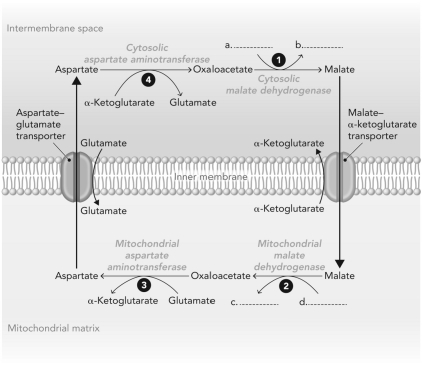
(Essay)
4.8/5 (72)
(72) The ultimate electron acceptor of the mitochondrial electron transport system is
(Multiple Choice)
4.9/5 (97)
(97) Draw a diagram of the mitochondrion and indicate which side of the organelle has a net positive charge and which side has a net negative charge as a result of proton pumping.
(Essay)
4.8/5 (73)
(73) Use the table below to (A)write out the balanced reaction between NADH and O2 that drives the electron transport system and (B)compute the standard reduction potential.
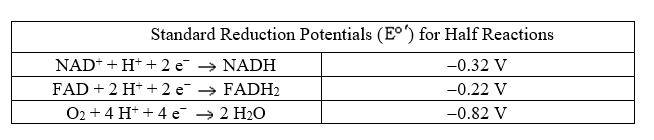
(Essay)
4.9/5 (100)
(100) Identify the correct order of electron transfers in the electron transport chain starting from FADH2.
(Multiple Choice)
4.8/5 (75)
(75) Which part of the native ATP synthase enzyme is stationary and does NOT rotate during ATP synthesis?
(Multiple Choice)
4.9/5 (81)
(81) Which reaction does the concept of oxidative phosphorylation refer to?
(Multiple Choice)
4.9/5 (94)
(94) Electrons from a succinate molecule can enter into the ETC and result in enough pumped protons to make how many ATPs?
(Multiple Choice)
4.7/5 (84)
(84) The structure of 2,4-dinitrophenol is shown below.Explain how it functions to uncouple a proton gradient across the mitochondrial membrane. 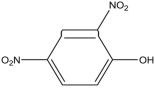
(Essay)
5.0/5 (91)
(91) In yeast,it is estimated that approximately __________ H+ are required by ATP synthase per ATP synthesized.
(Multiple Choice)
4.9/5 (74)
(74) Which animal would have the lowest levels of brown adipose tissue?
(Multiple Choice)
4.9/5 (76)
(76) What happens to patients given the proton gradient uncoupler 2,4-dinitrophenol?
(Multiple Choice)
5.0/5 (81)
(81) How are many mitochondrial diseases passed on from parents to offspring?
(Multiple Choice)
5.0/5 (77)
(77) The electron transport complexes found in the electron transport system
(Multiple Choice)
4.9/5 (71)
(71) 
Filters
- Essay(0)
- Multiple Choice(0)
- Short Answer(0)
- True False(0)
- Matching(0)