



 Chat with AI
Exam 22: Long-Run Economic Growth: Sources and Policies

Exam 1: Economics: Foundations and Models142 Questions
Exam 2: Trade-Offs, comparative Advantage, and the Market System152 Questions
Exam 3: Where Prices Come From: the Interaction of Demand and Supply149 Questions
Exam 4: Economic Efficiency, government Price Setting, and Taxes137 Questions
Exam 5: Externalities, environmental Policy, and Public Goods139 Questions
Exam 6: Elasticity: The Responsiveness of Demand and Supply149 Questions
Exam 7: The Economics of Health Care117 Questions
Exam 8: Firms, the Stock Market, and Corporate Governance140 Questions
Exam 9: Comparative Advantage and the Gains From International Trade124 Questions
Exam 10: Consumer Choice and Behavioral Economics154 Questions
Exam 11: Technology, production, and Costs174 Questions
Exam 12: Firms in Perfectly Competitive Markets153 Questions
Exam 13: Monopolistic Competition: The Competitive Model in a More Realistic Setting137 Questions
Exam 14: Oligopoly: Firms in Less Competitive Markets129 Questions
Exam 15: Monopoly and Antitrust Policy148 Questions
Exam 16: Pricing Strategy134 Questions
Exam 17: The Markets for Labor and Other Factors of Production149 Questions
Exam 18: Public Choice, taxes, and the Distribution of Income134 Questions
Exam 19: GDP: Measuring Total Production and Income135 Questions
Exam 20: Unemployment and Inflation148 Questions
Exam 21: Economic Growth, the Financial System, and Business Cycles130 Questions
Exam 22: Long-Run Economic Growth: Sources and Policies134 Questions
Exam 23: Aggregate Expenditure and Output in the Short Run157 Questions
Exam 24: Aggregate Demand and Aggregate Supply Analysis145 Questions
Exam 25: Money, banks, and the Federal Reserve System144 Questions
Exam 26: Monetary Policy145 Questions
Exam 27: Fiscal Policy155 Questions
Exam 28: Inflation, unemployment, and Federal Reserve Policy135 Questions
Exam 29: Macroeconomics in an Open Economy145 Questions
Exam 30: The International Financial System139 Questions
Select questions type


Figure 22-1 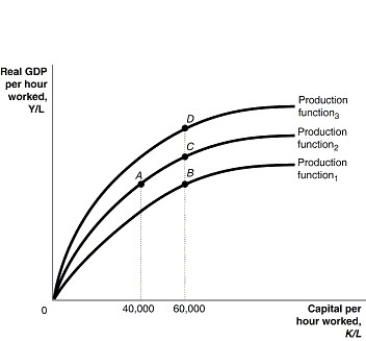 -Refer to Figure 22-1.Using the per-worker production function in the figure above,the largest changes in an economy's standard of living would be achieved by a movement from
A) A to B to C.
B) B to C to D.
C) C to B to A.
D) D to C to B.
-Refer to Figure 22-1.Using the per-worker production function in the figure above,the largest changes in an economy's standard of living would be achieved by a movement from
A) A to B to C.
B) B to C to D.
C) C to B to A.
D) D to C to B. (Not Answered)
This question doesn't have any answer yet
How do government policies that enforce property rights affect economic growth?
(Essay)
4.7/5  (84)
(84) Why do some economists point to a decline in the quality of labor as an explanation for the productivity slowdown in the mid-1970s?
(Multiple Choice)
4.9/5 (85)
(85) In 1973,the Club of Rome published a book titled The Limits to Growth,which predicted that economic growth would likely end in high-income countries because of
(Multiple Choice)
4.8/5 (73)
(73) In a small European country,it is estimated that changing the level of capital from $8 million to $10 million will increase real GDP from $2 million to $3 million.If the number of hours worked in the labor force does not change,what does this information tell you about the slope of the per-worker production function in this range?
(Multiple Choice)
4.8/5 (87)
(87) Which of the following is an example of the way the financial markets in the United States can encourage technological progress more efficiently than other countries?
(Multiple Choice)
4.9/5 (84)
(84) Because of diminishing returns,an economy can continue to increase real GDP per hour worked only if
(Multiple Choice)
4.9/5 (76)
(76) Human capital refers to the percentage of the working-age population in the labor force.
(True/False)
4.7/5 (88)
(88) Would you expect to see higher or lower growth rates for countries that start out with a relatively low level of real GDP per capita? Explain using the concept of "catch-up" and support your answer with a graph.
(Essay)
4.8/5 (68)
(68) Which of the following would you expect to result in faster economic growth?
(Multiple Choice)
4.8/5 (80)
(80) Foreign direct investment declined worldwide during the recession of 2007-2009.The decline in foreign direct investment in developing countries can make it more difficult for these countries to break out of the vicious cycle of low economic growth and
(Multiple Choice)
4.8/5 (82)
(82) According to Joseph Schumpeter,economic growth is achieved through
(Multiple Choice)
4.8/5 (86)
(86) 
Filters
- Essay(0)
- Multiple Choice(0)
- Short Answer(0)
- True False(0)
- Matching(0)