



 Chat with AI
Exam 22: Long-Run Economic Growth: Sources and Policies

Exam 1: Economics: Foundations and Models142 Questions
Exam 2: Trade-Offs, comparative Advantage, and the Market System152 Questions
Exam 3: Where Prices Come From: the Interaction of Demand and Supply149 Questions
Exam 4: Economic Efficiency, government Price Setting, and Taxes137 Questions
Exam 5: Externalities, environmental Policy, and Public Goods139 Questions
Exam 6: Elasticity: The Responsiveness of Demand and Supply149 Questions
Exam 7: The Economics of Health Care117 Questions
Exam 8: Firms, the Stock Market, and Corporate Governance140 Questions
Exam 9: Comparative Advantage and the Gains From International Trade124 Questions
Exam 10: Consumer Choice and Behavioral Economics154 Questions
Exam 11: Technology, production, and Costs174 Questions
Exam 12: Firms in Perfectly Competitive Markets153 Questions
Exam 13: Monopolistic Competition: The Competitive Model in a More Realistic Setting137 Questions
Exam 14: Oligopoly: Firms in Less Competitive Markets129 Questions
Exam 15: Monopoly and Antitrust Policy148 Questions
Exam 16: Pricing Strategy134 Questions
Exam 17: The Markets for Labor and Other Factors of Production149 Questions
Exam 18: Public Choice, taxes, and the Distribution of Income134 Questions
Exam 19: GDP: Measuring Total Production and Income135 Questions
Exam 20: Unemployment and Inflation148 Questions
Exam 21: Economic Growth, the Financial System, and Business Cycles130 Questions
Exam 22: Long-Run Economic Growth: Sources and Policies134 Questions
Exam 23: Aggregate Expenditure and Output in the Short Run157 Questions
Exam 24: Aggregate Demand and Aggregate Supply Analysis145 Questions
Exam 25: Money, banks, and the Federal Reserve System144 Questions
Exam 26: Monetary Policy145 Questions
Exam 27: Fiscal Policy155 Questions
Exam 28: Inflation, unemployment, and Federal Reserve Policy135 Questions
Exam 29: Macroeconomics in an Open Economy145 Questions
Exam 30: The International Financial System139 Questions
Select questions type


Growth in real GDP per hour worked in the United States was slowest during what period of time?
(Multiple Choice)
4.8/5  (65)
(65) Which of the following government policies would most likely result in an increase in economic growth?
(Multiple Choice)
4.9/5 (94)
(94) The industrialized group of countries has growth rates that are consistent with the findings of the economic growth model.That is,Taiwan,Korea,and Singapore had ________ incomes in 1960 than the United States and Switzerland,and Taiwan,Korea,and Singapore grew ________ than the United States and Switzerland between 1960 and 2009.
(Multiple Choice)
4.7/5 (95)
(95) If the Commerce Department adjusts the growth rate of GDP downward for the first quarter of 2011,and the Bureau of Labor Statistics adjusts the number of hours worked upward for the first quarter of 2011,what will the Bureau of Labor Statistics do in terms of revising the figures on the growth rate of labor productivity for the first quarter of 2011?
(Multiple Choice)
4.7/5 (94)
(94) Robert Lucas,a Nobel laureate in economics,argues that there are ________ returns to human capital.
(Multiple Choice)
4.9/5 (74)
(74) The lower-income industrial countries are catching up to the higher-income industrial countries in terms of economic growth.
(True/False)
4.9/5 (80)
(80) The labor productivity slowdown in the United States in the 1970s was due to declining quality of education in the United States,because no other industrialized country experienced the same labor productivity slowdown at the same time.
(True/False)
4.8/5 (77)
(77) Which of the following is true regarding the productivity slowdown in the United States during the mid-1970s?
(Multiple Choice)
4.8/5 (72)
(72) A policy that offers parents a tax reduction based on how much they are saving for their children's college education should ________ the equilibrium level of loanable funds and ________ the rate of long-term growth.
(Multiple Choice)
4.9/5 (78)
(78) Explain how advances in technology are critical to sustaining economic growth,even if capital per hour worked is consistently increasing.Provide a graph of a per-worker production function to support your answer.
(Essay)
4.9/5 (84)
(84) If real GDP per capita in the United States is $8,000 in 2011,and if real GDP per capita is $12,000 in 2021,what is the average annual percent change in the growth rate of GDP per capita between 2011 and 2021?
(Multiple Choice)
4.7/5 (83)
(83) Draw a graph of "catch-up" that shows where you would expect to see a country with low saving rates and low levels of health and education.How would you expect real GDP per capita to grow in a country like this? Explain.
(Essay)
4.7/5 (86)
(86) In a small European country,it is estimated that a $10,000 increase in capital per hour worked will increase real GDP per hour worked by $300.Based on this information,what is the slope of the per-worker production function in this range?
(Multiple Choice)
4.9/5 (74)
(74) Growth in real GDP per capita for the world economy was greatest during
(Multiple Choice)
5.0/5 (85)
(85) Firms free ride on the research and development of other firms when they
(Multiple Choice)
4.8/5 (67)
(67) Increasing the growth rate of GDP per capita and sustaining this growth rate in an economy can
(Multiple Choice)
4.9/5 (78)
(78) Figure 22-3 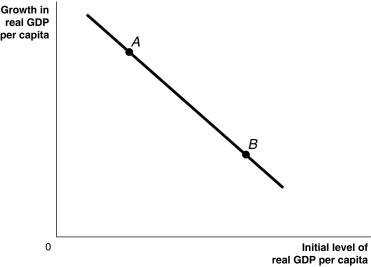 -Refer to Figure 22-3.Based on the "catch-up line" drawn above,poorer countries are more likely to be at a point like ________,where growth in GDP is relatively ________,while richer countries are more likely to be at a point like ________,where growth in GDP is relatively ________.
 (Multiple Choice)
4.8/5 (74)
(74) 
Filters
- Essay(0)
- Multiple Choice(0)
- Short Answer(0)
- True False(0)
- Matching(0)