



 Chat with AI
Exam 22: Long-Run Economic Growth: Sources and Policies

Exam 1: Economics: Foundations and Models142 Questions
Exam 2: Trade-Offs, comparative Advantage, and the Market System152 Questions
Exam 3: Where Prices Come From: the Interaction of Demand and Supply149 Questions
Exam 4: Economic Efficiency, government Price Setting, and Taxes137 Questions
Exam 5: Externalities, environmental Policy, and Public Goods139 Questions
Exam 6: Elasticity: The Responsiveness of Demand and Supply149 Questions
Exam 7: The Economics of Health Care117 Questions
Exam 8: Firms, the Stock Market, and Corporate Governance140 Questions
Exam 9: Comparative Advantage and the Gains From International Trade124 Questions
Exam 10: Consumer Choice and Behavioral Economics154 Questions
Exam 11: Technology, production, and Costs174 Questions
Exam 12: Firms in Perfectly Competitive Markets153 Questions
Exam 13: Monopolistic Competition: The Competitive Model in a More Realistic Setting137 Questions
Exam 14: Oligopoly: Firms in Less Competitive Markets129 Questions
Exam 15: Monopoly and Antitrust Policy148 Questions
Exam 16: Pricing Strategy134 Questions
Exam 17: The Markets for Labor and Other Factors of Production149 Questions
Exam 18: Public Choice, taxes, and the Distribution of Income134 Questions
Exam 19: GDP: Measuring Total Production and Income135 Questions
Exam 20: Unemployment and Inflation148 Questions
Exam 21: Economic Growth, the Financial System, and Business Cycles130 Questions
Exam 22: Long-Run Economic Growth: Sources and Policies134 Questions
Exam 23: Aggregate Expenditure and Output in the Short Run157 Questions
Exam 24: Aggregate Demand and Aggregate Supply Analysis145 Questions
Exam 25: Money, banks, and the Federal Reserve System144 Questions
Exam 26: Monetary Policy145 Questions
Exam 27: Fiscal Policy155 Questions
Exam 28: Inflation, unemployment, and Federal Reserve Policy135 Questions
Exam 29: Macroeconomics in an Open Economy145 Questions
Exam 30: The International Financial System139 Questions
Select questions type


The question of whether economic growth is desirable is a positive question,easily settled by economic analysis.
(True/False)
4.8/5  (74)
(74) Which of the following best explains why productivity growth in the United States has been faster than in other leading industrialized nations?
(Multiple Choice)
4.8/5 (74)
(74) A patent grants an inventor exclusive rights to a product for how long?
(Multiple Choice)
4.9/5 (86)
(86) Foreign portfolio investment occurs when an individual or firm buys stock or bonds issued in another country.
(True/False)
4.7/5 (76)
(76) Figure 22-1  -Refer to Figure 22-1.Within a country,the impact of wars and revolutions and their subsequent destruction of capital is reflected in the per-worker production function in the figure above by a movement from
A) A to B.
B) B to C.
C) B to A.
D) C to A.
-Refer to Figure 22-1.Within a country,the impact of wars and revolutions and their subsequent destruction of capital is reflected in the per-worker production function in the figure above by a movement from
A) A to B.
B) B to C.
C) B to A.
D) C to A. (Not Answered)
This question doesn't have any answer yet
Figure 22-2  -Refer to Figure 22-2.Assuming no technological change,if the United States increases capital per hour worked by $40,000 every year between 2010 and 2014,we would expect to see
 (Multiple Choice)
4.8/5 (81)
(81) The purchase by an individual or firm of stock or bonds issued in another country is called
(Multiple Choice)
4.8/5 (74)
(74) Most of the countries of Africa are considered newly industrializing countries.
(True/False)
4.9/5 (69)
(69) According to Douglass North,the Industrial Revolution occurred in England because
(Multiple Choice)
4.8/5 (77)
(77) Does globalization promote economic growth,and how does globalization affect the welfare of a given country's citizens?
(Essay)
4.9/5 (70)
(70) The opportunity cost of being unemployed tends to be the highest in which of the following countries?
(Multiple Choice)
4.9/5 (70)
(70) Figure 22-1
-Refer to Figure 22-1.Suppose the per-worker production function in the figure above represents the production function for the U.S.economy.If the United States decided to double its support of university research,this would cause a movement from
A) A to B.
B) B to C.
C) B to A.
D) D to C.
-Refer to Figure 22-1.Suppose the per-worker production function in the figure above represents the production function for the U.S.economy.If the United States decided to double its support of university research,this would cause a movement from
A) A to B.
B) B to C.
C) B to A.
D) D to C. (Not Answered)
This question doesn't have any answer yet
If real GDP per capita in the United States is $8,000 in 2011,and if real GDP per capita is $12,000 in 2021,what is the total percent change in the growth rate of GDP per capita between 2011 and 2021?
(Multiple Choice)
4.9/5 (75)
(75) What are some of the reasons used to explain improvements in health,education,democracy,and political stability in many low-income countries?
(Essay)
4.8/5 (79)
(79) Table 22-2
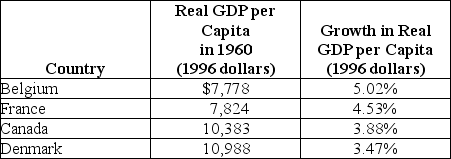 -Refer to Table 22-2.Consider the statistics in the table above in describing the industrialized countries.Are these consistent with the economic growth model? Briefly explain.
 (Essay)
4.8/5 (74)
(74) Paul Romer,an economist at Stanford University,is most closely associated with what economic theory?
(Multiple Choice)
4.8/5 (82)
(82) 
Filters
- Essay(0)
- Multiple Choice(0)
- Short Answer(0)
- True False(0)
- Matching(0)