



 Chat with AI
Exam 8: Consolidated Tax Returns

Exam 1: Understanding and Working With the Federal Tax Law74 Questions
Exam 2: Corporations: Introduction and Operating Rules113 Questions
Exam 3: Corporations: Special Situations109 Questions
Exam 4: Corporations: Organization and Capital Structure92 Questions
Exam 5: Corporations: Earnings Profits and Dividend Distributions130 Questions
Exam 6: Corporations: Redemptions and Liquidations115 Questions
Exam 7: Corporations: Reorganizations140 Questions
Exam 8: Consolidated Tax Returns175 Questions
Exam 9: Taxation of International Transactions177 Questions
Exam 10: Partnerships: Formation, Operation, and Basis135 Questions
Exam 11: Partnerships: Distributions, Transfer of Interests, and Terminations144 Questions
Exam 12: S: Corporations158 Questions
Exam 13: Comparative Forms of Doing Business170 Questions
Exam 14: Taxes on the Financial Statements87 Questions
Exam 15: Exempt Entities185 Questions
Exam 16: Multistate Corporate Taxation187 Questions
Exam 17: Tax Practice and Ethics174 Questions
Exam 18: The Federal Gift and Estate Taxes222 Questions
Exam 19: Family Tax Planning188 Questions
Exam 20: Income Taxation of Trusts and Estates183 Questions
Select questions type


Each of the members of a Federal consolidated tax return group can claim its own $40,000 AMT exemption, subject to phase-out.
(True/False)
4.7/5  (90)
(90) How must the IRS collect the liability for Federal taxes from among a consolidated group?
(Multiple Choice)
4.9/5 (79)
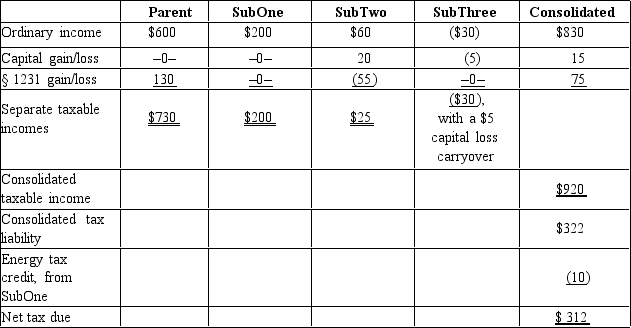
(79) The Parent consolidated group reports the following results for the tax year. Determine each member's share of the consolidated tax liability, assuming that the members all have consented to use the relative tax liability tax-sharing method. Dollar amounts are listed in millions, and a 35% marginal income tax rate applies to all of the entities.
(Essay)
4.8/5 (86)
(86) When a member departs from a consolidated group, it leaves behind any NOLs that it generated while in the group. The parent corporation and remaining affiliates apply those NOLs against future consolidated taxable income.
(True/False)
5.0/5 (78)
(78) In computing consolidated taxable income, the domestic production activities deduction (DPAD) is removed from the taxable incomes of the group members and determined on a group basis.
(True/False)
4.8/5 (76)
(76) With the filing of its first consolidated return, the parent corporation of a Federal consolidated group makes an irrevocable election as to how the group will allocate a tax year's income tax liability among the group members.
(True/False)
4.8/5 (84)
(84) Match each of the following items with the appropriate description, indicating whether the item's treatment for financial accounting and Federal income tax purposes is the same or not.
a. Tax and book treatment is the same
b. Tax and book treatment differ
-Parent owns 100% of a Brazil corporation and wants the entity to join the consolidated group.
(Short Answer)
5.0/5 (76)
(76) When the parent acquires 51% of a subsidiary U.S. corporation, the subsidiary can join the consolidated financial statements and the consolidated tax return of the parent.
(True/False)
4.8/5 (71)
(71) When the net accumulated taxable losses of a subsidiary exceed the parent's acquisition price, the parent's basis in the subsidiary's stock becomes negative.
(True/False)
5.0/5 (77)
(77) How are the members of a Federal consolidated group affected by computations related to E & P?
(Multiple Choice)
4.9/5 (79)
(79) A consolidated Federal income tax return may be the product of a merger of the affiliates, or of a stock-for-assets takeover.
(True/False)
4.9/5 (84)
(84) A calendar year parent corporation wants to file its tax returns on a consolidated basis with its affiliates. The group's election to file consolidated Federal corporate income tax returns must be made by the extended due date of the first return on which the consolidation is applied .
(True/False)
4.8/5 (85)
(85) The rules can limit the net operating loss deduction claimed on a Federal consolidated return.
(Essay)
4.9/5 (81)
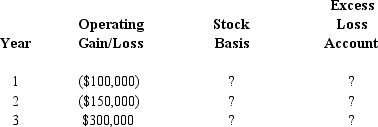
(81) Calendar year Parent Corporation acquired all of the stock of SubCo on January 1, Year 1, for $500,000. The subsidiary's operating gains and losses are shown below. In addition, a $50,000 dividend is paid early in Year 2.
Complete the following chart, indicating the appropriate stock basis and excess loss account amounts.
(Essay)
4.8/5 (80)
(80) Match each of the following items with the appropriate description, indicating whether the item is computed on a group basis on a consolidated tax return.
a. Group item
b. Not a group item
-Compensation deductions
(Short Answer)
4.8/5 (81)
(81) 
Filters
- Essay(0)
- Multiple Choice(0)
- Short Answer(0)
- True False(0)
- Matching(0)