



 Chat with AI
Exam 2: Corporations: Introduction and Operating Rules


A taxpayer is considering the formation of a business that would derive some amounts of tax-exempt interest, qualified dividends, and capital gains. Explain how these income categories would be reported and taxed under the various types of entity forms discussed in the chapter. Consider the tax implications both to the entities and to their owners.

 (78)
 Verified
For certain business entity forms, the entity is not subject to a Federal income tax. This is the case with the sole proprietorship, partnership, and (generally) S corporation entity forms. The owners of these three entity forms would benefit from any preferential tax treatment associated with tax-exempt income and taxed to the partner or shareholder. The partner or shareholder would include the taxexempt interest, qualified dividends, and capital gains on the partner's or shareholder's tax return.
In the case of a regular (C) corporation, tax-exempt interest, qualified dividends, and capital gains would be reported as such on the corporate tax return (Form 1120). A corporation would exclude tax- exempt interest from gross income and offset capital gains against capital losses, but corporate taxpayers do not receive any preferential tax rate with respect to qualified dividends or LTCG. Further, the tax attributes of income do not pass through the corporation to the shareholders. Instead, corporate distributions to shareholders generally are taxed as dividend income.
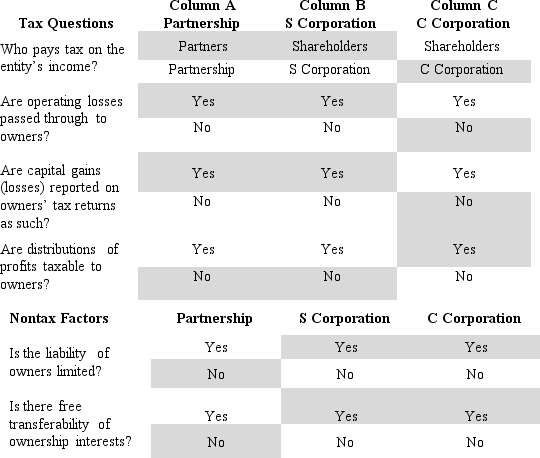
Compare the basic tax and nontax factors of doing business as a partnership, an S corporation, and a C corporation. Circle the correct answers.
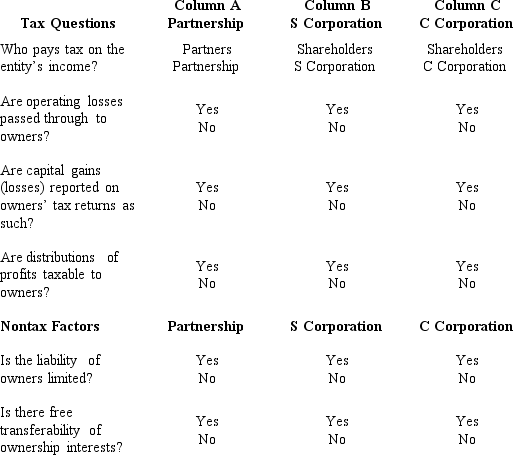
(64) VerifiedThe correct answers are shaded.
Red Corporation, which owns stock in Blue Corporation, had net operating income of $200,000 for the year. Blue pays Red a dividend of $40,000. Red takes a dividends received deduction of $28,000. Which of the following statements is correct?
(84) VerifiedD
Robin Corporation, a calendar year C corporation, had taxable income of $1.9 million, $1.2 million, and $900,000 for 2011, 2012, and 2013, respectively. Robin has taxable income of $1.5 million for 2014. The minimum 2014 estimated tax installment payments for Robin are:
(81) Which of the following statements is correct regarding the taxation of C corporations?
(91) Briefly describe the charitable contribution deduction rules applicable to C corporations.
(77) Patrick, an attorney, is the sole shareholder of Gander Corporation, a C corporation. Gander is a personal service corporation with a fiscal year ending November 30 (pursuant to a § 444 election). The corporation paid Patrick a salary of $180,000 during its fiscal year ending November 30, 2014. How much salary must Gander pay Patrick during the period December 1 through December 31, 2014, to permit the corporation to continue to use its fiscal year without negative tax effects?
(66) Jake, the sole shareholder of Peach Corporation, a C corporation, has the corporation pay him $100,000. For tax purposes, Jake would prefer to have the payment treated as dividend instead of salary.
(66) In the current year, Sunset Corporation (a C corporation) had operating income of $200,000 and operating expenses of $175,000. In addition, Sunset had a $30,000 long-term capital gain, a $52,000 short-term capital loss, and $5,000 taxexempt interest income. What is Sunset Corporation's taxable income for the year?
(87) Saleh, an accountant, is the sole shareholder of Turquoise Corporation, a C corporation. Turquoise is a personal service corporation with a fiscal year ending September 30 (pursuant to a § 444 election). The corporation paid Saleh a salary of $330,000 during its fiscal year ending September 30, 2014. How much salary must Turquoise pay Saleh during the period October 1 through December 31, 2014, if the corporation is to continue to use its fiscal year without negative tax effects?
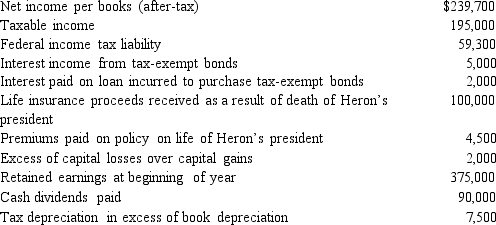
(74) Heron Corporation, a calendar year, accrual basis taxpayer, provides the following information for this year and asks you to prepare Schedule M-1:
(69) Beige Corporation, a C corporation, purchases a warehouse on August 1, 1998, for $1 million. Straight-line depreciation is taken in the amount of $411,750 before the property is sold on June 11, 2014, for $1.2 million. What is the amount and character of the gain recognized by Beige on the sale of the realty?
a. Ordinary income of $0 and § 1231 gain of $611,750.
b. Ordinary income of $411,750 and § 1231 gain of $200,000.
c. Ordinary income of $82,350 and § 1231 gain of $529,400.
d. Ordinary income of $117,650 and § 1231 gain of $494,100.
e. None of the above.
(73) Carrot Corporation, a C corporation, has a net short-term capital gain of $65,000 and a net long-term capital loss of $250,000 during 2014. Carrot Corporation had taxable income from other sources of $720,000. Prior years' transactions included the following:
 Compute the amount of Carrot's capital loss carryover to 2015.
a. $0
b. $32,000
c. $45,000
d. $185,000
e. None of the above
Compute the amount of Carrot's capital loss carryover to 2015.
a. $0
b. $32,000
c. $45,000
d. $185,000
e. None of the above (86) Adrian is the president and sole shareholder of Pigeon Corporation. He also lends money and rents a building to the corporation. Discuss how these business relationships between Adrian and Pigeon Corporation can help avoid double taxation. What limitations are there on the use of such relationships?
(85) On December 31, 2014, Peregrine Corporation, an accrual method, calendar year taxpayer, accrued a performance bonus of $100,000 to Charles, a cash basis, calendar year taxpayer. Charles is president and sole shareholder of the corporation. When can Peregrine deduct the bonus?
(94) Quail Corporation is a C corporation with net income of $125,000 during the current year. If Quail paid dividends of $25,000 to its shareholders, the corporation must pay tax on $100,000 of net income. Shareholders must report the $25,000 of dividends as income.
(91) Hornbill Corporation, a cash basis and calendar year C corporation, was formed and began operations on May 1, 2014. Hornbill incurred the following expenses during its first year of operations (May 1 - December 31, 2014): temporary directors meeting expenses of $10,500, state of incorporation fee of $5,000, stock certificate printing expenses of $1,200, and legal fees for drafting corporate charter and bylaws of $7,500. Hornbill Corporation's current year deduction for organizational expenditures is $5,800.
(64) Azure Corporation, a C corporation, had a long-term capital gain of $50,000 in the current year. The maximum amount of tax applicable to the capital gain is $7,500 ($50,000 × 15%).
(81) During the current year, Woodchuck, Inc., a closely held personal service corporation, has $115,000 of net active income, $40,000 of portfolio income, and $135,000 of passive activity loss. What is Woodchuck's taxable income for the current year?
(71) Carol and Candace are equal partners in Peach Partnership. In the current year, Peach had a net profit of $75,000 ($250,000 gross income - $175,000 operating expenses) and distributed $25,000 to each partner. Peach must pay tax on $75,000 of income.
(88) 
Filters
- Essay(0)
- Multiple Choice(0)
- Short Answer(0)
- True False(0)
- Matching(0)