



 Chat with AI
Exam 6: Ionic Compounds: Periodic Trends and Bonding

Exam 1: Chemical Tools: Experimentation and Measurement154 Questions
Exam 2: Atoms, molecules, and Ions275 Questions
Exam 3: Mass Relationships in Chemical Reactions159 Questions
Exam 4: Reactions in Aqueous Solutions211 Questions
Exam 5: Periodicity and the Electronic Structure of Atoms168 Questions
Exam 6: Ionic Compounds: Periodic Trends and Bonding138 Questions
Exam 7: Covalent Bonding and Electron-Dot Structures92 Questions
Exam 8: Covalent Compounds: Bonding Theories and Molecular Structure205 Questions
Exam 9: Thermochemistry: Chemical Energy170 Questions
Exam 10: Gases: Their Properties and Behavior188 Questions
Exam 11: Liquids, solids, and Phase Changes141 Questions
Exam 12: Solutions and Their Properties198 Questions
Exam 13: Chemical Kinetics190 Questions
Exam 14: Chemical Equilibrium171 Questions
Exam 15: Aqueous Equilibria: Acids and Bases231 Questions
Exam 16: Applications of Aqueous Equilibria201 Questions
Exam 17: Thermodynamics: Entropy, free Energy, and Equilibrium150 Questions
Exam 18: Electrochemistry212 Questions
Exam 19: Nuclear Chemistry176 Questions
Exam 20: Transition Elements and Coordination Chemistry190 Questions
Exam 21: Metals and Solid-State Materials154 Questions
Exam 22: The Main-Group Elements294 Questions
Exam 23: Connections to Organic and Biological Chemistry290 Questions
Select questions type


Of the following,which element has the highest first ionization energy?
(Multiple Choice)
5.0/5  (77)
(77) 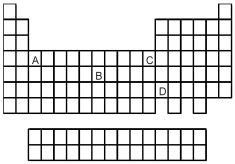 -Which element,indicated by letter on the periodic table above,has a 3+ ion with the electron configuration [Kr]4d5?
 (Multiple Choice)
4.8/5 (85)
(85) An element that has the valence electron configuration 3s23p3 belongs to which period and group?
(Multiple Choice)
4.8/5 (89)
(89) The third-row element having a less negative electron affinity than the elements on either side of it on the periodic table is ________.
(Short Answer)
4.9/5 (68)
(68) Calculate the energy change in kJ/mol for the reaction  using the following information: Li(g)→ Li+(g)+ e- +520 kJ/mol
F(g)+ e- → F-(g)-328 kJ/mol
using the following information: Li(g)→ Li+(g)+ e- +520 kJ/mol
F(g)+ e- → F-(g)-328 kJ/mol (Multiple Choice)
4.8/5 (70)
(70) The electron configuration of an element,X,is [Ne]3s1. The formula of the most probable ionic compound that this element will form with O is
(Multiple Choice)
4.7/5 (77)
(77) How many electrons does barium lose and nitrogen need to form Ba3P2?
(Multiple Choice)
4.7/5 (75)
(75) 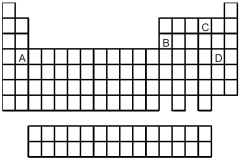 -What is the likely formula for the binary compound formed from the elements represented by letters A and D on the periodic table above?
 (Multiple Choice)
4.9/5 (82)
(82)
-Which element,indicated by letter on the periodic table above,has a 2+ ion with the electron configuration [Ar]3d10?
-Which element,indicated by letter on the periodic table above,has a 2+ ion with the electron configuration [Ar]3d10? (Multiple Choice)
4.8/5 (70)
(70) Of the following,which element has the highest first ionization energy?
(Multiple Choice)
4.8/5 (84)
(84) The following four spheres represent a Na atom,a Na+ ion,a Cl atom,and a Cl- ion,not necessarily in that order.Use your knowledge about the relative sizes of atoms,cations,and anions to determine which of the following sets of reactions is most consistent with the sizes of the atoms and ions shown below. 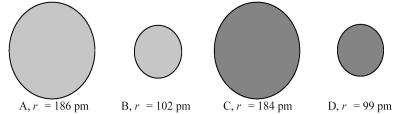
(Multiple Choice)
4.9/5 (89)
(89) Of the following,which element has the highest first ionization energy?
(Multiple Choice)
4.9/5 (81)
(81) Of the following,which element has the highest first ionization energy?
(Multiple Choice)
4.9/5 (75)
(75) Which element,indicated by letter on the periodic table,is able to form compounds that do not obey the octet rule? 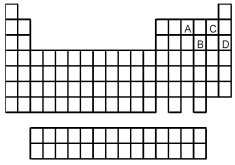
(Multiple Choice)
4.9/5 (81)
(81) The four spheres below represent Na+,Mg2+,F⁻,and O2-,not necessarily in that order. 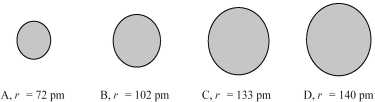 -Which sphere most likely represents the F- ion?
 (Multiple Choice)
4.9/5 (87)
(87) 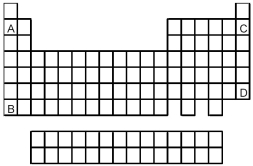 -Atoms of which element,indicated by letter on the periodic table above,would be expected to have the highest first ionization energy,Ei1?
 (Multiple Choice)
4.9/5 (88)
(88) Calculate the lattice energy for MgCl2(s)using a Born-Haber cycle and the following information: MgCl2(s)→ Mg2+(g)+ 2 Cl-(g)?
Mg(s)+ Cl2(g)→ MgCl2(s)-641.6 kJ/mol
Mg(s)→ Mg(g)+147.1 kJ/mol
Mg(g)→ Mg+(g)+ e- +737.8 kJ/mol
Mg+(g)→ Mg2+(g)+ e- +1451.0 kJ/mol
1/2 Cl2(g)→ Cl(g)+121.7 kJ/mol
Cl(g)+ e- → Cl-(g)-348.6 kJ/mol
(Multiple Choice)
4.8/5 (76)
(76) 
Filters
- Essay(0)
- Multiple Choice(0)
- Short Answer(0)
- True False(0)
- Matching(0)