



 Chat with AI
Exam 6: Ionic Compounds: Periodic Trends and Bonding

Exam 1: Chemical Tools: Experimentation and Measurement154 Questions
Exam 2: Atoms, molecules, and Ions275 Questions
Exam 3: Mass Relationships in Chemical Reactions159 Questions
Exam 4: Reactions in Aqueous Solutions211 Questions
Exam 5: Periodicity and the Electronic Structure of Atoms168 Questions
Exam 6: Ionic Compounds: Periodic Trends and Bonding138 Questions
Exam 7: Covalent Bonding and Electron-Dot Structures92 Questions
Exam 8: Covalent Compounds: Bonding Theories and Molecular Structure205 Questions
Exam 9: Thermochemistry: Chemical Energy170 Questions
Exam 10: Gases: Their Properties and Behavior188 Questions
Exam 11: Liquids, solids, and Phase Changes141 Questions
Exam 12: Solutions and Their Properties198 Questions
Exam 13: Chemical Kinetics190 Questions
Exam 14: Chemical Equilibrium171 Questions
Exam 15: Aqueous Equilibria: Acids and Bases231 Questions
Exam 16: Applications of Aqueous Equilibria201 Questions
Exam 17: Thermodynamics: Entropy, free Energy, and Equilibrium150 Questions
Exam 18: Electrochemistry212 Questions
Exam 19: Nuclear Chemistry176 Questions
Exam 20: Transition Elements and Coordination Chemistry190 Questions
Exam 21: Metals and Solid-State Materials154 Questions
Exam 22: The Main-Group Elements294 Questions
Exam 23: Connections to Organic and Biological Chemistry290 Questions
Select questions type


Calculate the energy change for the formation of CaF2(s)from its elements in their standard states and the following information: Ca(s)+ F2(g)→ CaF2(s)?
Ca(s)→ Ca(g)+179.3 kJ/mol
Ca(g)→ Ca+(g)+ e- +589.9 kJ/mol
Ca+(g)→ Ca2+(g)+ e- +1145 kJ/mol
1/2 F2(g)→ F(g)+79.0 kJ/mol
F(g)+ e- → F-(g)-328.0 kJ/mol
CaF2(s)→ Ca2+(g)+ 2 F-(g)+2630 kJ/mol
(Multiple Choice)
4.9/5  (79)
(79) Of the following,which element has the highest first ionization energy?
(Multiple Choice)
4.8/5 (93)
(93) Which species does not have an octet of electrons for its outer core?
(Multiple Choice)
4.9/5 (75)
(75) The element in period 4 with the smallest first ionization energy is ________.
(Short Answer)
5.0/5 (85)
(85) Which of the following ionic compounds would be expected to have the highest lattice energy?
(Multiple Choice)
4.8/5 (86)
(86) Which of these elements has the most favorable (most negative)electron affinity?
(Multiple Choice)
4.8/5 (77)
(77) 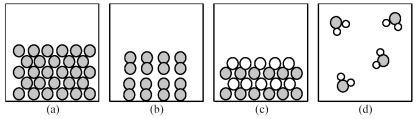 -Which of the above pictures best represents a solid ionic compound?
 (Multiple Choice)
5.0/5 (67)
(67) Consider the following electron configurations for neutral atoms: atom I = 1s22s22p63s2
Atom II = 1s22s22p63s23p4
Atom III = 1s22s22p63s23p6
Which atom would be expected to have the largest third ionization energy?
(Multiple Choice)
4.9/5 (78)
(78) Which of the following ionic compounds would be expected to have the highest lattice energy?
(Multiple Choice)
4.9/5 (90)
(90) The four spheres below represent K+,Ca2+,Cl-,and S2-,not necessarily in that order. 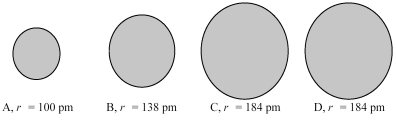 -Which sphere most likely represents the K+ ion?
 (Multiple Choice)
4.8/5 (66)
(66) 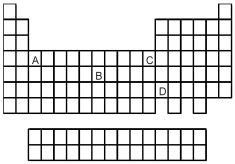 -Which element,indicated by letter on the periodic table above,has a 3+ ion with the electron configuration

-Which element,indicated by letter on the periodic table above,has a 3+ ion with the electron configuration (Multiple Choice)
5.0/5 (89)
(89) Using shorthand notation,the ground-state electron configuration for Sr2 is predicted to be ________.
(Short Answer)
4.9/5 (86)
(86) Lattice energy increases with ________ cation and anion charges and ________ cation and anion radii.
(Short Answer)
4.9/5 (67)
(67) Using shorthand notation,the ground-state electron configuration for F- is predicted to be ________.
(Short Answer)
4.8/5 (71)
(71) Which element has the most favorable (most negative)electron affinity?
(Multiple Choice)
4.8/5 (76)
(76) An element that has the valence electron configuration 2s22p2 belongs to which period and group?
(Multiple Choice)
4.8/5 (83)
(83) Which ionic compound would be expected to have the highest lattice energy?
(Multiple Choice)
4.8/5 (79)
(79) 
Filters
- Essay(0)
- Multiple Choice(0)
- Short Answer(0)
- True False(0)
- Matching(0)