



 Chat with AI
Exam 6: Ionic Compounds: Periodic Trends and Bonding

Exam 1: Chemical Tools: Experimentation and Measurement154 Questions
Exam 2: Atoms, molecules, and Ions275 Questions
Exam 3: Mass Relationships in Chemical Reactions159 Questions
Exam 4: Reactions in Aqueous Solutions211 Questions
Exam 5: Periodicity and the Electronic Structure of Atoms168 Questions
Exam 6: Ionic Compounds: Periodic Trends and Bonding138 Questions
Exam 7: Covalent Bonding and Electron-Dot Structures92 Questions
Exam 8: Covalent Compounds: Bonding Theories and Molecular Structure205 Questions
Exam 9: Thermochemistry: Chemical Energy170 Questions
Exam 10: Gases: Their Properties and Behavior188 Questions
Exam 11: Liquids, solids, and Phase Changes141 Questions
Exam 12: Solutions and Their Properties198 Questions
Exam 13: Chemical Kinetics190 Questions
Exam 14: Chemical Equilibrium171 Questions
Exam 15: Aqueous Equilibria: Acids and Bases231 Questions
Exam 16: Applications of Aqueous Equilibria201 Questions
Exam 17: Thermodynamics: Entropy, free Energy, and Equilibrium150 Questions
Exam 18: Electrochemistry212 Questions
Exam 19: Nuclear Chemistry176 Questions
Exam 20: Transition Elements and Coordination Chemistry190 Questions
Exam 21: Metals and Solid-State Materials154 Questions
Exam 22: The Main-Group Elements294 Questions
Exam 23: Connections to Organic and Biological Chemistry290 Questions
Select questions type


Calculate the energy change for the formation of LiCl(s)from its elements in their standard states and the following tabulated information: Li(s)+ 1/2 Cl2(g)→ LiCl(s)?
Li+(g)+ Cl-(g)→ LiCl(s)-853 kJ/mol
Li(s)→ Li(g)+159.4 kJ/mol
1/2 Cl2(g)→ Cl(g)+121.7 kJ/mol
Cl(g)+ e- → Cl-(g)-348.6 kJ/mol
Li(g)→ Li+(g)+ e- +520.2 kJ/mol
(Multiple Choice)
4.8/5  (80)
(80) What is the third-row element having the successive ionization energies in kJ/mol: 738,1451,7733,10,540,13,630,17,995,21,703?
(Short Answer)
4.8/5 (69)
(69) To reach a noble gas electron configuration how many electrons would tellerium have to adopt?
(Multiple Choice)
4.9/5 (75)
(75) Of the following,which element has the highest first ionization energy?
(Multiple Choice)
4.8/5 (74)
(74) What is the ground-state electron configuration of the ion Hg2+?
(Multiple Choice)
4.9/5 (73)
(73) Which of the following represents the change in electronic configuration that is associated with the second ionization energy of magnesium?
(Multiple Choice)
4.7/5 (76)
(76) The ionic radius of Cs+ is ________ than the atomic radius of Cs,and the ionic radius of I- is ________ than the atomic radius of I.
(Short Answer)
4.8/5 (92)
(92) 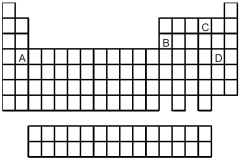 -What is the likely formula for the binary compound formed from the elements represented by letters A and C on the periodic table above?
 (Multiple Choice)
4.9/5 (75)
(75) Which of the following ionic compounds would be expected to have the highest lattice energy?
(Multiple Choice)
4.7/5 (84)
(84) What is the general trend in ionization energy and electron affinity values?
(Multiple Choice)
4.8/5 (86)
(86) 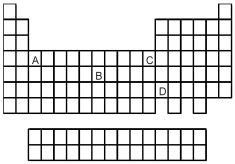 -Which element,indicated by letter on the periodic table above,has a 1+ ion with the electron configuration

-Which element,indicated by letter on the periodic table above,has a 1+ ion with the electron configuration (Multiple Choice)
4.8/5 (93)
(93) Which of the following species will have the highest ionization energy?
(Multiple Choice)
4.8/5 (78)
(78) Which of the following ionic compounds would be expected to have the highest lattice energy?
(Multiple Choice)
4.9/5 (79)
(79) Of the following,which element has the highest first ionization energy?
(Multiple Choice)
4.8/5 (65)
(65) The octet rule is most likely to fail occasionally for which of the following elements?
(Multiple Choice)
4.8/5 (96)
(96) The element in group 7A with the least favorable (least negative)electron affinity is ________.
(Short Answer)
4.8/5 (81)
(81) Which period 3 element has successive first through seventh ionization energies (kJ/mol)of Ei1 = 578;Ei2 = 1,817;Ei3 = 2,745;Ei4 = 11,575;Ei5 = 14,830;Ei6 = 18,376;and Ei7 = 23,293?
(Multiple Choice)
5.0/5 (77)
(77) The following four spheres represent an Mg atom,an Mg2+ ion,a S atom,and a S2- ion,not necessarily in that order.Use your knowledge about the relative sizes of atoms,cations,and anions to determine which of the following sets of reactions is most consistent with the sizes of the atoms and ions shown below. 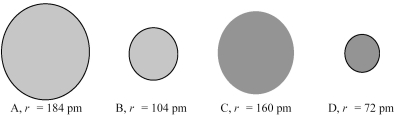
(Multiple Choice)
4.7/5 (71)
(71) 
Filters
- Essay(0)
- Multiple Choice(0)
- Short Answer(0)
- True False(0)
- Matching(0)