



 Chat with AI
Exam 6: Ionic Compounds: Periodic Trends and Bonding

Exam 1: Chemical Tools: Experimentation and Measurement154 Questions
Exam 2: Atoms, molecules, and Ions275 Questions
Exam 3: Mass Relationships in Chemical Reactions159 Questions
Exam 4: Reactions in Aqueous Solutions211 Questions
Exam 5: Periodicity and the Electronic Structure of Atoms168 Questions
Exam 6: Ionic Compounds: Periodic Trends and Bonding138 Questions
Exam 7: Covalent Bonding and Electron-Dot Structures92 Questions
Exam 8: Covalent Compounds: Bonding Theories and Molecular Structure205 Questions
Exam 9: Thermochemistry: Chemical Energy170 Questions
Exam 10: Gases: Their Properties and Behavior188 Questions
Exam 11: Liquids, solids, and Phase Changes141 Questions
Exam 12: Solutions and Their Properties198 Questions
Exam 13: Chemical Kinetics190 Questions
Exam 14: Chemical Equilibrium171 Questions
Exam 15: Aqueous Equilibria: Acids and Bases231 Questions
Exam 16: Applications of Aqueous Equilibria201 Questions
Exam 17: Thermodynamics: Entropy, free Energy, and Equilibrium150 Questions
Exam 18: Electrochemistry212 Questions
Exam 19: Nuclear Chemistry176 Questions
Exam 20: Transition Elements and Coordination Chemistry190 Questions
Exam 21: Metals and Solid-State Materials154 Questions
Exam 22: The Main-Group Elements294 Questions
Exam 23: Connections to Organic and Biological Chemistry290 Questions
Select questions type


Which ion does not have a noble gas configuration in its ground state?
(Multiple Choice)
4.9/5  (96)
(96) Calculate the lattice energy for NaCl(s)using a Born-Haber cycle and the following information: NaCl(s)→ Na+(g)+ Cl-(g)?
Na(s)+ 1/2 Cl2(g)→ NaCl(s)-411.0 kJ/mol
Na(s)→ Na(g)+107.3 kJ/mol
Na(g)→ Na+(g)+ e- +495.8 kJ/mol
1/2 Cl2(g)→ Cl(g)+121.7 kJ/mol
Cl(g)+ e- → Cl-(g)-348.6 kJ/mol
(Multiple Choice)
4.9/5 (85)
(85) Using shorthand notation,the ground-state electron configuration for Co2+ is predicted to be ________.
(Short Answer)
4.9/5 (74)
(74) Which of the following atoms with the specified electronic configurations would have the lowest first ionization energy?
(Multiple Choice)
4.8/5 (85)
(85) 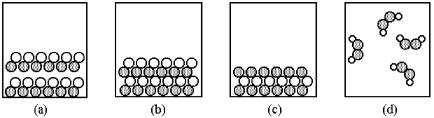 -Which of the above pictures are more likely to represent covalent compounds?
 (Multiple Choice)
4.8/5 (71)
(71) Indicate which is larger in each of the following two sets. (I)Cr2+ or Cr (II)N2- or N
(Multiple Choice)
4.8/5 (87)
(87) An element M reacts with chlorine to form MCl2,with oxygen to form MO,and with nitrogen to form M3N2.The most likely candidate for the element is
(Multiple Choice)
4.8/5 (65)
(65) Which of the following species will have the highest ionization energy?
(Multiple Choice)
4.8/5 (85)
(85) 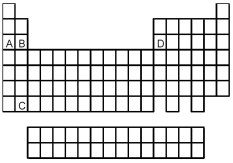 -Atoms of which element,indicated by letter on the periodic table above,would be expected to have the highest second ionization energy,Ei1?
 (Multiple Choice)
4.8/5 (74)
(74) The four spheres below represent Na+,Mg2+,F⁻,and O2-,not necessarily in that order. 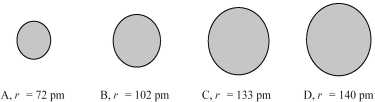 -Which sphere most likely represents the Mg2+ ion?
 (Multiple Choice)
4.9/5 (76)
(76) Which two ions have the same electron configuration in the ground state?
(Multiple Choice)
4.9/5 (84)
(84) Calculate the lattice energy for MgO(s)using a Born-Haber cycle and the following information: MgO(s)→ Mg2+(g)+ O2-(g)?
Mg(s)→ Mg(g)+147.1 kJ/mol
Mg(g)→ Mg+(g)+ e- +737.8 kJ/mol
Mg+(g)→ Mg2+(g)+ e- +1451 kJ/mol
1/2 O2(g)→ O(g)+249.0 kJ/mol
O(g)+ e- → O-(g)-141.1 kJ/mol
O-(g)+ e- → O2-(g)+798.0 kJ/mol
Mg(s)+ 1/2 O2(g)→ MgO(s)-601.8 kJ/mol
(Multiple Choice)
4.8/5 (78)
(78) What is the ground-state electron configuration of the ion Cu2+?
(Multiple Choice)
4.8/5 (85)
(85) Of the following,which element has the highest first ionization energy?
(Multiple Choice)
4.8/5 (74)
(74) Which chemical process is associated with the lattice energy for sodium chloride?
(Multiple Choice)
4.9/5 (75)
(75) 
Filters
- Essay(0)
- Multiple Choice(0)
- Short Answer(0)
- True False(0)
- Matching(0)