



 Chat with AI
Exam 6: Ionic Compounds: Periodic Trends and Bonding

Exam 1: Chemical Tools: Experimentation and Measurement154 Questions
Exam 2: Atoms, molecules, and Ions275 Questions
Exam 3: Mass Relationships in Chemical Reactions159 Questions
Exam 4: Reactions in Aqueous Solutions211 Questions
Exam 5: Periodicity and the Electronic Structure of Atoms168 Questions
Exam 6: Ionic Compounds: Periodic Trends and Bonding138 Questions
Exam 7: Covalent Bonding and Electron-Dot Structures92 Questions
Exam 8: Covalent Compounds: Bonding Theories and Molecular Structure205 Questions
Exam 9: Thermochemistry: Chemical Energy170 Questions
Exam 10: Gases: Their Properties and Behavior188 Questions
Exam 11: Liquids, solids, and Phase Changes141 Questions
Exam 12: Solutions and Their Properties198 Questions
Exam 13: Chemical Kinetics190 Questions
Exam 14: Chemical Equilibrium171 Questions
Exam 15: Aqueous Equilibria: Acids and Bases231 Questions
Exam 16: Applications of Aqueous Equilibria201 Questions
Exam 17: Thermodynamics: Entropy, free Energy, and Equilibrium150 Questions
Exam 18: Electrochemistry212 Questions
Exam 19: Nuclear Chemistry176 Questions
Exam 20: Transition Elements and Coordination Chemistry190 Questions
Exam 21: Metals and Solid-State Materials154 Questions
Exam 22: The Main-Group Elements294 Questions
Exam 23: Connections to Organic and Biological Chemistry290 Questions
Select questions type


Which of the following three sets consist of atoms or ions with the same electron configuration in the ground state? (I)O2-,Ne,and Mg2+
(II)Ni,Cu+,and Zn2+
(III)Hg,Tl+,and Pb2+
(Multiple Choice)
4.7/5  (83)
(83) Which of the following most likely represent the atomic radius of a Cr atom,the ionic radius of a Cr2+ ion,and the ionic radius of a Cr3+ ion?
(Multiple Choice)
4.7/5 (93)
(93) 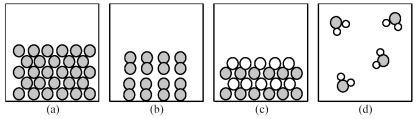 -Which of the above pictures best represents a gaseous covalent compound?
 (Multiple Choice)
4.9/5 (83)
(83) The tripositive ion with the electron configuration [Ar]3d6 is ________.
(Short Answer)
4.8/5 (74)
(74) Which electron affinity process would liberate the most energy?
(Multiple Choice)
4.9/5 (97)
(97) The neutral atom with the electron configuration [Ar}4s23d6 is ________.
(Short Answer)
4.9/5 (90)
(90) Which element has the most favorable (most negative)electron affinity?
(Multiple Choice)
4.9/5 (90)
(90) Which of the following represents the change in electronic configuration that is associated with the first ionization energy of barium?
(Multiple Choice)
4.8/5 (86)
(86) Of the following,which element has the highest first ionization energy?
(Multiple Choice)
5.0/5 (83)
(83) Isoelectronic means having the same number of electrons.The dipositive ion that is isoelectronic with Br- is ________.
(Short Answer)
4.8/5 (82)
(82) Arrange the ions N3-,O2-,Mg2+,Na+,and F- in order of increasing ionic radius,starting with the smallest first.
(Multiple Choice)
4.8/5 (90)
(90) The element in period 3 with the smallest seventh ionization energy is ________.
(Short Answer)
4.9/5 (69)
(69) Which element has the least favorable (least negative)electron affinity?
(Multiple Choice)
4.8/5 (73)
(73) The following pictures represent alkali halide salts.  -Which salt has the highest lattice energy?
 (Multiple Choice)
4.8/5 (92)
(92) The four spheres below represent K+,Ca2+,Cl-,and S2-,not necessarily in that order. 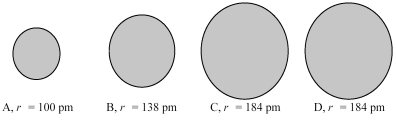 -Which sphere most likely represents the Cl⁻ ion?
 (Multiple Choice)
4.7/5 (76)
(76) 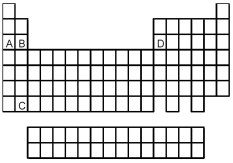 -Atoms of which element,indicated by letter on the periodic table,would be expected to have the most negative value of Eea?
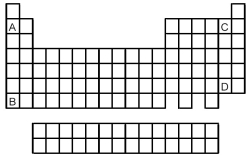
-Atoms of which element,indicated by letter on the periodic table,would be expected to have the most negative value of Eea? (Multiple Choice)
4.7/5 (80)
(80) The following four spheres represent a metal atom,a nonmetal atom,a monatomic anion and a monatomic cation,not necessarily in that order. 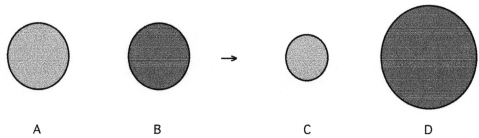 -Which sphere represents the nonmetal atom?
 (Multiple Choice)
4.9/5 (79)
(79) Using shorthand notation,the ground-state electron configuration of the chromium ion in CrCl2 is ________.
(Short Answer)
4.7/5 (60)
(60) Calculate the electron affinity for the formation of the hydride ion from the following information: H(g)+ e- → H-(g)?
1/2 H2(g)→ H(g)+217.9 kJ/mol
Na(s)→ Na(g)+107.3 kJ/mol
Na(g)→ Na+(g)+ e- +495.8 kJ/mol
Na(s)+ 1/2 H2(g)→ NaH(s)-60.0 kJ/mol
NaH(s)→ Na+(g)+ H-(g)+810.9 kJ/mol
(Multiple Choice)
4.7/5 (87)
(87) 
Filters
- Essay(0)
- Multiple Choice(0)
- Short Answer(0)
- True False(0)
- Matching(0)