



 Chat with AI
Exam 22: Reactions of Benzene and Its Derivatives

Exam 1: Covalent Bonding and Shapes of Molecules115 Questions
Exam 2: Alkanes and Cycloalkanes95 Questions
Exam 3: Stereoisomerism and Chirality93 Questions
Exam 4: Acids and Bases94 Questions
Exam 5: Alkenes: Bonding, Nomenclature, and Properties86 Questions
Exam 6: Reactions of Alkenes98 Questions
Exam 7: Alkynes100 Questions
Exam 8: Haloalkanes, Halogenation, and Radical Reactions76 Questions
Exam 9: Nucleophilic Substitution and Beta-Elimination111 Questions
Exam 10: Alcohols98 Questions
Exam 11: Ethers, Epoxides, and Sulfides93 Questions
Exam 12: Infrared Spectroscopy67 Questions
Exam 13: Nuclear Magnetic Resonance Spectroscopy102 Questions
Exam 14: Mass Spectrometry65 Questions
Exam 15: An Introduction to Organometallic Compounds66 Questions
Exam 16: Aldehydes and Ketones119 Questions
Exam 17: Carboxylic Acids71 Questions
Exam 18: Functional Derivatives of Carboxylic Acids112 Questions
Exam 19: Enolate Anions and Enamines93 Questions
Exam 20: Dienes, Conjugated Systems, and Pericyclic Reactions69 Questions
Exam 21: Benzene and the Concept of Aromaticity85 Questions
Exam 22: Reactions of Benzene and Its Derivatives107 Questions
Exam 23: Amines88 Questions
Exam 24: Catalytic Carbon-Carbon Bond Formation77 Questions
Exam 25: Carbohydrates60 Questions
Exam 26: Lipids54 Questions
Exam 27: Amino Acids and Proteins70 Questions
Exam 28: Nucleic Acids52 Questions
Exam 29: Organic Polymer Chemistry60 Questions
Select questions type


What is the major organic product obtained from the following reaction (if a reaction is likely to give you a mixture of ortho and para disubstituted compounds you should assume that they can be separated; continue the synthesis with either one)? 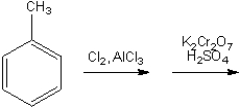
(Essay)
5.0/5  (80)
(80) Consider the reaction below to answer the following question(s).  Fill in the blank with the appropriate letter or response.
-The nucleophile in the reaction is _____.
Fill in the blank with the appropriate letter or response.
-The nucleophile in the reaction is _____. (Multiple Choice)
4.8/5 (73)
(73) Which of the following sets of substituents are all activating groups in electrophilic aromatic substitution reactions?
(Multiple Choice)
4.9/5 (77)
(77) Which of the following is the reactive intermediate in the nucleophilic substitution of 4-bromo-1-nitrobenzene with sodium hydroxide? 
(Multiple Choice)
4.8/5 (80)
(80) What is the major organic product obtained from the following reaction? 
(Multiple Choice)
4.8/5 (75)
(75) MATCHING
MATCH a structure or term from the following list with each description below. Place the letter of the structure or term in the blank to the left of the description.
-______ Groups which activate aromatic rings towards electrophilic substitution.
(Multiple Choice)
4.8/5 (66)
(66) Provide the structure (a single resonance contributor) of the key intermediate in the electrophilic aromatic chlorination of nitrobenzene. 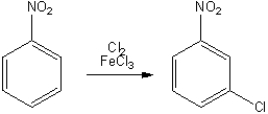
(Essay)
4.8/5 (73)
(73) 
Filters
- Essay(0)
- Multiple Choice(0)
- Short Answer(0)
- True False(0)
- Matching(0)