



 Chat with AI
Exam 25: Carbohydrates

Exam 1: Covalent Bonding and Shapes of Molecules115 Questions
Exam 2: Alkanes and Cycloalkanes95 Questions
Exam 3: Stereoisomerism and Chirality93 Questions
Exam 4: Acids and Bases94 Questions
Exam 5: Alkenes: Bonding, Nomenclature, and Properties86 Questions
Exam 6: Reactions of Alkenes98 Questions
Exam 7: Alkynes100 Questions
Exam 8: Haloalkanes, Halogenation, and Radical Reactions76 Questions
Exam 9: Nucleophilic Substitution and Beta-Elimination111 Questions
Exam 10: Alcohols98 Questions
Exam 11: Ethers, Epoxides, and Sulfides93 Questions
Exam 12: Infrared Spectroscopy67 Questions
Exam 13: Nuclear Magnetic Resonance Spectroscopy102 Questions
Exam 14: Mass Spectrometry65 Questions
Exam 15: An Introduction to Organometallic Compounds66 Questions
Exam 16: Aldehydes and Ketones119 Questions
Exam 17: Carboxylic Acids71 Questions
Exam 18: Functional Derivatives of Carboxylic Acids112 Questions
Exam 19: Enolate Anions and Enamines93 Questions
Exam 20: Dienes, Conjugated Systems, and Pericyclic Reactions69 Questions
Exam 21: Benzene and the Concept of Aromaticity85 Questions
Exam 22: Reactions of Benzene and Its Derivatives107 Questions
Exam 23: Amines88 Questions
Exam 24: Catalytic Carbon-Carbon Bond Formation77 Questions
Exam 25: Carbohydrates60 Questions
Exam 26: Lipids54 Questions
Exam 27: Amino Acids and Proteins70 Questions
Exam 28: Nucleic Acids52 Questions
Exam 29: Organic Polymer Chemistry60 Questions
Select questions type


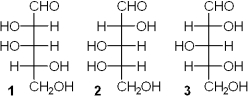
Which of the following represent an aldose? 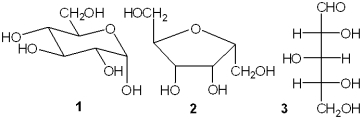

Free
(Multiple Choice)
4.9/5  (86)
(86) Correct Answer: Verified
B
The textile rayon is produced by treatment of cellulose with carbon disulfide in aqueous sodium hydroxide. What type of functional group is introduced on the cellulose under these conditions? 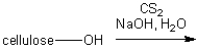
Free
(Essay)
4.9/5 (80)
(80) Correct Answer:Verified
Verified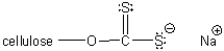 a sodium xanthate salt
What are the major organic products obtained from treatment of a methyl glycoside with periodic acid in water? 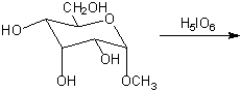
Free
(Essay)
4.7/5 (79)
(79) Correct Answer:Verified
Verified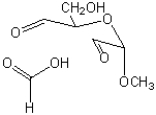
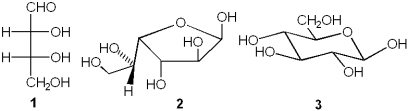
Consider the following structures.  Answer the following questions by placing the appropriate number or indicated letter in the blank.
-The number of hydroxyl groups in the pyranose form of glucose is _____.
Answer the following questions by placing the appropriate number or indicated letter in the blank.
-The number of hydroxyl groups in the pyranose form of glucose is _____. (Short Answer)
4.8/5 (79)
(79) Refer to the equilibrium below to answer the following question(s).  -The enantiomer of ribose is drawn is _______. (D or L)
 (Short Answer)
4.9/5 (87)
(87) 
Reduction of an optically active aldopentose with NaBH4 gives an optically inactive alditol. The aldopentose could be: 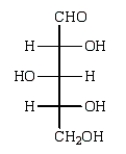
(True/False)
4.8/5 (84)
(84) 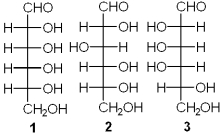
What is the major organic product obtained from the following reduction of glucose? 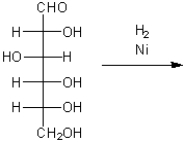
(Essay)
4.9/5 (71)
(71) Refer to the equilibrium below to answer the following question(s).
-The anomer of ribose is drawn is _______. (alpha or beta)
-The anomer of ribose is drawn is _______. (alpha or beta) (Short Answer)
4.9/5 (89)
(89) Consider the following structures. Answer the following questions by placing the appropriate number or indicated letter in the blank.
-The number of the anomeric carbon in the following structure is _____. 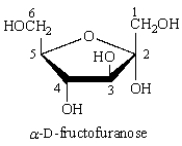
Answer the following questions by placing the appropriate number or indicated letter in the blank.
-The number of the anomeric carbon in the following structure is _____. (Short Answer)
4.8/5 (82)
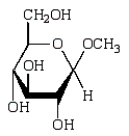
(82) Consider the structure shown below. 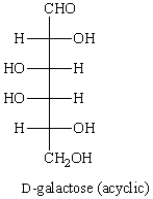 The Haworth projection formula for the pyranose form of -D-galactose is given below.
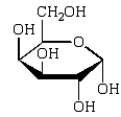
The Haworth projection formula for the pyranose form of -D-galactose is given below. (True/False)
4.9/5 (82)
(82) What are the major organic products obtained from treatment of a 1,2,3-triol with periodic acid in water? 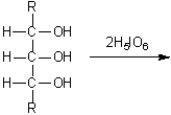
(Essay)
4.9/5 (92)
(92) Consider the following structures. Answer the following questions by placing the appropriate number or indicated letter in the blank.
-Structure ____ represents a aldopentose.
Answer the following questions by placing the appropriate number or indicated letter in the blank.
-Structure ____ represents a aldopentose. (Short Answer)
4.9/5 (81)
(81) 
Consider the following Fisher projections. 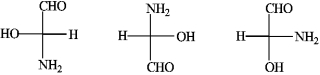 They all convert to the same tetrahedral representation as shown below..

They all convert to the same tetrahedral representation as shown below.. (True/False)
4.9/5 (79)
(79) Oxidation of optically active D-erythrose with nitric acid produces optically inactive meso-tartaric acid (below). 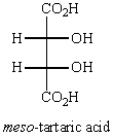 The structure of D-erythrose is shown below.
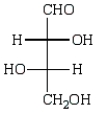
The structure of D-erythrose is shown below. (True/False)
4.9/5 (79)
(79) 
The textile cellulose acetate is produced by treatment of cellulose with acetic anhydride. What type of functional group is introduced on the cellulose under these conditions? 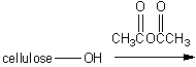
(Essay)
4.9/5 (88)
(88) 
Filters
- Essay(0)
- Multiple Choice(0)
- Short Answer(0)
- True False(0)
- Matching(0)