



 Chat with AI
Exam 23: Amines

Exam 1: Covalent Bonding and Shapes of Molecules115 Questions
Exam 2: Alkanes and Cycloalkanes95 Questions
Exam 3: Stereoisomerism and Chirality93 Questions
Exam 4: Acids and Bases94 Questions
Exam 5: Alkenes: Bonding, Nomenclature, and Properties86 Questions
Exam 6: Reactions of Alkenes98 Questions
Exam 7: Alkynes100 Questions
Exam 8: Haloalkanes, Halogenation, and Radical Reactions76 Questions
Exam 9: Nucleophilic Substitution and Beta-Elimination111 Questions
Exam 10: Alcohols98 Questions
Exam 11: Ethers, Epoxides, and Sulfides93 Questions
Exam 12: Infrared Spectroscopy67 Questions
Exam 13: Nuclear Magnetic Resonance Spectroscopy102 Questions
Exam 14: Mass Spectrometry65 Questions
Exam 15: An Introduction to Organometallic Compounds66 Questions
Exam 16: Aldehydes and Ketones119 Questions
Exam 17: Carboxylic Acids71 Questions
Exam 18: Functional Derivatives of Carboxylic Acids112 Questions
Exam 19: Enolate Anions and Enamines93 Questions
Exam 20: Dienes, Conjugated Systems, and Pericyclic Reactions69 Questions
Exam 21: Benzene and the Concept of Aromaticity85 Questions
Exam 22: Reactions of Benzene and Its Derivatives107 Questions
Exam 23: Amines88 Questions
Exam 24: Catalytic Carbon-Carbon Bond Formation77 Questions
Exam 25: Carbohydrates60 Questions
Exam 26: Lipids54 Questions
Exam 27: Amino Acids and Proteins70 Questions
Exam 28: Nucleic Acids52 Questions
Exam 29: Organic Polymer Chemistry60 Questions
Select questions type


What is the major organic product obtained from the following reaction? 

Free
(Multiple Choice)
4.9/5  (62)
(62) Correct Answer: Verified
C
What is the major organic product obtained from the following sequence of reactions? 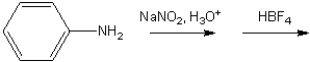
Free
(Essay)
5.0/5 (77)
(77) Correct Answer:Verified
Verified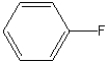
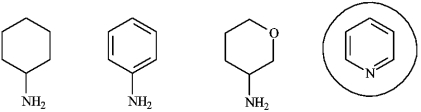
Consider the following compounds.  Answer the following questions by filling in the blank with the appropriate number from the diagram or an appropriate term.
-The ammonia ion of substance ____ will have the smallest pKa.
Answer the following questions by filling in the blank with the appropriate number from the diagram or an appropriate term.
-The ammonia ion of substance ____ will have the smallest pKa.Free
(Short Answer)
4.8/5 (82)
(82) Correct Answer:Verified
Verified4 four
Which of the following compounds are secondary (2 ) amines?
1)(CH3)3CNHCH3
2)CH3CH(NH2)CH2CH3
3)CH3CH2CH2NHCH3
4)CH3CH2CH2CH2CH2NH2
(Multiple Choice)
4.9/5 (95)
(95) What is the major organic product obtained from the following reaction? 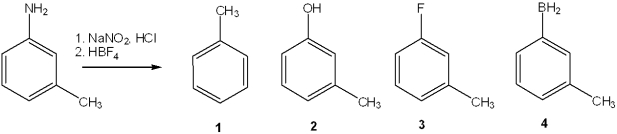
(Multiple Choice)
4.8/5 (65)
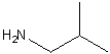
(65) 
Consider the following substances. 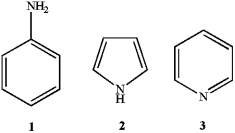 Complete the following statements using the appropriate number.
-Substance _____ is pyridine.
Complete the following statements using the appropriate number.
-Substance _____ is pyridine. (Short Answer)
4.9/5 (81)
(81) 
What is the major organic product obtained from the following reaction? 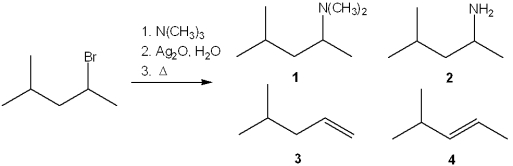
(Multiple Choice)
4.8/5 (95)
(95) Consider the following compounds. Answer the following questions by filling in the blank with the appropriate number from the diagram or an appropriate term.
-The name of the product formed by reacting CuCl and HCl with benzenediazonium chloride is ________________________.
Answer the following questions by filling in the blank with the appropriate number from the diagram or an appropriate term.
-The name of the product formed by reacting CuCl and HCl with benzenediazonium chloride is ________________________. (Short Answer)
4.8/5 (78)
(78) Which combination of carbonyl compound and amine can be used to prepare the following product by reductive amination? 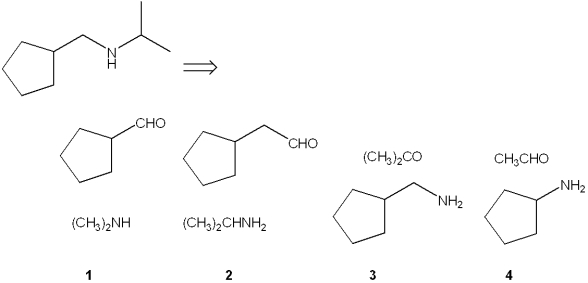
(Multiple Choice)
4.7/5 (72)
(72) Consider the following compounds. Answer the following questions by filling in the blank with the appropriate number from the diagram or an appropriate term.
-The name of the product formed by reacting KCN and CuCN with benzenediazonium chloride is ________________________.
Answer the following questions by filling in the blank with the appropriate number from the diagram or an appropriate term.
-The name of the product formed by reacting KCN and CuCN with benzenediazonium chloride is ________________________. (Short Answer)
4.9/5 (74)
(74) Provide a brief explanation, based on features of the molecules, for the following trend in pKa values?  4.15 4.63 1.0
 (Essay)
4.8/5 (86)
(86) What is the correct assignment of the names of the functional groups in the following nitrogen-containing compounds? 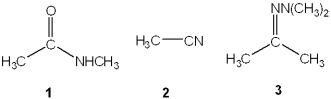
(Multiple Choice)
4.9/5 (77)
(77) What is the major organic product obtained from the following reaction? 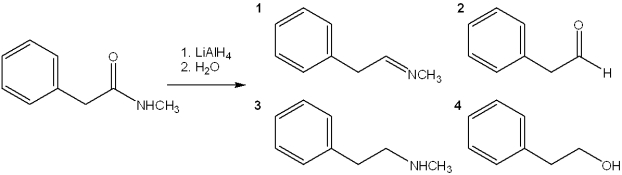
(Multiple Choice)
4.8/5 (86)
(86) What is the major organic product obtained from the following sequence of reactions? 
(Essay)
4.9/5 (76)
(76) 
What is the major organic product obtained from the following sequence of reactions? 
(Essay)
4.7/5 (90)
(90) 
Filters
- Essay(0)
- Multiple Choice(0)
- Short Answer(0)
- True False(0)
- Matching(0)