



 Chat with AI
Exam 13: Nuclear Magnetic Resonance Spectroscopy

Exam 1: Covalent Bonding and Shapes of Molecules115 Questions
Exam 2: Alkanes and Cycloalkanes95 Questions
Exam 3: Stereoisomerism and Chirality93 Questions
Exam 4: Acids and Bases94 Questions
Exam 5: Alkenes: Bonding, Nomenclature, and Properties86 Questions
Exam 6: Reactions of Alkenes98 Questions
Exam 7: Alkynes100 Questions
Exam 8: Haloalkanes, Halogenation, and Radical Reactions76 Questions
Exam 9: Nucleophilic Substitution and Beta-Elimination111 Questions
Exam 10: Alcohols98 Questions
Exam 11: Ethers, Epoxides, and Sulfides93 Questions
Exam 12: Infrared Spectroscopy67 Questions
Exam 13: Nuclear Magnetic Resonance Spectroscopy102 Questions
Exam 14: Mass Spectrometry65 Questions
Exam 15: An Introduction to Organometallic Compounds66 Questions
Exam 16: Aldehydes and Ketones119 Questions
Exam 17: Carboxylic Acids71 Questions
Exam 18: Functional Derivatives of Carboxylic Acids112 Questions
Exam 19: Enolate Anions and Enamines93 Questions
Exam 20: Dienes, Conjugated Systems, and Pericyclic Reactions69 Questions
Exam 21: Benzene and the Concept of Aromaticity85 Questions
Exam 22: Reactions of Benzene and Its Derivatives107 Questions
Exam 23: Amines88 Questions
Exam 24: Catalytic Carbon-Carbon Bond Formation77 Questions
Exam 25: Carbohydrates60 Questions
Exam 26: Lipids54 Questions
Exam 27: Amino Acids and Proteins70 Questions
Exam 28: Nucleic Acids52 Questions
Exam 29: Organic Polymer Chemistry60 Questions
Select questions type


Which of the following compounds gives a 1H NMR spectrum consisting of only two triplets and a singlet?

Free
(Multiple Choice)
4.8/5  (84)
(84) Correct Answer: Verified
B
How many signals appear in the proton-decoupled 13C NMR spectrum of 1,2-dibromobenzene?
Free
(Multiple Choice)
4.8/5 (83)
(83) Correct Answer:Verified
VerifiedC
MATCHING
The following questions pertain to the display of NMR spectra. Match a term to each description below.
-NMR spectrum are calibrated using an arbitrary scale that is divided into _____ units.
Free
(Multiple Choice)
4.9/5 (84)
(84) Correct Answer:Verified
VerifiedD
Identify the compound (C8H10) that gives the following 1H NMR spectrum. 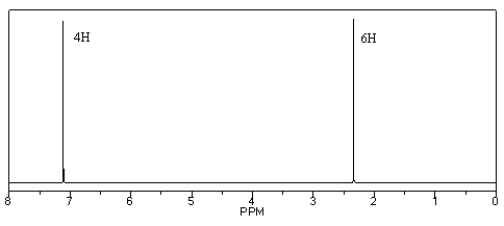
(Short Answer)
4.8/5 (69)
(69) Identify the compound (C3H7Cl) that gives the following 1H NMR spectrum. 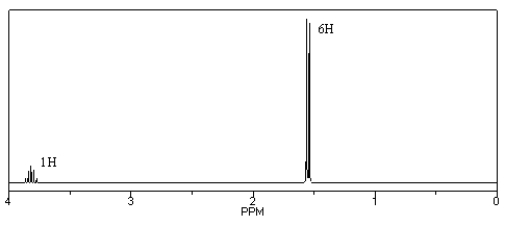
(Short Answer)
4.8/5 (77)
(77) Identify the compound (C4H8O2) that gives the following 1H NMR spectrum. 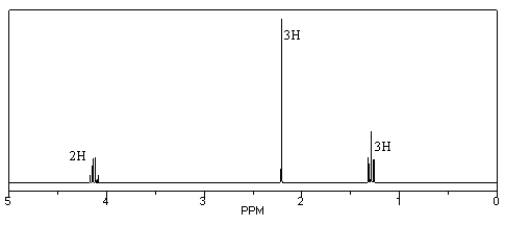
(Essay)
4.8/5 (76)
(76) All of the following would produce nuclear magnetic resonance: 2H, 14N, 16O, and 19F.
(True/False)
4.9/5 (85)
(85) Consider the following structure. Answer the following questions by placing the appropriate number in the blank to the left.  -_____The number of nonequivalent hydrogen atoms in this compound.
 (Short Answer)
4.9/5 (68)
(68) Which C4H9Br compound gives a doublet at approximately 3.3 ppm in the 1H NMR spectrum? 
(Multiple Choice)
4.8/5 (74)
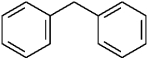
(74) For each of the compounds below tell how many signals you would expect the molecule to have in its normal, broadband hydrogen-decoupled 13C NMR spectra. Enter the numerical value in the blank provided to the left of the structure.
-_______ 
(Short Answer)
4.9/5 (67)
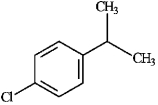
(67) For each of the compounds below tell how many signals you would expect the molecule to have in its normal, broadband hydrogen-decoupled 13C NMR spectra. Enter the numerical value in the blank provided to the left of the structure.
-_______ 
(Short Answer)
4.8/5 (74)
(74) Consider the following structure. Answer the following questions by placing the appropriate number in the blank to the left.
-_____The number of nonsinglet splitting patterns in the 1H NMR of this compound.
-_____The number of nonsinglet splitting patterns in the 1H NMR of this compound. (Short Answer)
4.8/5 (97)
(97) Which of the protons in the following molecule appear at the highest -value in the 1H NMR spectrum? 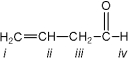
(Multiple Choice)
5.0/5 (75)
(75) Which of the following compounds have homotopic protons?
1)propane
2)butane
3)2-methylpropane
(Multiple Choice)
4.7/5 (79)
(79) MATCHING
The following questions pertain to the display of NMR spectra. Match a term to each description below.
-The calibration standard for 1H and 13C NMR is _____.
(Multiple Choice)
4.9/5 (87)
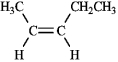
(87) For each of the compounds below tell how many signals you would expect the molecule to have in its normal, broadband hydrogen-decoupled 13C NMR spectra. Enter the numerical value in the blank provided to the left of the structure.
-_______ 
(Essay)
4.7/5 (71)
(71) What is the relative area of the six peaks in a septet in an 1H NMR spectrum?
(Multiple Choice)
4.9/5 (85)
(85) 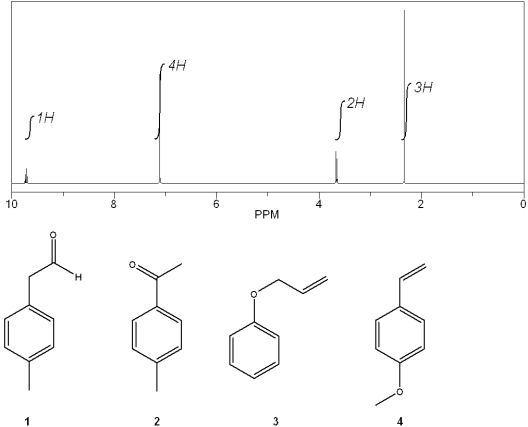
Identify the compound (C4H8O) that gives the following 1H NMR spectrum. 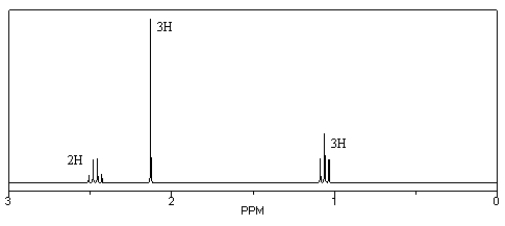
(Short Answer)
4.9/5 (77)
(77) All of the following compound produce only singlets in a 1H NMR spectrum. 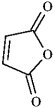
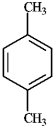

(True/False)
4.9/5 (81)
(81) 
Filters
- Essay(0)
- Multiple Choice(0)
- Short Answer(0)
- True False(0)
- Matching(0)