



 Chat with AI
Exam 13: Nuclear Magnetic Resonance Spectroscopy

Exam 1: Covalent Bonding and Shapes of Molecules115 Questions
Exam 2: Alkanes and Cycloalkanes95 Questions
Exam 3: Stereoisomerism and Chirality93 Questions
Exam 4: Acids and Bases94 Questions
Exam 5: Alkenes: Bonding, Nomenclature, and Properties86 Questions
Exam 6: Reactions of Alkenes98 Questions
Exam 7: Alkynes100 Questions
Exam 8: Haloalkanes, Halogenation, and Radical Reactions76 Questions
Exam 9: Nucleophilic Substitution and Beta-Elimination111 Questions
Exam 10: Alcohols98 Questions
Exam 11: Ethers, Epoxides, and Sulfides93 Questions
Exam 12: Infrared Spectroscopy67 Questions
Exam 13: Nuclear Magnetic Resonance Spectroscopy102 Questions
Exam 14: Mass Spectrometry65 Questions
Exam 15: An Introduction to Organometallic Compounds66 Questions
Exam 16: Aldehydes and Ketones119 Questions
Exam 17: Carboxylic Acids71 Questions
Exam 18: Functional Derivatives of Carboxylic Acids112 Questions
Exam 19: Enolate Anions and Enamines93 Questions
Exam 20: Dienes, Conjugated Systems, and Pericyclic Reactions69 Questions
Exam 21: Benzene and the Concept of Aromaticity85 Questions
Exam 22: Reactions of Benzene and Its Derivatives107 Questions
Exam 23: Amines88 Questions
Exam 24: Catalytic Carbon-Carbon Bond Formation77 Questions
Exam 25: Carbohydrates60 Questions
Exam 26: Lipids54 Questions
Exam 27: Amino Acids and Proteins70 Questions
Exam 28: Nucleic Acids52 Questions
Exam 29: Organic Polymer Chemistry60 Questions
Select questions type


How many signals appear in the proton-decoupled 13C NMR spectrum of 3-bromotoluene?
(Multiple Choice)
4.8/5  (77)
(77) Which of the following combinations of peaks appears in the 1H NMR spectrum of butane?
(Multiple Choice)
4.7/5 (80)
(80) What is the splitting of the signal in the 1H NMR spectrum for the methyl protons of ethane?
(Multiple Choice)
4.7/5 (91)
(91) Predict the splitting of each of the numbered hydrogen atoms in the structure below in a 1H NMR spectrum. Identify as singlet, doublet, triplet, quartet, quintet, sextet, septet, .... Place the correct splitting in the blank to the left of the number.  -______ 1
 (Short Answer)
4.9/5 (85)
(85) Which feature in the 1H NMR spectrum provides information about the electronic environment of the protons in a compound?
(Multiple Choice)
4.9/5 (82)
(82) How many signals appear in proton-decoupled 13C NMR spectrum of 3,4-dimethylhexane?
(Multiple Choice)
5.0/5 (80)
(80) Which C4H9Br compound(s) gives a 13C NMR spectrum consisting of two signals? 
(Multiple Choice)
4.8/5 (86)
(86) Which of the following combinations of peaks appears in the 1H NMR spectrum of 2,3-dimethylbutane?
(Multiple Choice)
4.7/5 (98)
(98) Which of the following compounds gives a 1H NMR spectrum consisting of only a singlet?
(Multiple Choice)
4.8/5 (90)
(90) Identify the compound (C8H10) that gives the following 1H NMR spectrum. 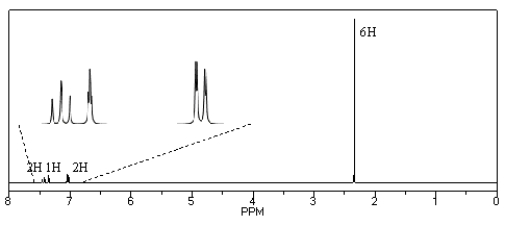
(Short Answer)
4.9/5 (92)
(92) Which of the following combinations of peaks appears in the 1H NMR spectrum of diethyl ether, CH3CH2OCH2CH3?
(Multiple Choice)
4.8/5 (85)
(85) Which of the following is true for pair of homotropic protons?
1)They will appear at the same chemical shift in an achiral (i.e., nonchiral) environment
2)They will appear at the same chemical shifts in a chiral environment
(Multiple Choice)
4.8/5 (76)
(76) Which of the carbon atoms in the following molecule appears furthest downfield in the 13C NMR spectrum? 
(Multiple Choice)
4.9/5 (71)
(71) What is the splitting of the signal in the 1H NMR spectrum for the methyl protons of propane?
(Multiple Choice)
4.9/5 (72)
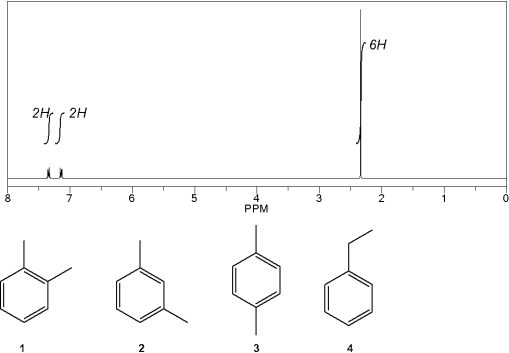
(72) 
MATCHING
The following questions pertain to the display of NMR spectra. Match a term to each description below.
-The exact place on the spectrum at which a nucleus absorbs is called its _____.
(Multiple Choice)
5.0/5 (71)
(71) Which C4H9Br compound(s) gives a 13C NMR spectrum consisting of four signals? 
(Multiple Choice)
4.9/5 (76)
(76) Which C6H12O2 compound gives the following 1H NMR spectrum? 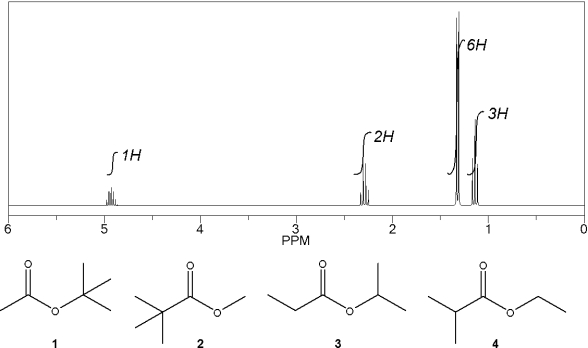
(Multiple Choice)
4.8/5 (71)
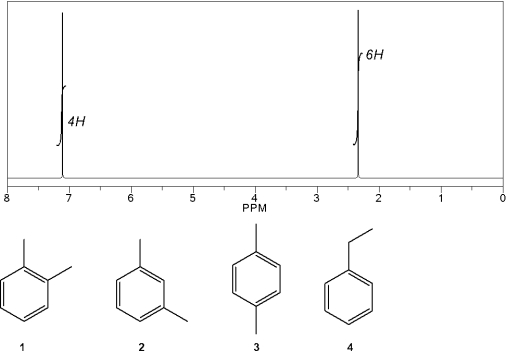
(71) 

Filters
- Essay(0)
- Multiple Choice(0)
- Short Answer(0)
- True False(0)
- Matching(0)