



 Chat with AI
Exam 29: Organic Polymer Chemistry

Exam 1: Covalent Bonding and Shapes of Molecules115 Questions
Exam 2: Alkanes and Cycloalkanes95 Questions
Exam 3: Stereoisomerism and Chirality93 Questions
Exam 4: Acids and Bases94 Questions
Exam 5: Alkenes: Bonding, Nomenclature, and Properties86 Questions
Exam 6: Reactions of Alkenes98 Questions
Exam 7: Alkynes100 Questions
Exam 8: Haloalkanes, Halogenation, and Radical Reactions76 Questions
Exam 9: Nucleophilic Substitution and Beta-Elimination111 Questions
Exam 10: Alcohols98 Questions
Exam 11: Ethers, Epoxides, and Sulfides93 Questions
Exam 12: Infrared Spectroscopy67 Questions
Exam 13: Nuclear Magnetic Resonance Spectroscopy102 Questions
Exam 14: Mass Spectrometry65 Questions
Exam 15: An Introduction to Organometallic Compounds66 Questions
Exam 16: Aldehydes and Ketones119 Questions
Exam 17: Carboxylic Acids71 Questions
Exam 18: Functional Derivatives of Carboxylic Acids112 Questions
Exam 19: Enolate Anions and Enamines93 Questions
Exam 20: Dienes, Conjugated Systems, and Pericyclic Reactions69 Questions
Exam 21: Benzene and the Concept of Aromaticity85 Questions
Exam 22: Reactions of Benzene and Its Derivatives107 Questions
Exam 23: Amines88 Questions
Exam 24: Catalytic Carbon-Carbon Bond Formation77 Questions
Exam 25: Carbohydrates60 Questions
Exam 26: Lipids54 Questions
Exam 27: Amino Acids and Proteins70 Questions
Exam 28: Nucleic Acids52 Questions
Exam 29: Organic Polymer Chemistry60 Questions
Select questions type


Thermosetting polymers continue to crosslink on heating followed by cooling to irreversibly produce an extremely hard material that cannot be remelted.

Free
(True/False)
4.9/5  (71)
(71) Correct Answer: Verified
True
Which of the following combinations of terms best describes the polymerization of a diisocyanate (OCN-R-NCO) and a diol to form a polyurethane?
Free
(Multiple Choice)
4.8/5 (85)
(85) Correct Answer:Verified
VerifiedA
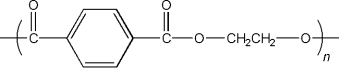
What is the name of the following polymer? 
Free
(Multiple Choice)
4.7/5 (80)
(80) Correct Answer:Verified
VerifiedB
MATCH a term or structure from the list below to each of the following definitions or names. Place the letter of the term or structure in the blank to the left of the definition or name which it describes.
-____ Characteristic of crystallites
(Multiple Choice)
4.8/5 (86)
(86) 
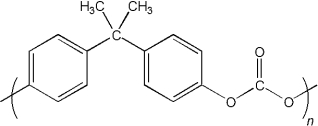
Provide the structure of poly(propylene oxide) that is formed by base catalyzed ring opening polymerization of the propylene oxide shown below. 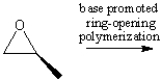
(Essay)
4.8/5 (78)
(78) What type of intermediate is formed in the polymerization of styrene with butyllithium?
(Multiple Choice)
4.7/5 (79)
(79) MATCH a term or structure from the list below to each of the following definitions or names. Place the letter of the term or structure in the blank to the left of the definition or name which it describes.
-____ a Ziegler-Natta catalyst
(Multiple Choice)
4.8/5 (84)
(84) MATCH a term or structure from the list below to each of the following definitions or names. Place the letter of the term or structure in the blank to the left of the definition or name which it describes.
-___ Isotactic propylene
(Multiple Choice)
4.9/5 (75)
(75) Consider the polymeric structure below for amylose (a type of starch). 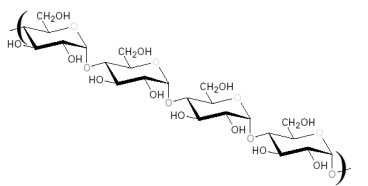 The structure for the monomer is given below.
 (True/False)
4.9/5 (99)
(99) MATCH a term or structure from the list below to each of the following definitions or names. Place the letter of the term or structure in the blank to the left of the definition or name which it describes.
-____ Bakelite is this type of polymer.
(Multiple Choice)
4.8/5 (66)
(66) Which type of polymerization can be used to polymerize isobutylene, (CH3)2C=CH2?
(Multiple Choice)
4.8/5 (73)
(73) MATCH a term or structure from the list below to each of the following definitions or names. Place the letter of the term or structure in the blank to the left of the definition or name which it describes.
-____ Polymers obtained when two or more different monomers are allowed to polymerize together.
(Multiple Choice)
4.9/5 (76)
(76) Ziegler-Natta catalysts, used to prepare linear polymer molecules, consist of: organoaluminum compounds and transition metal salts.
(True/False)
4.9/5 (79)
(79) Which type of polymerization can be used to polymerize methyl 2-cyanoacrylate, H2C=C(CN)CO2CH3?
(Multiple Choice)
4.8/5 (85)
(85) Provide the structure of polyacetylene that is formed by ring-opening metathesis polymerization of 1,3,5,7-cyclooctatetraene. 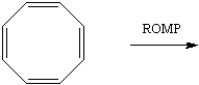
(Essay)
4.9/5 (85)
(85) 
Filters
- Essay(0)
- Multiple Choice(0)
- Short Answer(0)
- True False(0)
- Matching(0)