



 Chat with AI
Exam 25: Carbohydrates

Exam 1: Covalent Bonding and Shapes of Molecules115 Questions
Exam 2: Alkanes and Cycloalkanes95 Questions
Exam 3: Stereoisomerism and Chirality93 Questions
Exam 4: Acids and Bases94 Questions
Exam 5: Alkenes: Bonding, Nomenclature, and Properties86 Questions
Exam 6: Reactions of Alkenes98 Questions
Exam 7: Alkynes100 Questions
Exam 8: Haloalkanes, Halogenation, and Radical Reactions76 Questions
Exam 9: Nucleophilic Substitution and Beta-Elimination111 Questions
Exam 10: Alcohols98 Questions
Exam 11: Ethers, Epoxides, and Sulfides93 Questions
Exam 12: Infrared Spectroscopy67 Questions
Exam 13: Nuclear Magnetic Resonance Spectroscopy102 Questions
Exam 14: Mass Spectrometry65 Questions
Exam 15: An Introduction to Organometallic Compounds66 Questions
Exam 16: Aldehydes and Ketones119 Questions
Exam 17: Carboxylic Acids71 Questions
Exam 18: Functional Derivatives of Carboxylic Acids112 Questions
Exam 19: Enolate Anions and Enamines93 Questions
Exam 20: Dienes, Conjugated Systems, and Pericyclic Reactions69 Questions
Exam 21: Benzene and the Concept of Aromaticity85 Questions
Exam 22: Reactions of Benzene and Its Derivatives107 Questions
Exam 23: Amines88 Questions
Exam 24: Catalytic Carbon-Carbon Bond Formation77 Questions
Exam 25: Carbohydrates60 Questions
Exam 26: Lipids54 Questions
Exam 27: Amino Acids and Proteins70 Questions
Exam 28: Nucleic Acids52 Questions
Exam 29: Organic Polymer Chemistry60 Questions
Select questions type


From the sugars below, choose the one that best fits each description below. Place the letter of the sugar in the blank to the left of the description. There is only one correct answer for each question.
-_____ is a deoxy sugar.
(Multiple Choice)
4.8/5  (65)
(65) 
What are the two major organic products obtained from the following reaction? What is the relationship between them? (What type of isomers are they?) 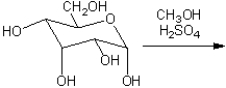
(Essay)
4.7/5 (74)
(74) A 1,4- -linkage between two glucose units produces a disaccharide called maltose.
(True/False)
4.8/5 (74)
(74) What is the major organic product obtained from the following reaction? 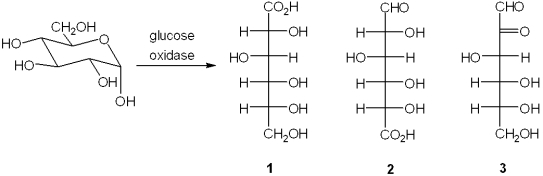
(Multiple Choice)
4.9/5 (78)
(78) What are the R/S stereochemical designations of C2 and C3 of D-erythrose? 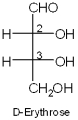
(Multiple Choice)
4.9/5 (74)
(74) What is the major organic product obtained from the reaction of glucose with glucose oxidase? 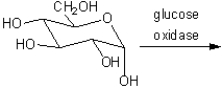
(Essay)
5.0/5 (66)
(66) Consider the following structures.  Answer the following questions by placing the appropriate number or indicated letter in the blank.
-The formula for maltose is:
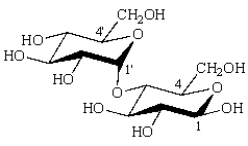 The number of the acetal carbon is _____.
Answer the following questions by placing the appropriate number or indicated letter in the blank.
-The formula for maltose is: The number of the acetal carbon is _____. (Short Answer)
4.9/5 (88)
(88) Which of the following structures represent the same carbohydrate? 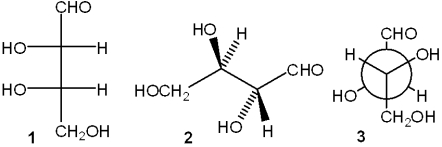
(Multiple Choice)
4.8/5 (76)
(76) Complete the structure on the right so that it represents the pyranose form of the carbohydrate shown on the left as a Fischer projection. Place the substituents carefully so that their position in axial or equatorial positions accurately reflects the stereochemistry of the carbohydrate. 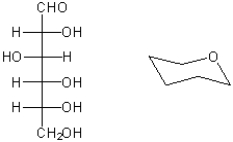
(Essay)
4.9/5 (75)
(75) From the sugars below, choose the one that best fits each description below. Place the letter of the sugar in the blank to the left of the description. There is only one correct answer for each question.
-The name of the following Fischer projection including stereochemistry is _____________________. 
(Short Answer)
4.9/5 (76)
(76) Which of the following structures represent the same carbohydrate? 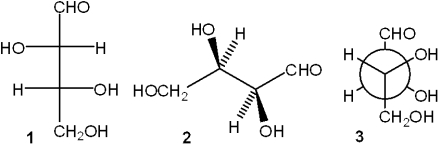
(Multiple Choice)
4.9/5 (58)
(58) From the sugars below, choose the one that best fits each description below. Place the letter of the sugar in the blank to the left of the description. There is only one correct answer for each question.
-_____ is a sugar with three chirality centers.
(Multiple Choice)
4.7/5 (82)
(82) The following are two different methods of representing the same structure. 
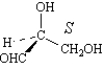
(True/False)
4.9/5 (79)
(79) Complete the structure on the right so that it represents the pyranose form of the carbohydrate shown on the left as a Fischer projection. Place the substituents carefully so that their position in axial or equatorial positions accurately reflects the stereochemistry of the carbohydrate. 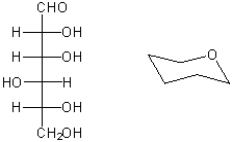
(Essay)
4.8/5 (87)
(87) Consider the following structures. Answer the following questions by placing the appropriate number or indicated letter in the blank.
-The structures that represent reducing sugars are:
a. only the ketoses.
b. only the aldoses.
c. all of these structures.
Answer the following questions by placing the appropriate number or indicated letter in the blank.
-The structures that represent reducing sugars are:
a. only the ketoses.
b. only the aldoses.
c. all of these structures. (Short Answer)
4.9/5 (72)
(72) What is the major organic product obtained from the following reaction? 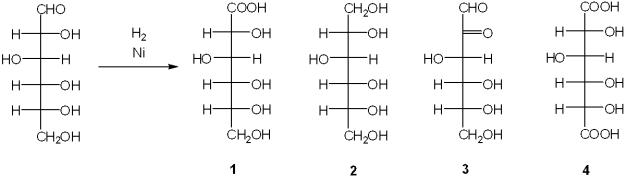
(Multiple Choice)
4.8/5 (76)
(76) 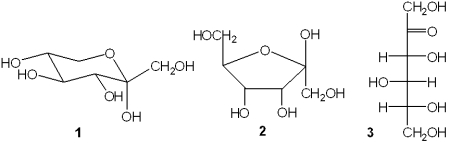
A glycoside is formed upon reaction of glucopyranose with NaBH4.
(True/False)
4.8/5 (77)
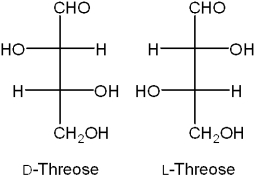
(77) What is the relationship between D-erythrose and D-threose? 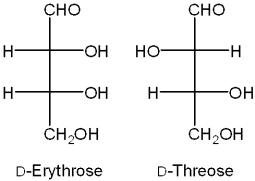
(Multiple Choice)
4.9/5 (77)
(77) 
Filters
- Essay(0)
- Multiple Choice(0)
- Short Answer(0)
- True False(0)
- Matching(0)