



 Chat with AI
Exam 22: Reactions of Benzene and Its Derivatives

Exam 1: Covalent Bonding and Shapes of Molecules115 Questions
Exam 2: Alkanes and Cycloalkanes95 Questions
Exam 3: Stereoisomerism and Chirality93 Questions
Exam 4: Acids and Bases94 Questions
Exam 5: Alkenes: Bonding, Nomenclature, and Properties86 Questions
Exam 6: Reactions of Alkenes98 Questions
Exam 7: Alkynes100 Questions
Exam 8: Haloalkanes, Halogenation, and Radical Reactions76 Questions
Exam 9: Nucleophilic Substitution and Beta-Elimination111 Questions
Exam 10: Alcohols98 Questions
Exam 11: Ethers, Epoxides, and Sulfides93 Questions
Exam 12: Infrared Spectroscopy67 Questions
Exam 13: Nuclear Magnetic Resonance Spectroscopy102 Questions
Exam 14: Mass Spectrometry65 Questions
Exam 15: An Introduction to Organometallic Compounds66 Questions
Exam 16: Aldehydes and Ketones119 Questions
Exam 17: Carboxylic Acids71 Questions
Exam 18: Functional Derivatives of Carboxylic Acids112 Questions
Exam 19: Enolate Anions and Enamines93 Questions
Exam 20: Dienes, Conjugated Systems, and Pericyclic Reactions69 Questions
Exam 21: Benzene and the Concept of Aromaticity85 Questions
Exam 22: Reactions of Benzene and Its Derivatives107 Questions
Exam 23: Amines88 Questions
Exam 24: Catalytic Carbon-Carbon Bond Formation77 Questions
Exam 25: Carbohydrates60 Questions
Exam 26: Lipids54 Questions
Exam 27: Amino Acids and Proteins70 Questions
Exam 28: Nucleic Acids52 Questions
Exam 29: Organic Polymer Chemistry60 Questions
Select questions type


What is the major organic product obtained from the following reaction? 
(Multiple Choice)
4.8/5  (75)
(75) Consider the reaction below to answer the following question(s).  Fill in the blank with the appropriate letter or response.
-This reaction proceeds _____ (faster or slower) than when benzene is used.
Fill in the blank with the appropriate letter or response.
-This reaction proceeds _____ (faster or slower) than when benzene is used. (Short Answer)
4.9/5 (79)
(79) What is the major organic product obtained from the following sequence of reactions? 
(Multiple Choice)
4.8/5 (77)
(77) The predominant intermediate in the electrophilic nitration of toluene is shown below. 
(True/False)
4.7/5 (73)
(73) Consider the following compounds. 


 Use the number of the compound to answer the following question. Place the number in the blank provided.
-The compound that is the least reactive to nitration is ______.
Use the number of the compound to answer the following question. Place the number in the blank provided.
-The compound that is the least reactive to nitration is ______. (Short Answer)
4.8/5 (75)
(75) Why does nitrobenzene fail to undergo Friedel-Crafts alkylation with tert-butyl chloride and AlCl3?
(Multiple Choice)
4.8/5 (76)
(76) What is the major organic product obtained from the following reaction? 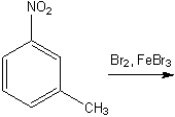
(Essay)
4.9/5 (74)
(74) Which of the following undergoes the most rapid nitration upon treatment with HNO3/H2SO4?
(Multiple Choice)
4.8/5 (89)
(89) Which of the following compounds undergoes the most rapid nucleophilic substitution with hydroxide ion? 
(Multiple Choice)
4.9/5 (73)
(73) The best sequence in which to carry out the following reaction is 1) Br2, AlBr3, 2) H2SO4, SO3. 
(True/False)
4.8/5 (87)
(87) What is the major organic product obtained from the following sequence of reactions (if a reaction is likely to give you a mixture of ortho and para disubstituted compounds you should assume that they can be separated; continue the synthesis with either one)? 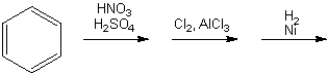
(Essay)
4.9/5 (86)
(86) What is the major organic product obtained from the following reaction? 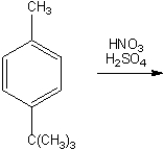
(Essay)
4.7/5 (77)
(77) 
The electrophile that could be used to make acetophenone (methyl phenyl ketone) from benzene is shown below. 
(True/False)
5.0/5 (83)
(83) Which of the following undergoes the most rapid bromination upon treatment with Br2/FeBr3?
(Multiple Choice)
4.8/5 (84)
(84) What is the major organic product obtained from the following sequence of reactions? 
(Multiple Choice)
4.9/5 (87)
(87) What is the electrophile in the reaction of benzene with acetyl chloride, CH3COCl, and AlCl3?
(Multiple Choice)
4.9/5 (79)
(79) Which mechanism accounts for the reaction of 4-bromo-1-nitrobenzene with sodium hydroxide to form 4-nitrophenol?
(Multiple Choice)
4.8/5 (78)
(78) Which mechanism accounts for the reaction of benzyl chloride with sodium cyanide to form cyanomethylbenzene (phenylacetonitrile, PhCH2CN)?
(Multiple Choice)
5.0/5 (88)
(88) Which of the following cannot be prepared from benzene in two synthetic steps? 
(Multiple Choice)
4.8/5 (78)
(78) 
Filters
- Essay(0)
- Multiple Choice(0)
- Short Answer(0)
- True False(0)
- Matching(0)