



 Chat with AI
Exam 22: Reactions of Benzene and Its Derivatives

Exam 1: Covalent Bonding and Shapes of Molecules115 Questions
Exam 2: Alkanes and Cycloalkanes95 Questions
Exam 3: Stereoisomerism and Chirality93 Questions
Exam 4: Acids and Bases94 Questions
Exam 5: Alkenes: Bonding, Nomenclature, and Properties86 Questions
Exam 6: Reactions of Alkenes98 Questions
Exam 7: Alkynes100 Questions
Exam 8: Haloalkanes, Halogenation, and Radical Reactions76 Questions
Exam 9: Nucleophilic Substitution and Beta-Elimination111 Questions
Exam 10: Alcohols98 Questions
Exam 11: Ethers, Epoxides, and Sulfides93 Questions
Exam 12: Infrared Spectroscopy67 Questions
Exam 13: Nuclear Magnetic Resonance Spectroscopy102 Questions
Exam 14: Mass Spectrometry65 Questions
Exam 15: An Introduction to Organometallic Compounds66 Questions
Exam 16: Aldehydes and Ketones119 Questions
Exam 17: Carboxylic Acids71 Questions
Exam 18: Functional Derivatives of Carboxylic Acids112 Questions
Exam 19: Enolate Anions and Enamines93 Questions
Exam 20: Dienes, Conjugated Systems, and Pericyclic Reactions69 Questions
Exam 21: Benzene and the Concept of Aromaticity85 Questions
Exam 22: Reactions of Benzene and Its Derivatives107 Questions
Exam 23: Amines88 Questions
Exam 24: Catalytic Carbon-Carbon Bond Formation77 Questions
Exam 25: Carbohydrates60 Questions
Exam 26: Lipids54 Questions
Exam 27: Amino Acids and Proteins70 Questions
Exam 28: Nucleic Acids52 Questions
Exam 29: Organic Polymer Chemistry60 Questions
Select questions type


Consider the reaction below to answer the following question(s).  Fill in the blank with the appropriate letter or response.
-The name of product D is ________________________.
Fill in the blank with the appropriate letter or response.
-The name of product D is ________________________. (Short Answer)
4.9/5  (80)
(80) What is the major organic product obtained from the following sequence of reactions (if a reaction is likely to give you a mixture of ortho and para disubstituted compounds you should assume that they can be separated; continue the synthesis with either one)? 
(Essay)
4.7/5 (89)
(89) Which of the following are valid resonance structures of the electophile involved in Friedel-Crafts acylation of benzene upon treatment with CH3COCl and AlCl3? 
(Multiple Choice)
4.8/5 (65)
(65) Which of the following sets of substituents are all ortho/para directing in electrophilic aromatic substitution reactions?
(Multiple Choice)
4.9/5 (83)
(83) Which of the following undergoes the most rapid sulfonation upon treatment with fuming sulfuric acid?
(Multiple Choice)
4.8/5 (82)
(82) Which mechanism accounts for the reaction of 4-bromotoluene with sodium amide to form a mixture of 3- and 4-aminotoluene?
(Multiple Choice)
5.0/5 (89)
(89) Consider the following compounds. 


 Use the number of the compound to answer the following question. Place the number in the blank provided.
-The compound that is the most reactive to nitration is ______.
Use the number of the compound to answer the following question. Place the number in the blank provided.
-The compound that is the most reactive to nitration is ______. (Short Answer)
4.9/5 (80)
(80) Which of the following is the reactive intermediate in the nucleophilic substitution of 4-bromo-1-toluene with sodium amide? 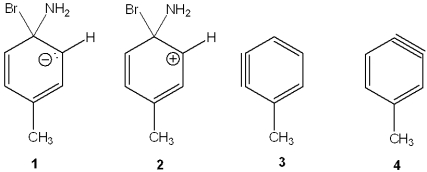
(Multiple Choice)
4.7/5 (74)
(74) What is the major organic product obtained from the following reaction? 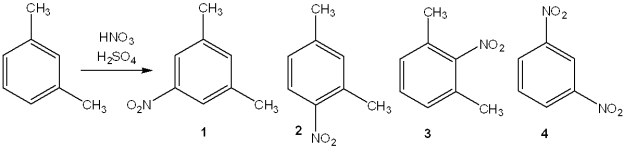
(Multiple Choice)
4.8/5 (85)
(85) Provide the structure (a single resonance contributor) of the key intermediate in the following reaction. 
(Essay)
4.7/5 (89)
(89) What is the major organic product obtained from the following sequence of reactions? 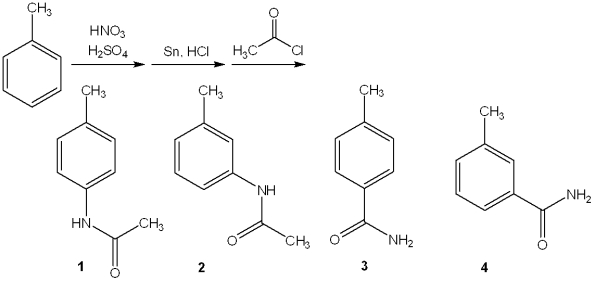
(Multiple Choice)
4.9/5 (80)
(80) The predominant product from sequential nitration and bromination of benzenesulfonic acid is shown below. 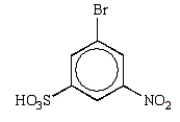
(True/False)
5.0/5 (85)
(85) What is the major organic product obtained from the following reaction? 
(Essay)
4.9/5 (86)
(86) What is the major organic product obtained from the following sequence of reactions? 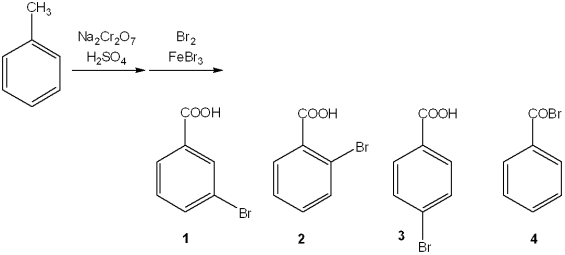
(Multiple Choice)
4.8/5 (74)
(74) Why does anisole undergo bromination with Br2 in the absence of FeBr3 whereas bromination of benzene requires the presence of FeBr3?
(Multiple Choice)
4.7/5 (69)
(69) Consider the reaction below to answer the following question(s). Fill in the blank with the appropriate letter or response.
-The Lewis acid catalyst in the reaction is _____.
Fill in the blank with the appropriate letter or response.
-The Lewis acid catalyst in the reaction is _____. (Multiple Choice)
4.8/5 (75)
(75) Tetracyclone (shown below) is often used to trap benzynes as Diels-Alder adducts. 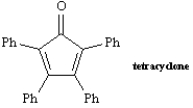 The structure of the Diels-Alder adduct that results when benzyne is trapped by tetracyclone would be
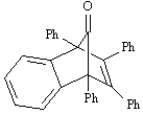
The structure of the Diels-Alder adduct that results when benzyne is trapped by tetracyclone would be (True/False)
4.9/5 (89)
(89) Which of the following chlorobenzenes produces a single isomer upon treatment with NaNH2? 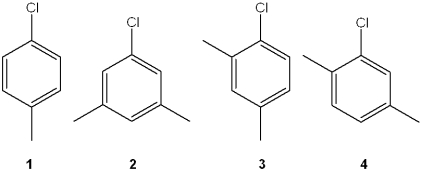
(Multiple Choice)
4.8/5 (78)
(78) Which of the following reactions or reaction sequences will not give isopropylbenzene as the major product?
(Multiple Choice)
4.8/5 (81)
(81) What is the major organic product obtained from the following reaction (assume that mixtures of ortho and para disubstituted compounds can be separated; continue the synthesis with either one)? 
(Essay)
4.9/5 (68)
(68) 
Filters
- Essay(0)
- Multiple Choice(0)
- Short Answer(0)
- True False(0)
- Matching(0)