



 Chat with AI
Exam 6: Thermochemistry

Exam 1: Chemistry: the Study of Change168 Questions
Exam 2: Atoms, Molecules, and Ions156 Questions
Exam 3: Mass Relationships in Chemical Reactions194 Questions
Exam 4: Reactions in Aqueous Solutions186 Questions
Exam 5: Gases121 Questions
Exam 6: Thermochemistry118 Questions
Exam 7: Quantum Theory and the Electronic Structure of Atoms136 Questions
Exam 8: Periodic Relationships Among the Elements144 Questions
Exam 9: Chemical Bonding I: Basic Concepts137 Questions
Exam 10: Chemical Bonding Ii: Molecular Geometry and Hybridization of Atomic Orbitals147 Questions
Exam 11: Intermolecular Forces and Liquids and Solids149 Questions
Exam 12: Physical Properties of Solutions122 Questions
Exam 13: Chemical Kinetics130 Questions
Exam 14: Chemical Equilibrium109 Questions
Exam 15: Acids and Bases178 Questions
Exam 16: Acid-Base Equilibria and Solubility Equilibria131 Questions
Exam 17: Entropy Free Energy and Equilibrium128 Questions
Exam 18: Electrochemistry154 Questions
Exam 19: Nuclear Chemistry133 Questions
Exam 20: Chemistry in the Atmosphere50 Questions
Exam 21: Metallurgy and the Chemistry of Metals63 Questions
Exam 22: Nonmetallic Elements and Their Compounds52 Questions
Exam 23: Transition Metal Chemistry and Coordination Compounds92 Questions
Exam 24: Organic Chemistry67 Questions
Exam 25: Synthetic and Natural Organic Polymers50 Questions
Select questions type


Three separate 3.5g blocks of Al, Cu, and Fe at 25 °C each absorb 0.505 kJ of heat.Which block reaches the highest temperature? The specific heats of Al, Cu, and Fe are 0.900 J/g·°C, 0.385J/g·°C, and 0.444 J/g·°C, respectively.
(Multiple Choice)
4.8/5  (87)
(87) How much heat is required to raise the temperature of 1.5 x 10³ g of water from 45°F to 130.°F? The specific heat of water is 4.184 J/g·°C.
(Multiple Choice)
4.8/5 (90)
(90) The residential rate for natural gas is about $15 per thousand cubic foot.Burning one cubic foot of natural gas releases about 1080 kJ of heat.How much would it cost to heat the water in a 25,000 gallon swimming pool from 52°F to 78°F, assuming all of the heat from burning the natural gas went towards warming the water? (1 gal = 3.785 L; the specific heat of water = 4.184 J/g·°C)
(Short Answer)
4.8/5 (83)
(83) An average home in Colorado requires 20.GJ of heat per month.How many grams of natural gas (methane)must be burned to supply this energy?
CH4(g)+ 2O2(g) CO2(g)+ 2H2O(l), H°rxn= -890.4 kJ/mol
(Multiple Choice)
4.9/5 (67)
(67) When 0.7521 g of benzoic acid was burned in a calorimeter containing 1,000.g of water, a temperature rise of 3.60°C was observed.What is the heat capacity of the bomb calorimeter, excluding the water? The heat of combustion of benzoic acid is -26.42 kJ/g.
(Multiple Choice)
4.9/5 (68)
(68) The reaction that represents the standard enthalpy of formation for benzene (C6H6)is:
(Multiple Choice)
4.8/5 (86)
(86) The work done on the surroundings by the expansion of a gas is w = -P V.
(True/False)
5.0/5 (76)
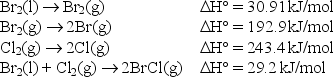
(76) The bond enthalpy of the Br-Cl bond is equal to H° for the reaction
BrCl(g) Br(g)+ Cl(g).
Use the following data to find the bond enthalpy of the Br-Cl bond.
(Multiple Choice)
4.8/5 (77)
(77) At body temperature 2,404 joules of energy are required to evaporate 1.00 g of water.After vigorous exercise, a person feels chilly because the body is giving up heat to evaporate the perspiration.A typical person perspires 25 mL of water after 20.minutes of exercise.How much body heat is this person using to evaporate this water?
(Short Answer)
4.7/5 (90)
(90) A piece of copper with a mass of 218 g has a heat capacity of 83.9 J/°C.What is the specific heat of copper?
(Multiple Choice)
4.9/5 (83)
(83) Aluminum oxide can be reduced to aluminum metal using carbon, the other reaction product being carbon monoxide.Determine the enthalpy change when 12.5 g of aluminum is produced by this method.[ H°f(carbon monoxide)= -110.5 kJ/mol; H°f(aluminum oxide)= -1669.8 kJ/mol]
(Multiple Choice)
4.7/5 (68)
(68) Calculate the standard enthalpy change for the reaction
2A + 2A2 + 4AB + B 5A2B
Given: 
(Multiple Choice)
4.9/5 (85)
(85) During volcanic eruptions, hydrogen sulfide gas is given off and oxidized by air according to the following chemical equation:
2H2S(g)+ 3O2(g) 2SO2(g)+ 2H2O(g)
Calculate the standard enthalpy change for the above reaction given: 
(Multiple Choice)
4.9/5 (67)
(67) Calculate the standard enthalpy change for the reaction
4A + 2B 2AB + A2
Given: 
(Multiple Choice)
4.7/5 (80)
(80) Given that CaO(s)+ H2O(l) Ca(OH)2(s), H°rxn = -64.8 kJ/mol, how many grams of CaO must react in order to liberate 525 kJ of heat?
(Multiple Choice)
4.7/5 (85)
(85) Concerning the reaction  how many grams of C(graphite)must be burned to release 275 kJ of heat?
 (Multiple Choice)
4.8/5 (66)
(66) What would be the standard enthalpy change for the reaction of 1.00 mole of H2(g)with 1.00 mole of Cl2(g)to produce 2.00 moles of HCl(g)at standard state conditions?
H°f (HCl(g))= -92.3 kJ/mol]
(Short Answer)
5.0/5 (80)
(80) Naphthalene combustion can be used to calibrate the heat capacity of a bomb calorimeter.The heat of combustion of naphthalene is -40.1 kJ/g.When 0.8210 g of naphthalene was burned in a calorimeter containing 1,000.g of water, a temperature rise of 4.21°C was observed.What is the heat capacity of the bomb calorimeter excluding the water?
(Multiple Choice)
4.9/5 (75)
(75) 
Filters
- Essay(0)
- Multiple Choice(0)
- Short Answer(0)
- True False(0)
- Matching(0)