



 Chat with AI
Exam 18: Thermodynamics

Exam 1: Introduction153 Questions
Exam 2: Atoms, Molecules, and Ions141 Questions
Exam 3: Stoichiometry168 Questions
Exam 4: Reactions in Aqueous Solution156 Questions
Exam 5: Gases109 Questions
Exam 6: Energy Relationships in Chemical Reactions105 Questions
Exam 7: The Electronic Structure of Atoms115 Questions
Exam 8: The Periodic Table119 Questions
Exam 9: Chemical Bonding I: the Covalent Bond118 Questions
Exam 10: Chemical Bonding Ii: Molecular Geometry and Hybridization of Atomic Orbitals120 Questions
Exam 11: Introduction to Organic Chemistry57 Questions
Exam 12: Intermolecular Forces and Liquids and Solids138 Questions
Exam 13: Physical Properties of Solutions109 Questions
Exam 14: Chemical Kinetics114 Questions
Exam 15: Chemical Equilibrium99 Questions
Exam 16: Acids and Bases163 Questions
Exam 17: Acid-Base Equilibria and Solubility Equilibria92 Questions
Exam 18: Thermodynamics112 Questions
Exam 19: Redox Reactions and Electrochemistry138 Questions
Exam 20: The Chemistry of Coordination Compounds76 Questions
Exam 21: Nuclear Chemistry112 Questions
Exam 22: Organic Polymerssynthetic and Natural42 Questions
Select questions type


Rubidium has a heat of vaporization of 69.0 kJ/mol at its boiling point (686°C). Calculate S for this process, Rb(l) Rb(g), at 1 atm and 686°C.
(Short Answer)
4.9/5  (76)
(76) HI has a normal boiling point of -35.4°C, and its Hvap is 21.16 kJ/mol. Calculate the molar entropy of vaporization ( Svap).
(Multiple Choice)
4.7/5 (86)
(86) Arrange these compounds in order of increasing standard molar entropy at 25°C: C3H8(g), C2H4(g), ZnS(s), and H2O(l).
(Multiple Choice)
4.9/5 (87)
(87) The solubility product constant at 25°C for AgI(s)in water has the value 8.3 * 10-17. Calculate Grxn at 25°C for the process AgI(s) Ag+(aq)+ I- (aq)where [Ag+] = 9.1 * 10-9 and [I-] = 9.1 * 10-9.
(Multiple Choice)
4.8/5 (83)
(83) Consider the reaction CO(g)+ 2H2(g) CH3OH(l)at 25°C.
G°f (CO)= -137.3 kJ/mol
G°f (CH3OH)= -166.3 kJ/mol
H°f (CO)= -110.5 kJ/mol
H°f (CH3OH)= -238.7 kJ/mol
S°(CO)= 197.9 J/K·mol
S°(CH3OH)= 126.8 J/K·mol
Calculate value of the equilibrium constant (Kp)for this reaction at 25°C.
(Essay)
4.8/5 (80)
(80) How does the entropy change when a gas is converted to a liquid?
(Short Answer)
4.9/5 (82)
(82) The equilibrium constant for the reaction AgBr(s) Ag+(aq)+ Br- (aq)is the solubility product constant, Ksp = 7.7* 10-13 at 25°C. Calculate G for the reaction when [Ag+] = 1.0 * 10-2 M and [Br-] = 1.0 * 10-3 M. Is the reaction spontaneous or nonspontaneous at these concentrations?
(Multiple Choice)
4.7/5 (98)
(98) Which of these species would you expect to have the lowest standard entropy (S°)?
(Multiple Choice)
4.8/5 (77)
(77) Arrange the following substances in the order of increasing entropy at 25°C. HF(g), NaF(s), SiF4(g), SiH4(g), Al(s)
Lowest highest
(Multiple Choice)
4.9/5 (74)
(74) Calculate the equilibrium constant for the decomposition of water 2H2O(l) 2H2(g)+ O2(g)
At 25°C, given that G°f (H2O(l))= -237.2 kJ/mol.
(Multiple Choice)
4.9/5 (70)
(70) For the reaction HCONH2(g) NH3(g)+ CO(g), Kc = 4.84 at 400 K. If H° for this reaction is 29 kJ/mol, find Kc at 500 K.
(Multiple Choice)
4.8/5 (82)
(82) Predict the sign of S for the reaction 6CO2(g)+ 6H2O(g) C6H12O6(g)+ 6O2(g).
(Short Answer)
5.0/5 (82)
(82) Assuming S° and H° do not vary with temperature, at what temperature will the reaction shown below become spontaneous?
C(s)+ H2O(g) H2(g)+ CO(s)( S° = 133.6 J/K·mol; H° = 131.3 kJ/mol)
(Short Answer)
4.9/5 (81)
(81) For the reaction SbCl5(g) SbCl3(g)+ Cl2(g),
G°f (SbCl5)= -334.34 kJ/mol
G°f (SbCl3)= -301.25 kJ/mol
H°f (SbCl5)= -394.34 kJ/mol
H°f (SbCl3)= -313.80 kJ/mol
Will this reaction proceed spontaneously at 298 K and 1 atm pressure?
(Short Answer)
4.8/5 (81)
(81) Using the thermodynamic data provided below, calculate Ksp for Mg(OH)2(s)at 25°. 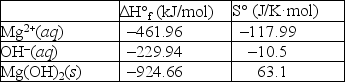
(Essay)
4.8/5 (85)
(85) What is the free energy change for the reaction SiO2(s)+ Pb(s) PbO2(s)+ Si(s)?
G°f (PbO2)= -217 kJ/mol
G°f (SiO2)= -856 kJ/mol
(Short Answer)
4.8/5 (60)
(60) Choose the substance with the higher entropy per mole at a given temperature: Br2(l)or Br2(g).
(Short Answer)
4.9/5 (79)
(79) For the reaction CuS(s)+ H2(g) H2S(g)+ Cu(s),
G°f (CuS)= -53.6 kJ/mol
G°f (H2S)= -33.6 kJ/mol
H°f (CuS)= -53.1 kJ/mol
H°f (H2S)= -20.6 kJ/mol
Calculate the value of the equilibrium constant (Kp)at 798 K and 1 atm pressure.
(Short Answer)
4.8/5 (69)
(69) For the reaction CuS(s)+ H2(g) H2S(g)+ Cu(s),
G°f (CuS)= -53.6 kJ/mol
G°f (H2S)= -33.6 kJ/mol
H°f (CuS)= -53.1 kJ/mol
H°f (H2S)= -20.6 kJ/mol
Will this reaction proceed spontaneously at 298 K and 1 atm pressure?
(Short Answer)
4.8/5 (84)
(84) For the reaction 3H2(g)+ N2(g) 2NH3(g), Kc = 9.0 at 350°C. What is the value of G at this temperature when 1.0 mol NH3, 5.0 mol N2, and 5.0 mol H2 are mixed in a 2.5 L reactor?
(Short Answer)
4.8/5 (82)
(82) 
Filters
- Essay(0)
- Multiple Choice(0)
- Short Answer(0)
- True False(0)
- Matching(0)